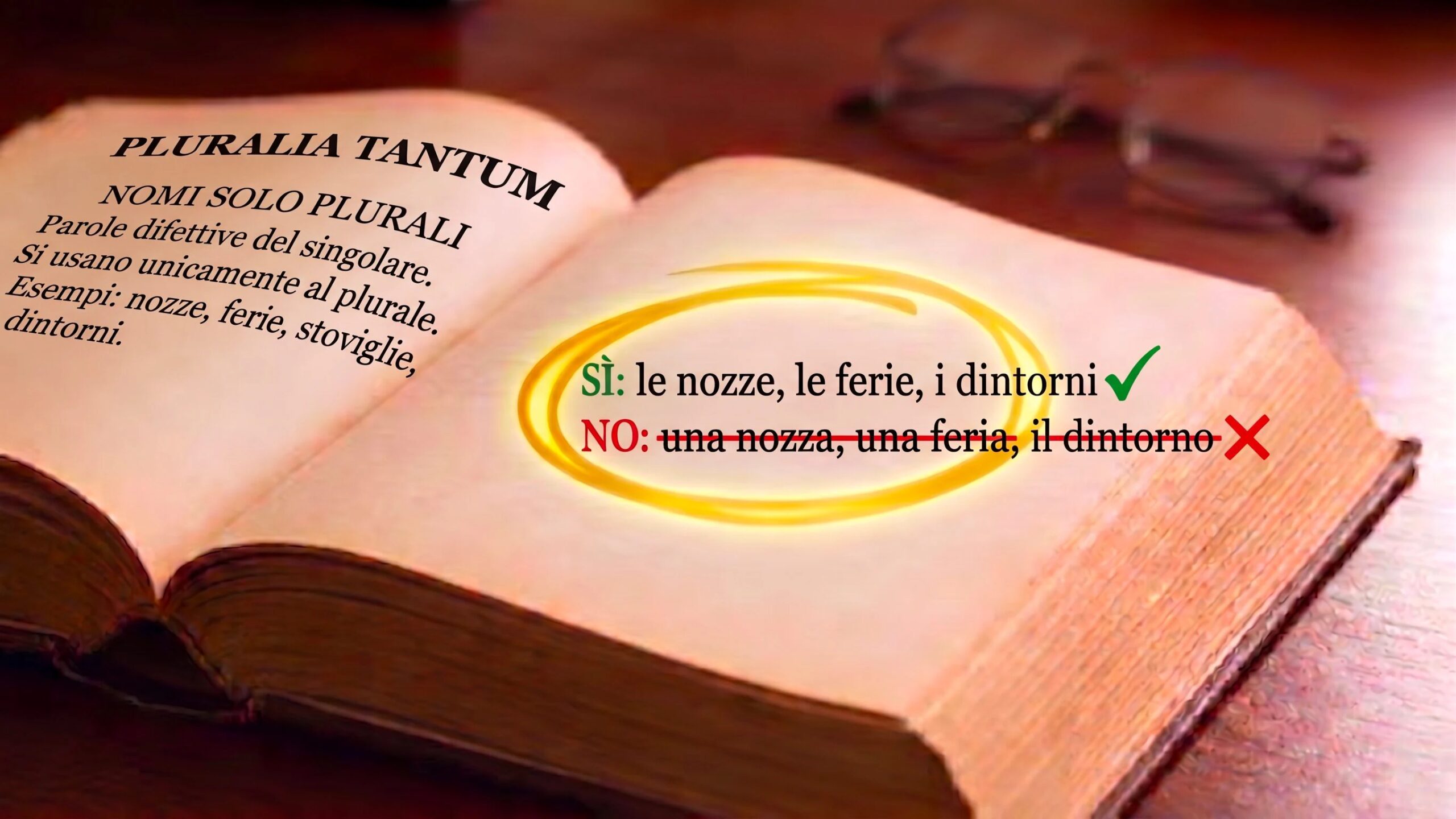
Wedding, holidays, dishes, darkness, surroundings: they are the so-called plurality once (“plurals only”), o defective nameswords that in Italian are used only, or almost exclusively, in the plural. Have you ever heard someone say that they will go “on holiday” next week? It would sound wrong. No rule prohibits it, but these singular words do not exist or are not used: they are often words already born “in the plural” or which are conceived in the plural according to the function of the object.
What are the plurality once
THE plurality once (literally “plural only”) are those words that are used solely (or predominantly) in the plural: as he explains Treccanithe definition in reference to Latin, with words like nuptiae (wedding), divitiae (riches), darkness (darkness) and by extension is now also applied to Italian, with wedding as a symbolic example.
However, grammar prefers a name that sounds more severe: defective namesi.e. “missing”. In Italian there are also defective verbs, that is, those that are missing some voice, such as urgere. Likewise, some nouns also lack a number.
There are the plural defectswhich exist only in the singular (singularia gigante), for example abstract nouns like patience and courage. Again, the months of the year and the diseases (chickenpox, measles, malaria, salmonella) are lacking in the singular. There are the defects of the singularthat is, those “plural only” words that have a different perception than the classic plurals: when I say “the books” I am thinking of more than one book, but when I say “the wedding” I am not imagining a collection of weddings. The form is therefore plural, but the meaning is “singular”. It is precisely this gap between form and substance that makes these words small logical exceptions.
Not just Latin: the three families of “plural only” words
The defectives of the singular are divided into three large groupseach with its own logic:
- the first is that of objects made of two or more equal parts: trousers, trousers, glasses, reins, handcuffs, etc. Here the plural has its own almost geometric coherence: the object is double, with two legs, two lenses, two crossing blades. Language photographs the shape of the thing;
- the second collects i collective nouns which indicate a indistinct pluralitya whole that we perceive as collective: surroundings, vicinity, viscera, food, beatings. It doesn’t make much sense to talk about “a dish” or “a surrounding”, because the word was born precisely to embrace the group;
- the third is the most literary and the most interesting from a historical point of view: they are the names which were already only plural in Latin, which have never had a singular, and which we have carried with us like this. Here we find weddings, darkness, but also the glories, the annals, the posterity and the names of the ancient Roman dates: the ides, the calends, the nones.
Some of these names actually even have the singular form, which however belongs to particular contexts or dialects: the shop assistant will suggest that you try another model of “trousers” and the colleague might ask you to pass him “the scissors”.
The linguist Luca Serianniin its grammar, is prudent precisely for this reason: it speaks of nouns that “are used Almost only in the plural”, with an “almost” that carries weight. Some singular forms, once unthinkable, are making their way into speech; others, such as “nozza”, are not used for the moment.
The etymology of defective nouns: wedding, holiday, crockery
THE plurality once they bring with them a history: some were born from the very shape of the objects (the two blades of the scissors), others from the way we perceive a whole (the crockery in the cupboard), still others arrived intact from Latin.
Wedding comes from Latin nuptiaein turn linked to the verb nubĕre“to take a husband”. Taking a step back, nubĕre originally it probably meant “to veil oneself”, and has the same root as nubes, i.e. “cloud”, “cloud”. In ancient Rome the bride wore a fiery-colored veil (il flammeuma drape between red and orange) that covered her head during the ceremony. Getting married meant, literally, “covering oneself with a veil”, like a cloud veiling the sun. From the same root also comes unmarried, the woman “capable of being covered by the veil”, that is, who can still marry.
Holidays comes from Latin feriae and in ancient Rome it indicated the days dedicated to the cult of the gods: sacred days in which it was nefasprohibited from exercising judicial power or convening rallies. In short, holidays were religious holidays, the opposite of work. With Christianity the word changed course: to avoid the names of the days of pagan origin (dedicated to Mars, Mercury, Jupiter…), the Church began to call the days of the week with a number: second holiday on Monday, third holiday on Tuesday, until feria sextaon Friday. The adjective comes from feria in the sense of “day of the week”. weekdayswhich for us means “working”, i.e. exactly the opposite of the meaning from which the word started.
Treccani it brings up crockery at a crossroads between medieval Latin usitilia And usibiliai.e. “use materials”, from the verb uti“use”. In practice, the set of plates, glasses and cups that fill our cupboards are called that because they are, simply, “the things that are used”. The word describes the practical function more than the material: in fact its singular, a dish, exists in dictionaries, but almost no one uses it in real language.
Words that only exist in the singular
As mentioned above, there are also those names that are plural defectsthat is, words that are used exclusively (or almost!) in the singular form. There are quite a few and among them there are:
- abstract nouns such as patience, courage, pride: concepts which, by their nature, cannot be “counted”.
- unique things in the worldof which there is only one example (the Equator, the North, the East);
- the names of the diseases (measles, malaria, typhus);
- food products understood as substance (bread, honey, rice, chocolate);
- collective nouns now consolidated, which already indicate a whole (the people, the offspring, the stuff);
- chemical elements and metals (hydrogen, uranium, iron);
- the months of the year (April, May, June).
Even in this case there are exceptionsfor example metals in the plural refer to those objects made of that material (cathedral gold, family silver, tools of the trade), foods are transformed into their varieties (chocolates from Belgium, rice from Vercelli and Pavia), and even abstract terms such as love are used in the plural to indicate, for example, the loves of a famous person.
