
The largest Spanish glacier, that of Dill in the Pyrenees, it is significantly reducing in thickness. And he’s not the only one: the same fate is happening to all the glaciers in Spain. These are the conclusions reached by a team of researchers from Research Group CryoPyr of thePyrenean Institute of Ecology (IPE-CSIC). The data was collected via drone in September 2025 and concern some of the main glacial bodies of the Pyrenees:
- the most affected is the Ossoue glacier (Vignemale, actually in the French Pyrenees), which has an average loss of 3.4 meters and a maximum drop to 5.4 meters compared to the previous year;
- the glaciers of Dill And Monte Perdido instead they show more moderate losses included between 1.3 and 1.2 metreswith maximum values of –4 meters. It should also be noted that this year the Aneto glacier has fragmented with the consequent reclassification of a part of it as a simple “snowfield” (no longer an active glacier);
- the glacier of Llardana (Posets) also recorded an average decline of 1.4 meters with maximum values up to 4.1 m;
- the glacier Infiernos finally it settles around 1.8 meterswith sectors losing up to 4.2 meters.
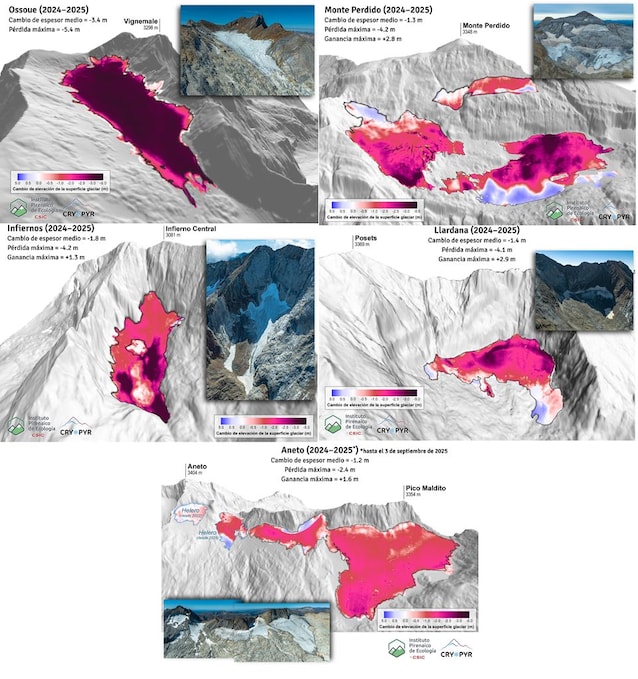
Although the trend is overall negative, the researchers also report that in some areas they have been recorded slight increaseswith values up to 2.8 meters in Monte Perdido, 2.9 meters in Llardana e 1.6 meters in Aneto.
But how was this data obtained? The measurements were carried out via drone and, for each glacier, the following data were obtained high resolution three-dimensional models. By comparing these with models from previous years, it was possible to evaluate the losses and gains of each glacial body. Overall, the 2024-2025 period is positioned among the worst in terms of losses since annual data is available, immediately behind the years 2021-2022 and 2022-2023.
