
It was thought they couldn’t collaborate, but instead they built a colossal structure that extends across 106 m2 into the depths of the earth on horseback between Albania and Greece: scientists believe it is the largest spider web in the world. Here is revealed a new natural laboratory that invites us to review our ideas about light-free habitats, the underground ecology of caves and animal behavior in “extreme” conditions. In a study recently published on Subterranean Biology entitled “An extraordinary colonial spider community in Sulfur Cave (Albania/Greece) sustained by chemoautotrophy”, the discovery of a giant spider’s web in underground environment on the border between Greece and Albania and created by cooperation between two species Tegenaria domestica And Prinerigone vagans. The authors, led by Professor István Urák, analyze not only the structure of the spider web, but also the composition of the spider communitythe origin of the food web that supports it, the genetics of the populations and the way of adapting to this extreme habitat, allowing us to expand our knowledge onecology of underground environments.
A huge cave for a giant spider web
The discovery of the spider’s web dates back to 2022when a team of Czech Speleological Society was conducting a wildlife survey in the region’s caves and spotted this exceptional structure.
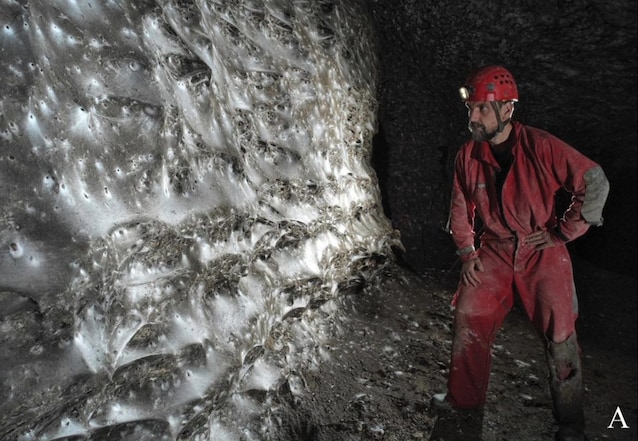
We are inside the Sulfur Cavea sulfur-rich underground environment located on the border between Albania and Greece. Its cavities are known for the typical pungent odor of sulfur produced by the action of the aquifers with the rocks typical of that area. Water from springs and a sulfur-rich stream flows through the cave complex and flows into the river Sarandapororeaching temperatures inside the cave of approximately 25°C all year round.
Exploring its tunnels, in 2022 speleologists stumbled upon a gigantic spider web which was analyzed and taken care of by a team of expert scientists. The record-breaking spider web – made up of thousands of webs – it covers an area of approximately 106 m² according to the authors’ estimates, and accommodates approximately 111,000 spiders.
A huge underground community of spiders
At first glance it may appear as one thing, but the giant spider web discovered in the Sulfur Cave it is a set of two species of spiders who cooperate generating a mega community: Tegenaria domesticaa well-known species – commonly called the house funnel spider (with approx 69,000 esteemed individuals in the colony) e Prinerigone vagansa less well-known species of the family Linyphiidae (with more than 42,000 esteemed individuals).

Both species, normally solitaryshow a “colonial” behavior in this hypogean, i.e. underground, context: they live in a common canvas that covers one wall of the cave like an enormous tapestry. Yet another case in which we can quote, romantically, that “unity is strength”… even in zoology. Although it seems that the funnel spiders do most of the work, while the other species just lives inside.
From a physiological and genetic point of view, the study reveals that the population of T. domestica in the cave it is distinct genetically from surface populations: this suggests an isolation and a possible adaptation to the underground environment, a specialization to its environmental conditions that we can intuit from DNA analyses. But it is not the only singular aspect that differentiates cave individuals from “common” ones. In fact, they also diverge in the microbiome: one has been recorded specific intestinal microbial community for these animals which suggests a further peculiar adaptation to the underground habitat.
There being a large number of midges in the cave (chironomids of the species Tanytarsus albisutus), scientists suggest that food availability may have been a determining factor in cooperation and decreased interspecific predation among spiders. For some reason they do not need to eat each other, which makes them even more diverse from individuals inhabiting external habitats.
“The colonization of Sulfur Cave by the T. domestica was most likely determined by abundant food resources represented by the dense swarm of chironomids that thrived in the cave.” These are the words of the authors, reported in the magazine Subterranean Biology. At the base of the food network there would be the enormous quantity of biofilm which covers the walls of the cave and which forms a slimy and nutrient-rich surface.
Why discovery is so important
The discovery is important on several fronts. First of all, as we have already mentioned, it is probably the largest spider web ever documented in an underground contextboth in terms of surface area and number of individuals hosted.
Furthermore, it represents an unusual case of coloniality in normally solitary specieswhich raises new questions about the evolution of social behavior in spiders. The cave’s ecosystem is powered not by sunlight but by sulfur-oxidizing bacteria, making the find a rare example of independent food web from photosynthesis. Finally, it can offer insights into how surface species can colonize extreme underground environments, such as their own adaptive mechanisms and how communities are structured in isolated conditions.
Sources
Urák, I., Vrenozi, B., Głąbiak, Z., Lecoquierre, N., Eiberger, C., Maraun, M., Ştefan, A., Flot, J.-F., Brad, T., Dainelli, L., Sarbu, S.M., & Băncilă, R.I. (2025). An extraordinary colonial spider community in Sulfur Cave (Albania/Greece) sustained by chemoautotrophy. Subterranean Biology, 53, 155-177. Kuta, S. (2025, November 6). This Massive Web—Home to More Than 100,000 Spiders—Found in a Cave in Europe Could Be the World’s Largest. Smithsonian Magazine. Smithsonian magazine
