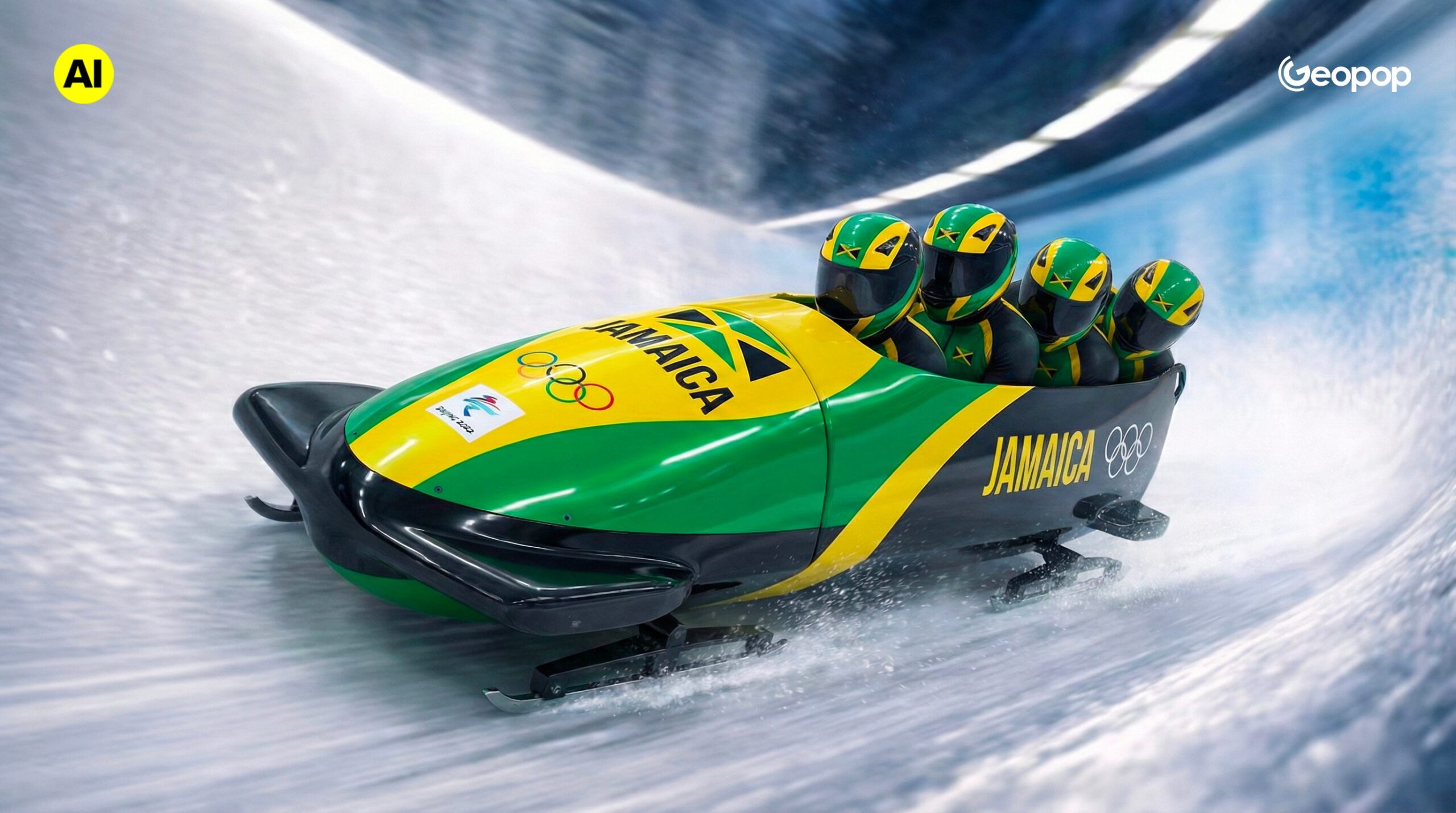
Let’s close our eyes and think about Jamaica: crystal clear beaches, sun, the notes of Bob Marley in the background…”Everything is gonna be alright“… and one bobsled team speeding down an icy track at full speed. Wait, what do you mean? Yes, Jamaica has an Olympic bobsled team and its history is truly curious. On the island the national sport has always been athletics: legends like Usain Bolt And Asafa Powell they wrote the history of world speed. But George Fitcha commercial attaché of the American embassy, noticed a fundamental detail: between running the 100 meters and the initial push phase of the bobsleigh there isn’t much difference, apart from the ice. To excel in this winter discipline you need explosive power at the start, and the Jamaican sprinters were perfect for this. It was the beginning of the adventure that brought the Caribbean to Winter Olympics and inspired the Disney cult “Cool Runnings – Four Below Zero“. At Milano-Cortina 2026 the Caribbean national team competes in the 4-man bob, the men’s 2-man bob and the women’s monobob.
How the myth of the Jamaican bob was born
In the summer of 1987 George Fitchformer commercial attaché of the U.S. Embassy in Kingston, was in Jamaica. Watching a race street carts he noticed an incredible resemblance to a sport very dear to him, the bob. The dynamics were the same: the boys took off running and slipped into the cart to go down the steep streets of the island. With the help of William Maloney and Michael Fennell, president of the Jamaica Olympic Association, they set a crazy goal of creating the country’s first bobsled team. In a few months there would be the Winter Olympics CalgaryCanada (1988).
Recruitment began with athletes preparing for the 1988 Seoul Summer Olympics, but no one took it seriously. Fitch then fell back on members of the military. After the first selections they came on board the project Dudley Stokes (helicopter pilot), Devon Harris, Michael White, Freddie Powell And Clayton Solomon.
The boys began to study the theory in depth, but in Jamaica there was a lack of suitable equipment and, above all, snow. Thanks to the funding that came directly from Fitch’s pockets (around 60 thousand dollars), they managed to fly to train in more suitable places such as Lake Placid (New York) or Igls, in Austria. The technical turning point came with the hiring of the American coach Howard Silerformer bobsledder, supported by the Austrian Sepp Haidacher.
The team managed to participate in a World Cup competition in Austria, necessary to obtain the Olympic pass. The IOC was not on their side and tried to disqualify them by raising doubts about the qualification path, but the opposition was strong and the team obtained the decisive support of the Prince Albert II of Monacoat the time a bobsledder for the Principality.
With only a few months of preparation and very few competitions behind us, nothing could stop the first participation in the Winter Games of a Caribbean country. Stokes and White broke the ice by finishing thirtieth in the 2-way racethe only one the team thought they would play. But this result changed the cards on the table: “We are also taking part in the 4-way race”. Self-financing through the sale of T-shirts in Calgary, the newly formed Jamaican Bobsleigh Federation managed to buy a sled to 4.
Try to imagine what it means to participate in an Olympic race almost without ever having tried the vehicle with the full crew. The result? After the first two runs concluded not without some difficulty, during the third run the bob was launched 130 km/h – overturned to the dismay of the 40,000 spectators present. The bobsledders’ heads hit the inside walls of the track, but fortunately they all escaped unharmed. The pilots got up and walked to the finish line dragging the bobsled with them amidst the applause of the public: a scene that has gone down in history.
A movement that has made the impossible possible over the years
This story, which changed Jamaican sport forever, entered everyone’s hearts thanks to the cult Disney “Cool Runnings – Four Below Zero”. A film that took inspiration from the company but which, as the real protagonists have explained several times, is highly fictionalized and does not reflect reality 100%. It doesn’t matter, the film still managed to perfectly convey that “Jamaican spirit” that made the impossible possible.
Despite the Calgary incident, Jamaican enthusiasm for ice has not melted. Indeed, a real movement was born from there. Four years later the national team returned to the Olympics in Albertville, France. But the real sporting miracle occurred in 1994 in Lillehammerin Norway. There Dudley Stokes, Winston Watt, Chris Stokes and Wayne Thomas achieved an incredible 14th place in the 4-man bobsleighfinishing ahead of world powers such as the United States, France, Russia and even one of the Italian crews.
The story continued in Nagano 1998 (21st place), the last appearance of the “four” until the great return in Beijing 2022. In the two-man bobsleigh, however, the Jamaican flag continued to fly in Salt Lake City 2002 (28th), Sochi 2014 (29th) and Beijing 2022 (30th). And the movement didn’t stop at men: Jamaica also brought women to the Olympics, with the debut of Jazmine Fenlator and Carrie Russell at Pyeongchang 2018.
A few weeks ago the highest point of the movement was reached, the gold medal in the North American Cup Whistlerwhich allowed the national team to also qualify for the 2026 Milan-Cortina Olympics. Whether they arrive first or last, they fully deserved that nickname: they are still “The Hottest Thing on Ice” (“The Warmest Thing on Ice”).
