
There new Riyadh metroin Saudi Arabia, is the driverless public transport system longest in the world with its 176 km of length, distributed in 6 lines and 85 stations. Riyadh is a city in continuous expansion, also thanks to the Vision 2030 project, and this new generation metro – which came into operation on 1 December 2024 – is capable of managing well 3.6 million passengers per day.
The Riyadh metro: the project by Zaha Hadid Architects
With a length of 176 kmdistributed on 6 lines and 85 stationsthe Arab city’s subway network is the longest driverless public transport system in the world. One of the most interesting engineering elements is the absence of a driver of the convoys. That’s right, you read that right: Riyhad’s metro moves through a centralized system driverless of control of the trains moving along the tracks at a depth, in the city center, up to 35 meters. The metro also has some elevated sections, such as line 3, which is characterized by a 26.4 km section on viaduct, with spans of 37 meters.
The construction of any infrastructure in the desert climate always involves great challenges not only in terms of engineering, but also in terms of sustainability. The Riyhad metro, in fact, is equipped with sophisticated ventilation and ventilation systems that allow the internal environments, especially those that are not deep down, not to be too affected by the temperature changes typical of the desert climate.
In this sense, the technologies used are of different nature; they range from solar panels to systems capable of generating electricity from the recirculation and movement of air inside underground tunnels.
Another interesting technology used, again to recover energy with a view to saving and sustainability, is that of regenerative brake, a technology that allows kinetic energy to be recovered during braking, in electrical energy and not in simple heat, as happens in traditional braking systems. This technology, it must be said, only works on electric transport systems.
The King Abdullah Financial District station
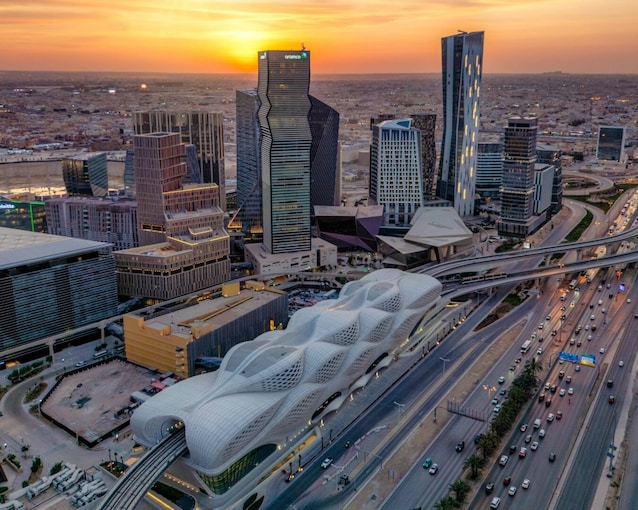
One of the most interesting infrastructural elements is certainly the station KAFD, located in the city’s financial district. It is certainly the most strategic node of the entire infrastructure, as it is capable of connecting six railway platforms on four levels with other, and additional, modes of transport, such as various bus stations. This highly strategic organization is aimed at solving the traffic problem, which the city of Riyadh certainly feels is important.
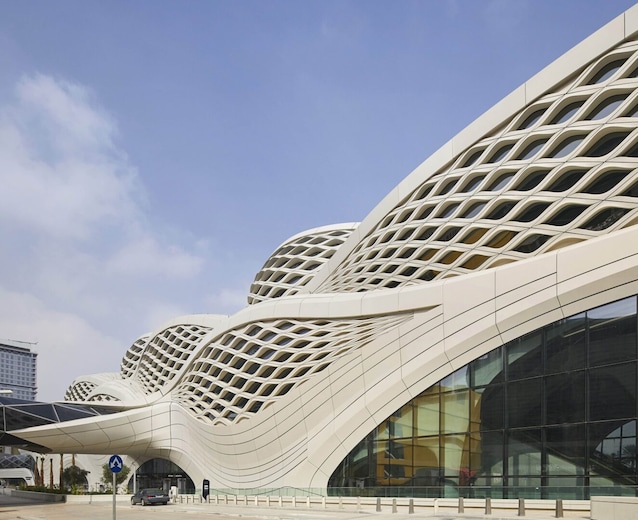
In terms of design, the external structure is made of concrete highly performing, with geometric elements that clearly recall the geometric elements typical of Arab architecture. Even the choice of these openings is not random, as it was designed in an integrated way with the highly efficient internal ventilation systems, which modulate their operation and their performance based on the flow of passengers and, clearly, based on the external temperatures.
Criticism of the longest driverless transport system in the world
Let’s see together what have been the major criticisms that have been leveled against this project over the years. The new Riyadh metro is certainly an engineering work of absolute importance, but one of the first problems that were encountered in the organizational phase, and in the construction phase, was that relating to the timing and ai payments. In fact, during the construction phases, many of the companies that worked on the project complained about many missed payments from the government. Another important factor that caused a huge delay was caused by the 2020 COVID-19 pandemic.
The decision-making processes and the continuous changes to the project requested by the main client (Royal Commission for Riyadh City) also caused huge delays, both in the organizational phase and in the implementation phase. Other elements of criticism concerned the distribution of resourceswhich, according to some, were excessively diverted to the city of Riyadh, to the detriment of other cities in the kingdom which should instead have been able to enjoy further resources in economic terms and investments in modern infrastructure.
