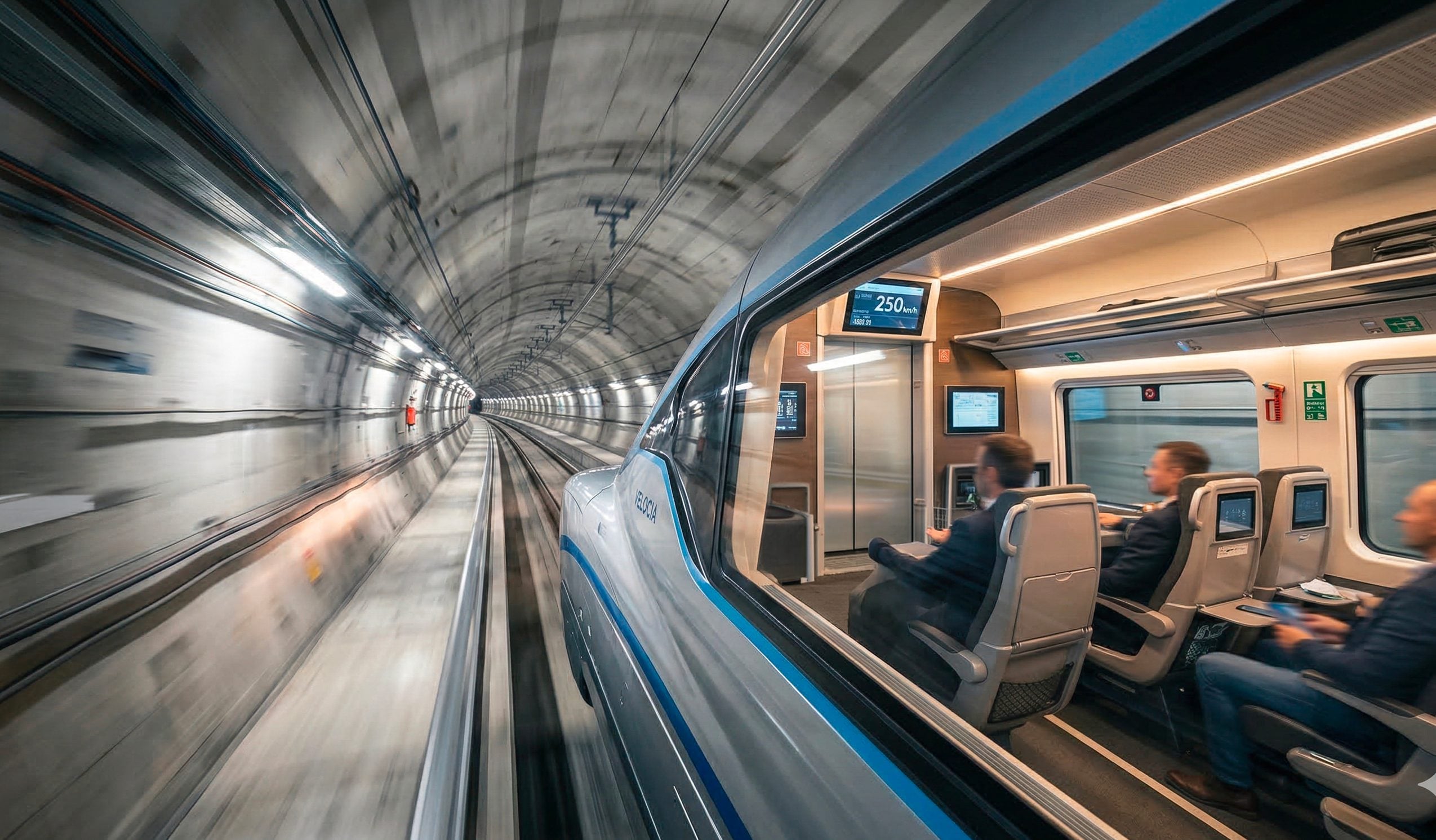
There Chinaas we know, loves to do things big, especially when it comes to infrastructure. And the underwater tunnel they are building now will be no different, with an expected length of well 120km! The main objective of the Bohai Strait Tunnel will be to connect the cities of by train Dalian and Yantai crossing the Bohai Strait and, once completed, will become the longest such work in the world. However, it is worth highlighting that the works have not yet started, despite the project having been officially approved.
The characteristics of the impressive underwater tunnel
That of Bohai Strait Tunnel it is, undoubtedly, one of the most impressive infrastructural works that will ever be built. We are talking about a 120km long underwater tunnel, which will connect the city of Dalian, located in the province of Liaoning, to that of Yantai, in Shandong province. Once completed it will far surpass both the Channel Tunnel and the Seikan in Japan, becoming the longest underwater tunnel in the world.
Currently, the journey between the two cities includes a distance of more than 1,400 km by land or, optionally, well 8 hours by ferry. The objective, with the construction of an underwater tunnel capable of making the journey and therefore the connection between the two cities much easier, is to economically integrate the northeastern regions of China with the Shandong Economic Corridor, reducing travel times to less than an hour.
The engineering challenges: 80 m below sea level
From the point of view of engineering challenges, designers are finding themselves facing many. First of all, unlike “normal” underwater tunnels, this one will be at a rather high depth (maximum 70-80 meters below sea level) and, to do this, the designers had to employ Tunnel Boring Machines (TBM) giants, with a diameter of more than 15 meters.
The project involves the construction of three parallel tunnelstwo main ones, configured for railway transit, and a central tunnel which will be used in case of maintenance of the two railway tunnels which, obviously, will run in the opposite direction from each other. The project is therefore designed for high speed, with trains capable of reaching even i 250 km/h. However, one might ask whether expansions are also planned to also allow car transit. In reality no, even if the designers have already foreseen the loading of the vehicles onto special shuttle cars, following a model already tested in other similar works – first of all the Eurotunnel.
Another problem is certainly the intense seismic activity of this area, which is one of the most active in the whole of China. The area is in fact crossed by the Tan Luand this will require the use of very high performance concrete, capable of resisting not only the impacts of earthquakes, but also very high hydrostatic pressure. To this end, the use of seismic joints, capable of absorbing the stresses resulting from earthquakes.
The tunnel project, as anticipated, has been approved but at the moment the works for its construction have not yet begun.
