
The Mayans are one of the Precolombian Mesoamerican peoplesborn between the third and 9th century AD and still existing today, known for their art and their astronomical and mathematical knowledge. Their story is generally divided into Three large phases: thepreclaxic erafrom the second millennium a. C. to the third century AD. C., during which the Mayan people formed and started their development; theclassic erafrom the III to the 9th century AD. C., during which the Mayans reached the maximum splendor from a political and cultural point of view; The decline: from the 9th century AD forward, it is a period characterized first by the domain of other Amerinds peoples, then from Spanish conquest.
In the past the Mayans equipped with a system of giraglifica writing and they were capable of profitablely developing the arts and sciences. The current Mayans, although largely assimilated to modern lifestyles, retain some elements of their original culture.
Who are the Mayans and where they live today
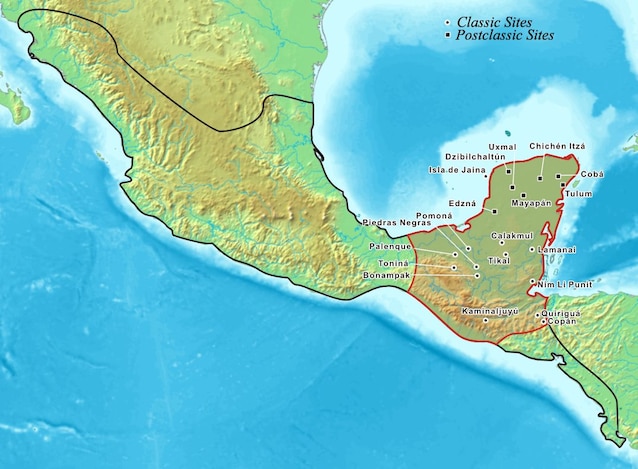
The Mayan people today are made up of about six million individualsmostly poor and dedicated to agricultureallocated largely in Guatemala and, to a lesser extent, in Southern Mexico. In the past, the people roughly occupied the current states of Chiapas, Tabasco, Campeche, Yucatan and Quintana Roo and the territories today belonging to some Central American states: Guatemala Belize, Honduras.

Today the Maya profess the Catholic religion And they speak the Spanish languagebut they keep some ancestral cultural traitsespecially in the field of oral culture, magical-religious beliefs and crafts. Furthermore, theirs speak next to the Spaniard traditional languages.
The origins of the Mayan civilization: ethnogenesis and preclaxic era
The origins of the Mayans must be traced, in all likelihood, in the wider strain of the Olmeca populationwhich emerged in Central America in the second millennium a. C. in an age placed around 2000-1500 years before Christ These people differentiated from the other Olmechi, thus starting the preclaxic period of the Mayan history, which lasted approximately until the third century AD. C. During this era the Mayans founded before the villages and, later, real cities; also developed a Sillabic writing systembased on hieroglyphics; from an economic point of view, they proved to be dedicated to agriculture: the most important culture was the corna fundamental element not only of nutrition, but also of their culture.
The classic age of Maya
In the third century AD the Mayan civilization went against a florid development: urban centers became more extensive and were built large steps with stepswho had the function of the temple and, sometimes, of burials for the sovereigns and other powerful people. Most of the buildings, however, was not built in stone but with wood and earth, therefore it did not survive the centuries. The largest city was Tikallocated in the current Guatemala, of which the archaeological remains can be visited today.

In classical times, the Mayans perfected agriculture, which became more productive, and developed the trade with other Mesoamerican peoples. After a short period of decline around the 6th century, civilization returned to splendor and, next to Tikal, new cities were established, including among which Palenque in Chiapas (Mexico), Chichén itzá in Yucatan (Mexico) e Copán in Honduras. Mayan cities were independent of each other and was never constituted an empire Or a unified kingdom, unlike other pre -Columbian peoples such as the Aztecs and the Inca, who instead managed to structure their kingdoms according to these political models. In the city, the power was detained by a sovereignconsidered a divine being and, consequently, endowed with an almost absolute authority.
The decline of the Mayan people: the Spanish conquest
The decline of the Maya began around the 9th century AD The reasons are not clear And scholars have made several explanations: excessive exploitation of natural resourceswhich would have caused an “ecological collapse”; socio -political factorslike the strengthening of oligarchies at the expense of the monarch’s authority; invasions by peoples of central Mexico. What is certain is that from the 9th century the Mayans abandoned a part of the territory in which they lived: in the 16th century, when the SpanishThey suffered conquest without being able to oppose significant resistance. The last independent city, Itza Tayasalwas conquered in 1697.

The culture of the Maya: astronomy, mathematics, sport, religion
The Mayans equipped themselves with A very refined culturewhich flourished above all in the classical age. First of all, they were attentive observers of the sky and to measure time they developed a 365 days calendar. In addition to counting the years, they supported the theory of Cycles of civilization: The cycle that was underway during the maximum flowering of the Mayans had begun in 3114 BC. and the December 21, 2012 (date in which, as we remember, some people really feared the “end of the world”). The Mayans also excelled in mathematics And they developed a vigesimal calculation system, they were also great architects, artists and musicians.
Like other pre -Columbian peoples, the Mayans developed some recreational-sports activitiesincluding a game with the ball that was probably similar, at least in some respects, to basketball (but the exact rules are not known). From the point of view of religion, they were polytheists: the cult was administered by special priests and also provided human sacrifices.
