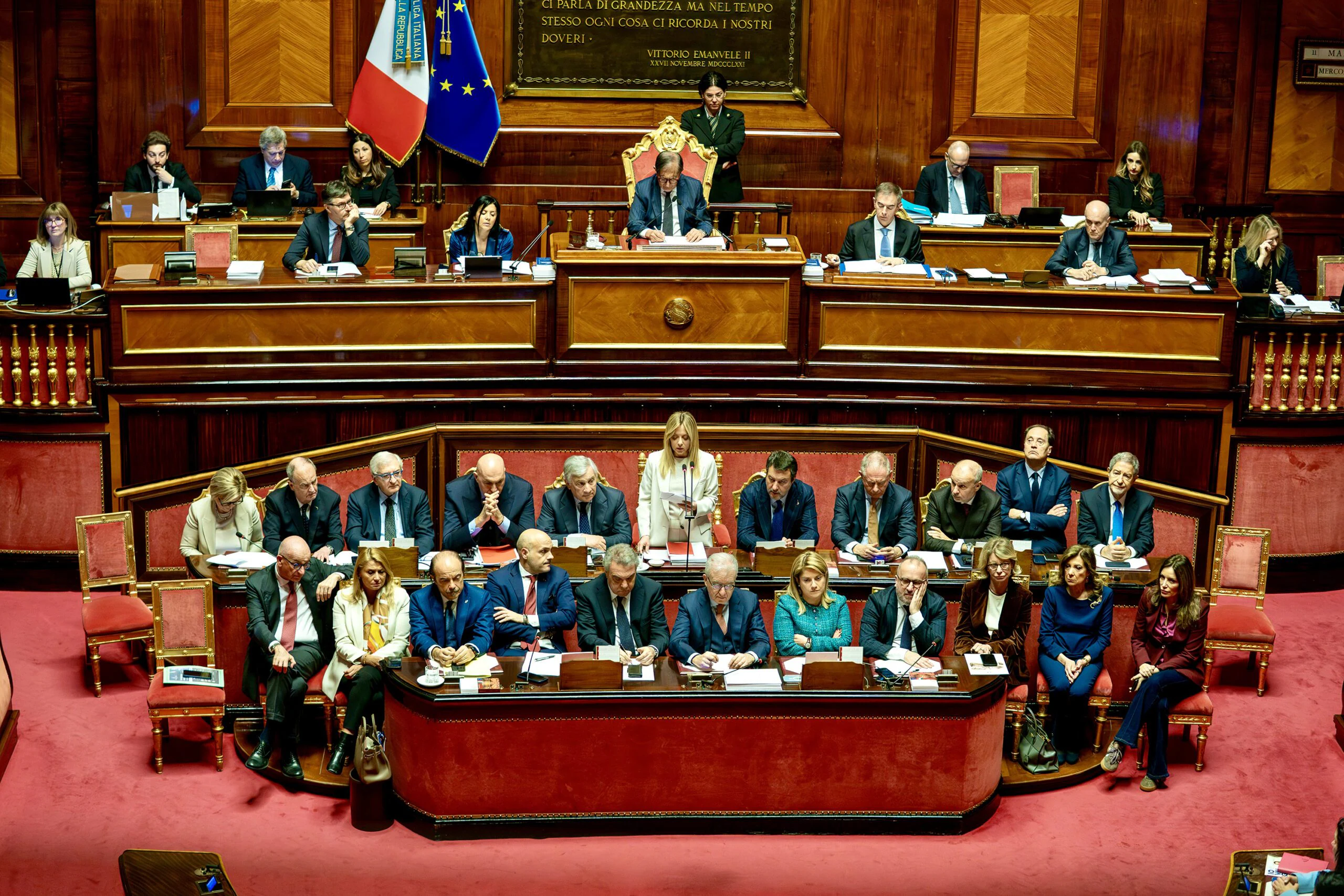
The government led by Giorgia Meloni it’s officially the longer-lived in the history of the Italian Republic: with 1,413 days elapsed since taking office, the current executive (the first in the history of Italy to be led by a woman) definitively overtook the second government Berlusconiwhich had held the record since 2005.
However, one thing should be highlighted technical detailalso reported by Pagella Politica: when carrying out this count, it would be more correct to consider i days in which the executive has actually done their own functions of government, therefore excluding the period in which the Council of Ministers has already resigned, but remains in office only to deal with the most urgent business before the next one takes office. Considering that the actual days of the second Berlusconi government were 1,409 days (plus three after resignation), Prime Minister Meloni would have already exceeded that threshold last Monday 31 August 2026, reaching 1,410 actual days.
Over the course of its history, our Republic (which this year marks the 80th anniversary of its birth) has seen 68 governmentsa number that demonstrates the precariousness of Italian executives, especially during the “First Republic”. Also thanks to solid majority in Parliament (the centre-right coalition has an absolute majority in both the Chamber and the Senate), the Meloni government has achieved a new record, while other European countries such as France and the United Kingdom (always considered stable) have changed several leaders over the last 5 years.
So let’s see the ten longest-serving governments of the history of the Republic based on the actual days of duration (therefore excluding the period in which the executives performed functions after resigning), already visible in the graph below:
The 10 longest-serving governments of the Italian Republic
Meloni government: 1,413 days
President of the Council: Giorgia Melonileader of Brothers of Italy. Inaugurated on 22 October 2022, it reached 1,413 days on 3 September 2026, becoming the longest-lasting executive ever in republican history, as well as the first government in the history of Italy led by a woman.
The longevity of the Meloni government can also be attributed to solid majority of the center-right in Parliament. Italy, in fact, is a parliamentary republic: this means that citizens do not directly elect the Government, but vote to elect the members of Parliament. Normally the Prime Minister is the leader of the most voted party, even if this is not a fixed rule (just think of technical governments). In any case, once the Government is formed, a relationship is established between the executive and Parliament relationship of trust.
It is a bond that can break at any time: Parliament in fact has the power to cast a vote of no confidence in the Government. It goes without saying that, without a large majority in the House and Senate, overcoming that vote becomes much more difficult, and this is precisely where strength in numbers makes the difference for a more or less lasting government. Currently, the center-right owns the absolute majority in both chambers.
Second Berlusconi government: 1,409 effective days
President of the Council: Silvio Berlusconifounder of Forza Italia. He took office on 11 June 2001, supported by a broad coalition (Forza Italia, Alleanza Nazionale, Lega Nord and center parties such as the Union of the Center and the New Socialist Party). He resigned on April 20, 2005, for one internal crisis within the majority arrived after the heavy defeat of the center-right in the regional elections.
However, Berlusconi already had the agreement between the parties ready for a new executive with a similar majority and remained in office for the ordinary administration for another three days, until April 23, when the third Berlusconi government took office. It was the longest-serving government of the Republic until Meloni’s overtaking.
Fourth Berlusconi government: 1,283 days
President of the Council: Silvio Berlusconi. In office from 8 May 2008 to 16 November 2011. With this executive, a fact recorded by sources is confirmed: before the Meloni era, the two governments that had governed the longest in the history of the Republic had both been led by Berlusconi.
First Craxi government: 1,058 days
President of the Council: Bettino Craxisecretary of the Italian Socialist Party. In office from 4 August 1983 to 1 August 1986, it is the oldest government to appear in the top positions of the ranking and the only one from less recent times to hold the comparison with the more stable executives of recent years. Craxi himself is a good example to understand how important the counting method is: his “effective” days at work are 1,058, but if we also count those spent in ordinary administration after his resignation we arrive at 1,093. The Craxi government was the protagonist of one of the most serious diplomatic crises between Italy and the United States, with the Sigonella crisis from 1985.
Renzi government: 1,019 days
President of the Council: Matteo Renzi. In office from 22 February 2014 to 12 December 2016. It was the fourth longest-lived government in republican history until August 2025, when the Meloni government surpassed it, reaching 1,025 days. The executive fell after the resignation of Matteo Renzi following the defeat at the constitutional referendum of December 2016.
First Prodi government: 874 days
President of the Council: Romano Prodi. In office from 17 May 1996 to 21 October 1998, it was the first government of the Ulivo, the centre-left coalition that Prodi himself had promoted and which won the 1996 elections, supported in Parliament also by the external support of Rifondazione Comunista. Its main objective was the consolidation of public finances to comply with the EU parameters of Treaty of Maastricht: milestone reached in May 1998, when Italy was admitted among the first Euro countries. He fell just when Rifondazione Comunista took away his support, causing him to lose confidence in Parliament.
Third Moro government: 832 days
President of the Council: Aldo Moroamong the founders of the Christian Democracy and long-time secretary of the party. In office from 23 February 1966 to 24 June 1968, it was the longest-lasting of the three consecutive governments led by Moro in the season of the first “organic” centre-left, with a coalition that united DC, PSI, PSDI and PRI and with Pietro Nenni as vice-presidency.
Seventh De Gasperi government: 704 days
President of the Council: Alcide De Gasperifounder of the Christian Democrats and central figure of Italian reconstruction after the Second World War. In office from 26 July 1951 to 7 July 1953 with a DC-PRI coalition, he was the last of its full-term executives. In view of the 1953 elections, the government promoted an electoral reform in a majoritarian sense, dubbed the “fraud law” by its opponents, which however did not produce the desired effect. It was precisely during this government that, in July 1951, a woman entered for the first timeItalian executivethe Christian Democrat Angela Maria Guidi Cingolani, as undersecretary.
First Segni government: 670 days
President of the Council: Antonio Segniexponent of the Christian Democrats who a few years later would become the fourth President of the Republic. In office from 6 July 1955 to 15 May 1957 with a centrist coalition (DC, PSDI and PLI, plus external support from the PRI), it was an extraordinarily long government by the standards of the time. During his mandate, the Constitutional Court came into operation, Italy was admitted to the UN and, on 25 March 1957, the Treaties of Rome were signed which gave rise to the European Economic Community.
Second Prodi government: 617 days
President of the Council: Romano Prodi. In office since 17 May 2006, it was born from the victory of the Union coalition in the elections of that year, in which the centre-left overtook the centre-right by a handful of votes. This was precisely his weak point: that fragility of numbers, combined with continua internal conflicts to a very broad coalition, weakened its action. The government fell on 24 January 2008, when the Senate denied it confidence, remaining in office for current affairs until the successor took office.
Because once upon a time Italian governments lasted so little
Looking at this ranking, there is a detail that immediately catches the eye: the longest-lived governments in the history of the Republic are mostly concentrated after the 1990s, while the shortest ones belong to the so-called “First Republic”, which goes from 1948 to 1992. During this period of Italian history, the fragmentation of parties and an electoral law with a proportional system generated weak governmentsoften the result of fragile compromises between different party forceswith a scant majority in Parliament: government crises, therefore, were very frequent and executives had a short duration.
Things, in part, changed in the nineties, with the “Second Republic”: the electoral reforms and the greater centrality of political leaders have favored governments that tend to be more stable, even if most of these have not reached the end of the legislature (which lasts 5 years from the elections).
