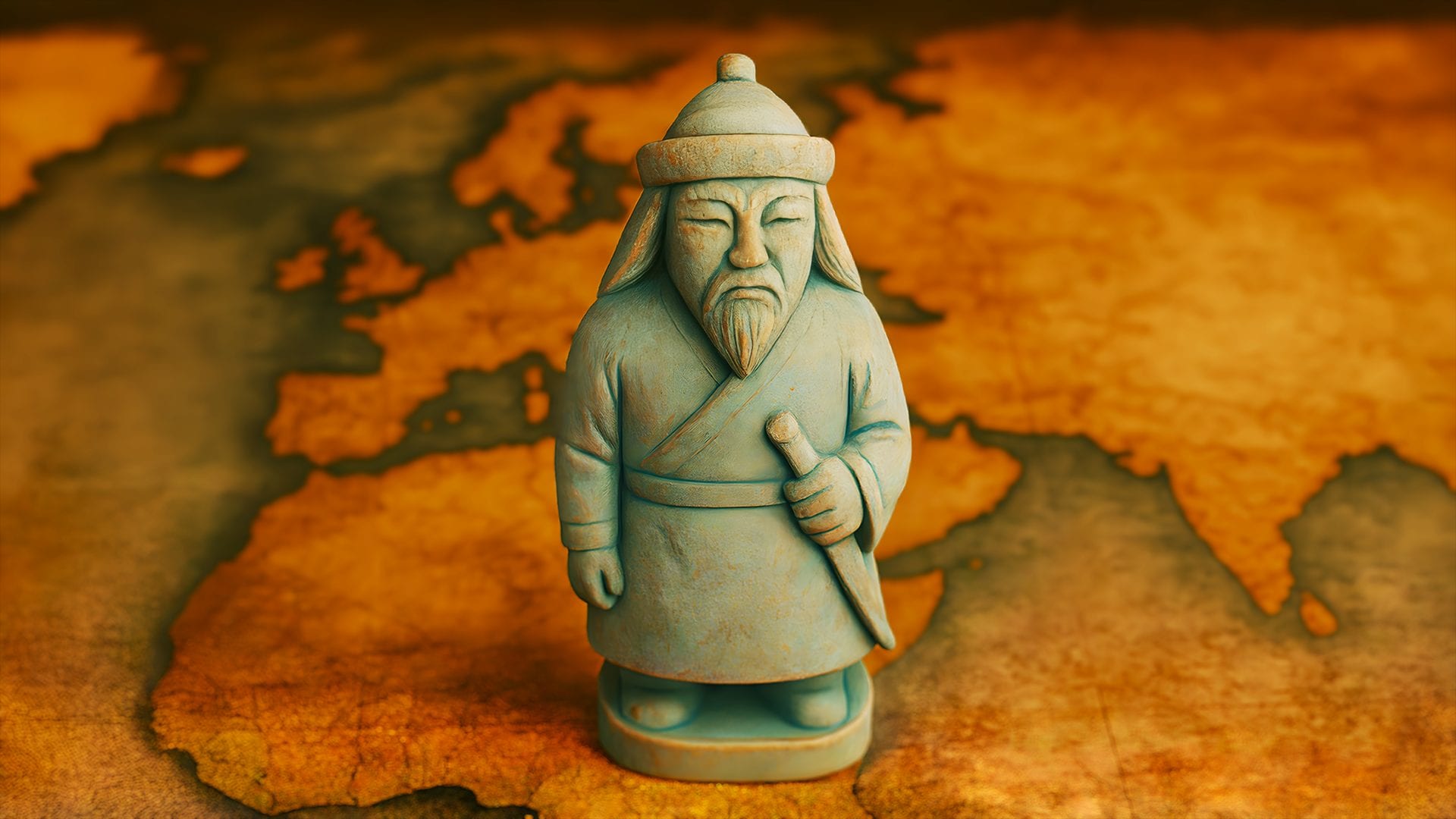
The Mongols of Gengis Khan they gave birth to one of the Greater terrestrial empires in history Thanks to the incredible military skills of their leader. Unfortunately, this people, originally inhabitant of Mongolia in Eastern Asia, are often forgotten, above all because they did not usually create large buildings or incredible works of art, unlike other contemporary peoples. But what were the military secrets of Khan? And what did his defeat cause in a few decades?
Who the Mongols were: the origins of the people
We are in Mongolia, in Asia. Here is the steppe, then a cold land with huge prairies and very few trees. In such an environment to survive the nomadic tribes they could not count too much on agriculture, and in fact they specialized in the breeding of animals such as sheep, horses, camels and yaks – which are typical cattle of those areas – which were exploited both for theirs dairy products than for theirs meat.
Speaking of meat, the Mongols were also excellent Hunters: From an early age they learned to go on horseback and pull with the bow. In particular they developed a particular hunting technique called nerge. With this technique the knights beat a huge area of Steppa, slowly pushing the prey in an ever smaller area, where they could be killed more easily by the archers on horseback.
As often happens, being a people nomadic, The Mongols lived mostly in clans and tribes, within which the women They had a role – I do not say equal to man – but still more considered than other contemporary peoples. This is because in such a hostile environment it was necessary to help each other and therefore it was more logical to reach something similar to equality and also allow women to actively contribute to the clan’s life. Speaking of clan, it is precisely from one of these, from the clan Kerait, who began to take the first steps the central figure of the future Mongol Empire: Gengis Khan.
The kingdom of Gengis Khan
Actually the first thing to know is that Gengis Khan It is not a proper name But it is instead a charge that we could translate as “universal sovereign“. The real name of the gingis Khan that we all know was in fact Temujin And on his life we have enough information thanks to a text in a Mongolian language called Secret story of the Mongols and written by an anonymous poet for the royal family around the middle of the 1200.
Precisely in this text it is said that Temujin was born in 1162 And after a hard childhood he became a skilled military commander. It was the one who understands that if the various tribes and clan had put together, they would have had the strength and ability necessary to be able to conquer the world. Obviously it is not easy to agree every single clan and Gengis Khan … well he used methods that we would probably disappear today. In fact, its magic formula was a mix between diplomacy and terrorand often warriors had no other choice than to join him if they didn’t want to be executed instantly.
Among other things, an interesting thing is that despite the fact that Genigs did not make too much scruples to kill men, women, children and animals if necessary, it seems that in reality within his kingdom not only were not often taken prisoners, but torture was really prohibited – unlike what happened for other populations of the period.
In any case, however brutal, the Gangis method proved to be effective for his purposes and in 1206 he managed to form a first great kingdom, united by a single writing system and a code of unique laws called Yasa Which, curiously, did not have a written form but was handed down orally.
The conquests of the Mongolian people and the expansion of the Empire
The Mongolian army in this first phase could already count on More than 10 thousand men. For the most part it was Archers on horseback which, coincidentally, in battle used the technique of nergethat is, the same that was also used to capture game. That is, they gradually squeezed the enemy in a small area, so as to eliminate it without too much effort. In addition to ordinary soldiers, the Khan’s personal guard, i Kheshigwho later became key characters of the Mongol Administration.
His first goal were two kingdoms in China, those of Jin and that of Xi xiathen moving on to Central Asia and Persia, where he managed to conquer cities like Samarkand, Bukhara, Herat And Nishapur. Do you think that for this phase of its conquests it is estimated that it used an army consisting of about 240 thousand units. Which also for the time was a figure totally out of scale, given that in the area the larger armies did not exceed tens of thousands of units. With all this military force it should not be surprised that he also managed to invade many countries of the Caspian Sea and the Black Sea – so much so that various Muslim kingdoms present there nicknamed him “the cursed“.
The quantity of lands that only one emperor has managed to subject is impressive. And the even more absurd thing is that it was such a vast empire that on the one hand, towards Japan, the Mongols had to fight against the samurai, while on the opposite side with i crusaders in the Holy Land! Which seems crazy, but this is to make you understand the extension of the Mongolian Empire.
In any case, precisely at the height of its success, Gengis Khan died. Not in battle, not betrayed by one of his very faithful, but because of a illness still unknown today that, in 1227, He made him go to a better life.
Because the Mongol Empire has fallen: the defeats
Upon his death, the Mongol Empire was divided among his four children … but did not last long. In about forty years, at the time in which power was now mostly in the hands of the grandchildren of Gensis Khan, every khanate – so they were called the kingdoms – became independent of the others and, as often happens, began to fight each other For disputes on boundaries and tax income, gradually starting to weaken each other, even if on a military level the expansion continued at least for another sixty years in the direction of Eastern Europe.
At the end of that vast empire he did not remain much: most of the Mongols in fact had become sedentary, And therefore they began to mix with the conquered peoples. For example, this can be seen from their conversions, given that they gradually abandoned their animist religion in favor of Buddhism, Islam or Christianity. Furthermore, on the geopolitical scene of the time, other powers also began to appear, such as the Ming dynasty, in China, which became their great opponent.
The Mongol Empire was therefore an extremely brilliant flame but which ended quickly. As we said they were never great artists or manufacturers, we have no great tangible signs of their passage. But their empire was so vast was the first case of globalization, in some ways, which allowed to connect extremely distant areas of the world: it is thanks to the Mongols if the gunpowder and the compass arrived in Europe, just to give an example. But it is also because of the Mongols that the black plague arrived in Europe, which came to Venice from China and then spread in many states.
So we can say that, for better or for worse, this often forgotten empire has perhaps been one of the most relevant in shaping the world in which we still live today.
