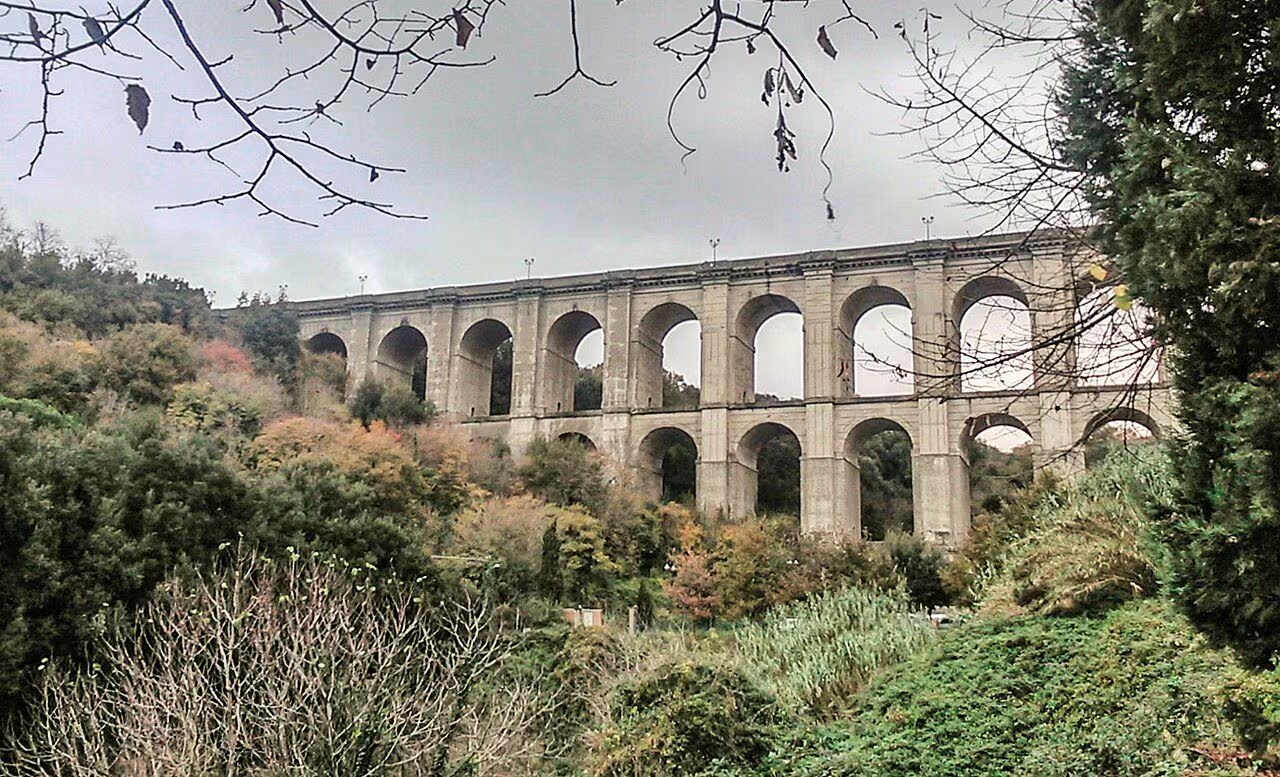
The Monumental Bridge of Ariccia it is a road viaduct among the most impressive road engineering works of the nineteenth century in the Papal State. With an overall length of 312 meters and with a height reaching i 59 meters at the bottom of the valley, the viaduct is structured on 3 overlapping orders of round arches (with 6, 6 and 12 arches respectively) made of cement conglomerate with peperino covering, a volcanic rock typical of Lazio. Approximately 100,000 cubic meters of material were used for its construction, allowing it to overcome a 14% slope along the historic route of the Appian Way.
Description of the monumental viaduct
The Ariccia viaduct was designed to rectify and level the route of the Via Appia Nuova, thus allowing the steep differences in height of the Ariccia Valley which had slopes of up to 14% to be eliminated. The work, with one total length of 312 metersand one height of 59 meters, it develops on a scheme of multiple overlapping spans in cement conglomerate covered in peperino. The structure is divided into three levels: the first lower order has a total of 6 arches, the second intermediate has 6 while the third, the upper, has 12. This allows for the distribution of vertical loads and stability against horizontal thrusts to be guaranteed.
All arches have a free span of 9.6 meters. The support pylons, with a rectangular section decreasing upwards to optimize the distribution of their weight, are rooted on continuous foundations in pozzolana and tuff flakes that sink into the volcanic soil of the Lazio area.
The road plan, in the configuration resulting from the post-war reconstruction, has a overall width of 12 metres between the internal faces of the parapets, of which 9.5 meters intended for roadway And 2.5 meters to the sidewalks lateralall protected by a continuous stone parapet. To counteract the thrust of the earth and ensure the drainage of rainwater, the technicians of the time integrated internal ducts into the wall texture and buttress spurs along the bases of the main pylons.
The history of the Ariccia Bridge and the reconstruction after the collapse
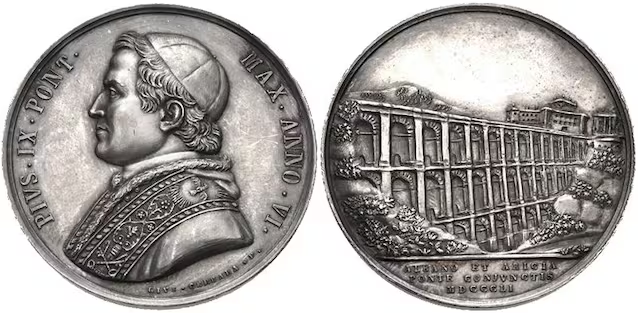
The need to rectify the route of the Appian Way between Albano Laziale and Ariccia, without the tiring crossing of the Ariccia valley, was promoted by Pope Pius IX, who decided to entrust the direction of the works to the architect Giuseppe Bertolini.
The construction site opened in 1846 and the construction continued for eight years, with the overcoming of great logistical difficulties linked to the lifting of the stone blocks and the consolidation of the soil, until the official inauguration which took place on 12 October 1854.
During the Second World War, the bridge suffered destruction of the central part. In fact, on 2 June 1944, the retreating German troops detonated explosive charges placed on the central piles, knocking down three spans.
After the war it was decided to immediately start the work of reconstruction “as it was and where it was”, reusing traditional masonry techniques together with reinforced concrete inserts for the internal ribs, definitively returning the viaduct to public traffic in 1948. January 18, 1967, however, the collapse of the central pylons of the bridge for reasons not entirely ascertained.
There reconstruction of these reinforced concrete pylons was started in December of same year and, after about a year, the bridge came reopened again at traffic. The new pylons, which should have been covered in peperino, remained intact exposed concretewith both aesthetic and static damage to the structure. In the following decades, the work has been the subject of structural consolidation interventions and conservative and seismic monitoring, aimed at preserving the integrity of one of the most significant infrastructural monuments of the Castelli Romani. In 2000, ANAS also installed tensile structure barriers along the entire route of the viaduct for prevention purposes.
