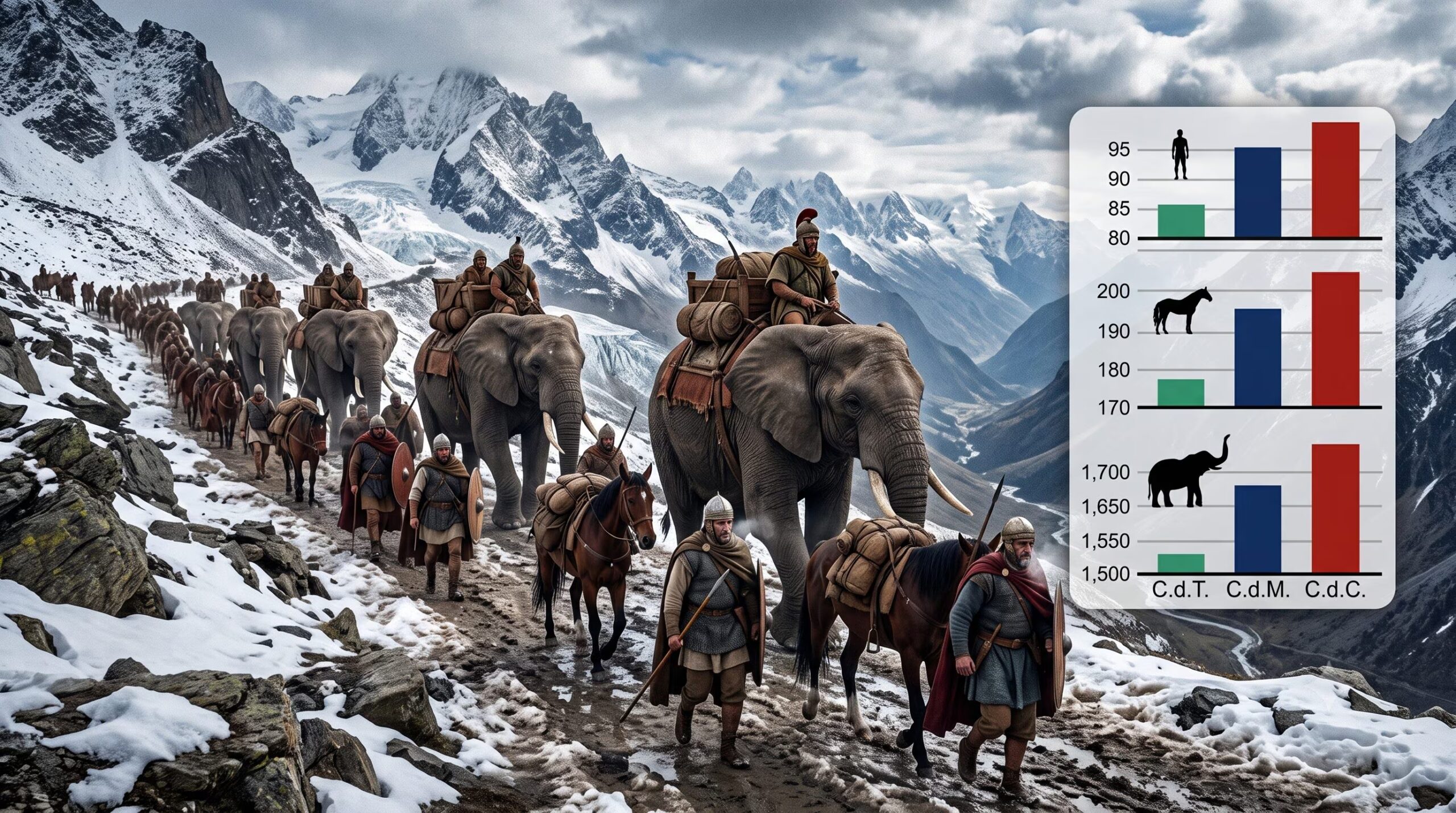
What path did he follow? Hannibal to cross the Alps in 218 BC? The question has accompanied historians for millennia, and continues to spark debate. A new study published in Proceedings of the National Academy of Scienceshosted by Emilio Berti from the University of Jena, Germany and from Fritz Vollrath of the University of Oxford, in the United Kingdom, addresses the problem from a new perspective, the energy cost incurred by the Carthaginian army during the crossing, revealing that only the Colle delle Traversette pass would have allowed the Carthaginian general to bring 37 elephants to Italy.
The authors developed a biomechanical model to estimate theenergy needed by men, horses and elephants in tackling the main Alpine passes proposed over the years by scholars. The analysis took into account factors such as slope, distance, altitude and mass of the animals, evaluating how much each route would impact the army’s energy reserves. The results indicate that the Colle delle Traversettein the Cottian Alps between France and Italy, represents the most compatible route for an expedition of that size. According to calculations, the crossing along this pass would have required an amount of energy between 11 and 19% lower compared to the other itineraries analyzed, making it the most efficient choice from a physiological point of view.
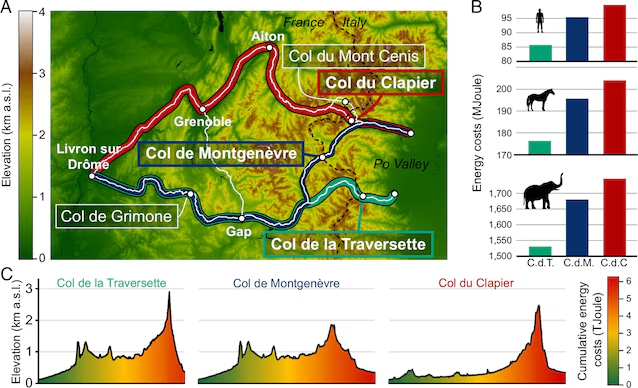
One of the most interesting aspects of the study concerns the elephantsprotagonists of Hannibal’s famous feat. Contrary to what one might imagine, the models show how these animals would have coped with the crossing crelatively better conditions than the soldiers. Thanks to their consistent fat reserves body and the efficiency of quadrupedal locomotionthe elephants would have consumed only a small part of their energy reserves, while the infantrymen would have undergone a proportionally much higher effort. This doesn’t mean the crossing was easy. Ancient sources describe difficult climatic conditions, harsh terrain and numerous losses among humans and animals. However, according to the authors, the limiting factor would not have been represented by the elephants, but by the ability of the Carthaginian army to sustain such a demanding march in a mountainous environment.
The study by no means claims to definitively resolve the debate on the path followed by Hannibal, but introduces a new quantitative criterion in the discussion. By integrating historical, topographical and biomechanical data, the researchers demonstrated how energy consumption analysis can help evaluate plausibility of the different itineraries. The research therefore represents a first example of interdisciplinary approach applied to ancient history. The union between archaeology, animal physiology and mathematical modeling offers new tools to address still open historical questions, combining traditional literary and archaeological sources with data obtained from modern biological sciences.
