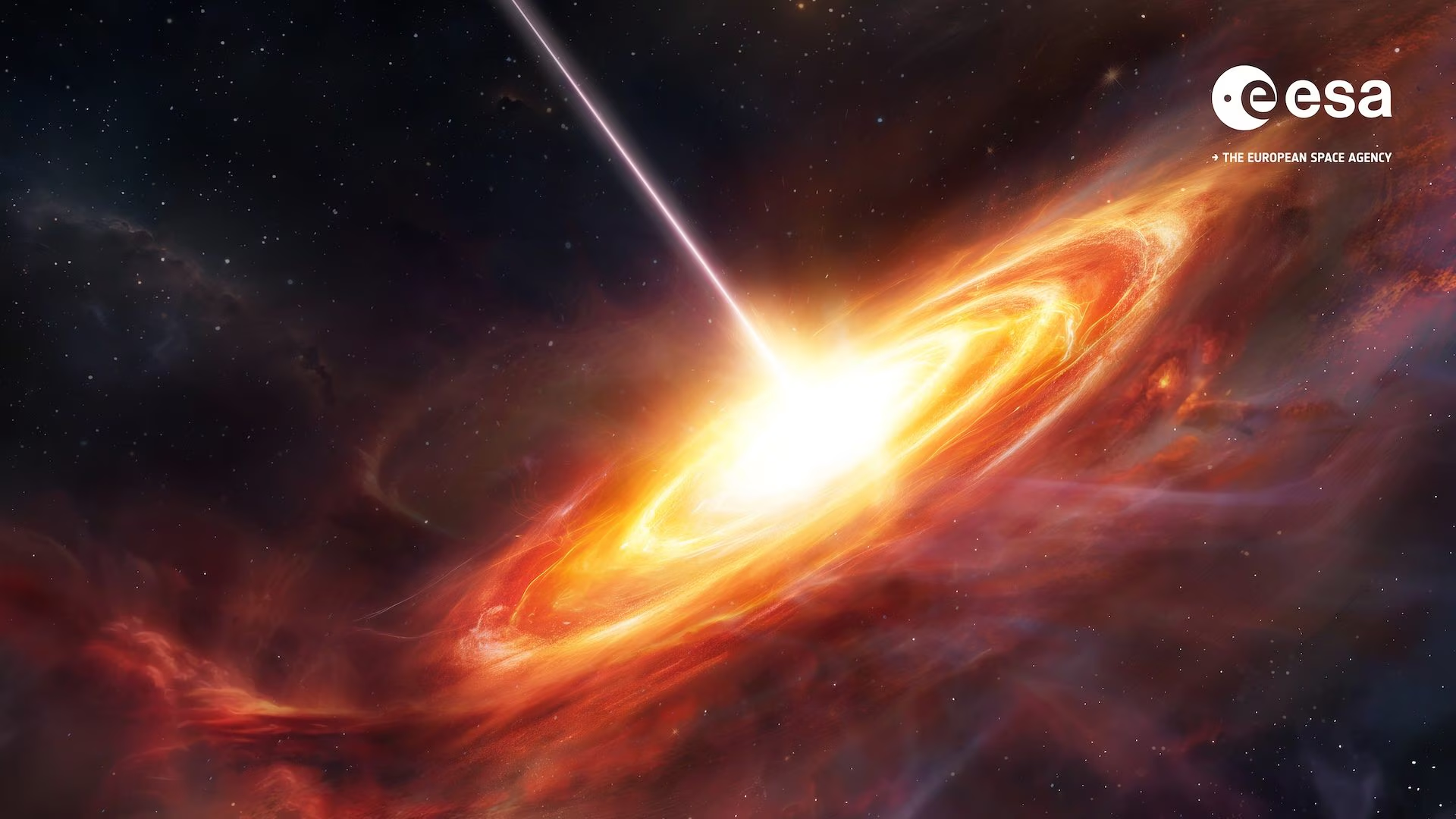
The space telescope Euclid of the European Space Agency (ESA) discovered 31 new quasars, the oldest never observed before: these are extremely luminous galactic nuclei powered by rapidly growing supermassive black holes. Among these, two record-breaking objects were also identified, called EUCL J172902.75+641018.1 and EUCL J125308.55+705432.3, approximately distant from Earth 13 billion light-years and with redshifts equal to 7.77 and 7.69 respectively: this means that their light she left when the Universe had just 670 million yearsabout the 5% of his current age.
The discovery, published in Astronomy & Astrophysics, comes from the first 18 months of observations of the Euclid Wide Survey and includes in total 31 new quasars at “high redshift”, of which 12 at redshift greater than or equal to 7 (prime 800 million years of life of the cosmos). It is an important result because it allows us to study one of the big questions of modern astrophysics: how did the first supermassive black holes a grow so quickly in the first hundreds of millions of years after the Big Bang.
The study by ESA’s Euclid space telescope
The discovery of the most distant quasars ever observed was achieved by analyzing images captured in first year and a half of operational life of the space telescope Euclid. We are talking about a large portion of the sky 3000 square degreesabout the 7% of the entire celestial vault.
In such a vast area of sky Euclid has identified approximately 300 million galaxies and among this enormous quantity of sources, Euclid identified 31 new quasars at “high redshift”, i.e. observed when the Universe was between 650 and 820 million yearsmore or less 5% of the current age. Of the 31 quasars discovered, i the two furthest are EUCL J172902.75+641018.1 and EUCL J125308.55+705432.3.
It’s about the new record of oldest quasars ever observed, whose light comes from a Very young universeonly 670 million years old, in the midst of the formation of the first galaxies and supermassive black holes in the cosmos. This period is also known as era of reionizationwhen ultraviolet radiation from the first stars, galaxies and black holes began to transform intergalactic gas from neutral to ionized.
Before this study, there simply hadn’t been enough quasars dating back to the early stages of the Universe to adequately study them as a population. In fact, it had taken astronomers more than a decade to find a handful of objects at redshifts greater than 7. All this changed with the advent of Euclid: the space telescope has in fact the number of known quasars at redshifts above 7 more than doubled in just over a year of observations, thanks to its ability to scan vast areas of the sky in search of these objects that are apparently faint, but which intrinsically are among the brightest sources in the cosmos. In particular, the authors of the study identified quasars using probabilistic techniques and of machine learning applied to Euclid images in visible/infrared filters, then confirmed through spectroscopic observations with the Keck, Magellan and LBT telescopes.
The importance of the discovery of the oldest quasars ever observed
Quasars represent a brief phase in the life of a galaxy during which large quantities of matter spiral towards the central supermassive black hole, releasing enormous quantities of energy. Being a short phase, this implies that quasars are rare and hard to findespecially when they are so far away in space and time as they appear through the telescope as point objectseasy to confuse with the stars closest to us. Discovering such distant ones allows us to study what happened during the dawns of the cosmosincluding how the first supermassive black holes and galaxies formed—some of the greatest unsolved mysteries in astrophysics.
What are quasars
Astronomers agree that at the center of almost every galaxy lies a supermassive black holethat is, a black hole whose mass is millions or billions of times that of our Sun. In most galaxies, this cosmic monster is sleeperhowever it can go through phases in which gas and dust spiral towards the central black hole emitting light across the entire electromagnetic spectrum, thus giving rise to a active galactic nucleus (AGN).
THE quasars I’m a special one class of active galactic nucleuswhere the rate of accretion of matter towards the central black hole is like this high to give rise to an intense light emission that exceeds that of all the stars in the galaxy hosting the supermassive black hole. Quasars are in fact among the brightest objects in the Universe known, typically emitting thousands of times more light than the entire Milky Way.
The closest quasar to Earth is Markarian 231, a 581 million light-years in the direction of the constellation Ursa Major, while i two further away are those just discovered by the Euclid space telescope, EUCLJ172902.75+641018.1 and EUCL J125308.55+705432.3, more than 13 billion light-years from Earth.
