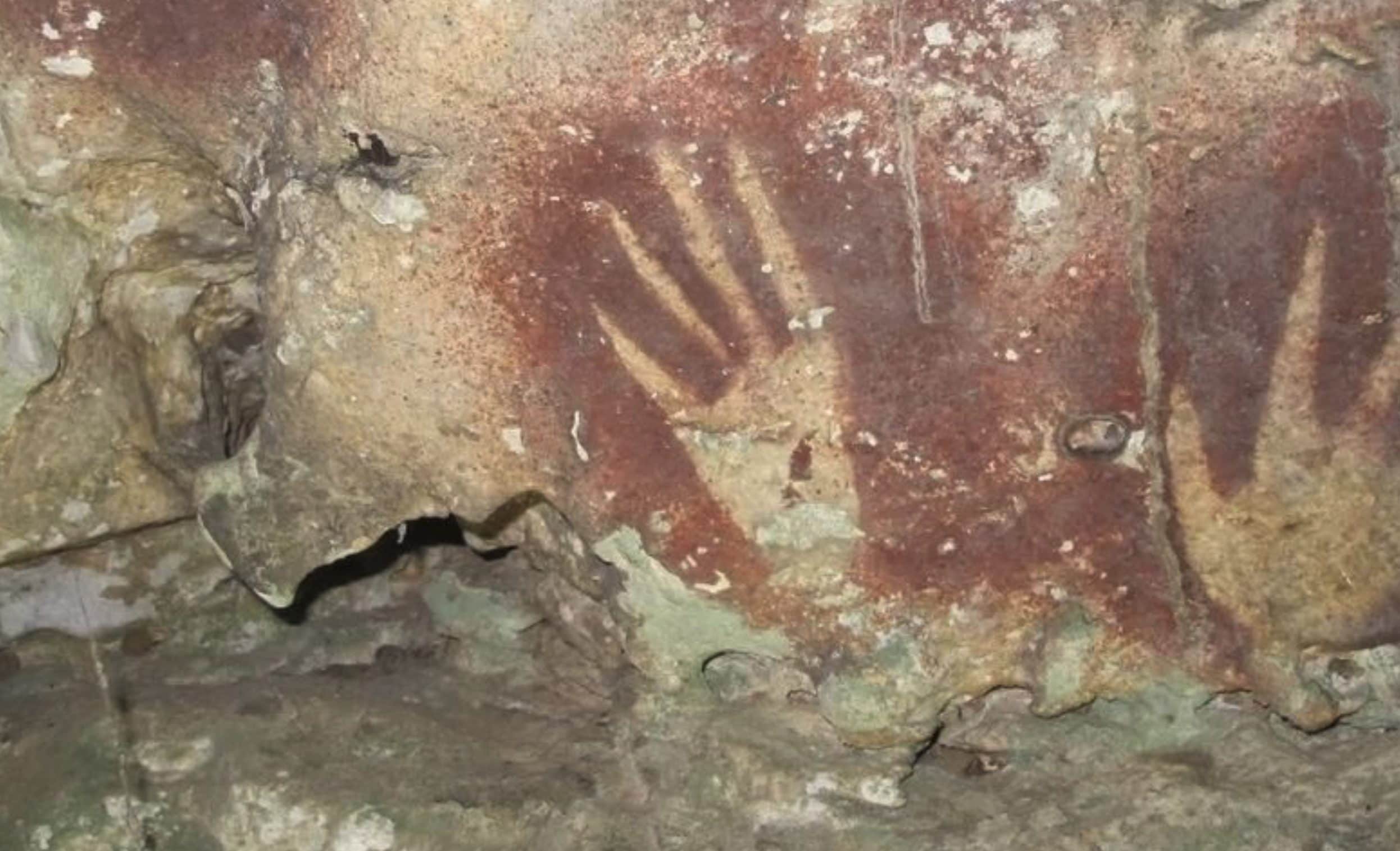
In a cave on the island of Sulawesi in Indonesia, not far from the island of Sulawesi, it was found the oldest rock painting ever discovered: these are the stylized outlines of hands that date back to well 67,800 years agoduring the Pleistocene.
The traces of pigment, found in the Liang Metanduno cave, represent in all respects stencils of a series of hands. But these are particular hands. According to archaeologists Adhi Agus Oktaviana (of the Indonesian National Agency for Research and Innovation) e Maxime Aubert (from Griffith University in Australia), who dated the painting and subsequently published the discovery in Nature, these “outlined” figures do not represent simple human hands but would be a reworking of hands with a more elongated and sharper shape. They are in fact represented by narrowing the thickness of the fingers: the result is a kind of claw hand.
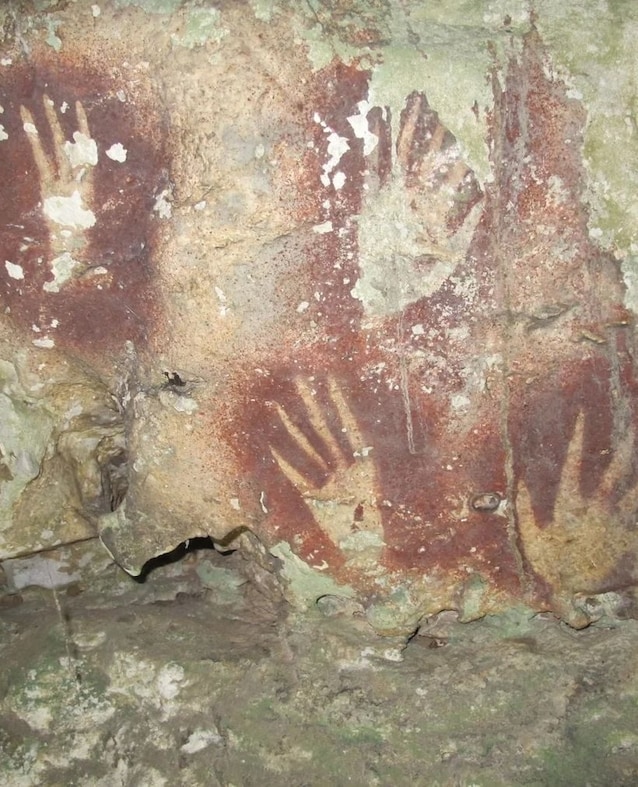
According to one of the co-authors of the research, Adam Brummthis choice could have «a deeper cultural meaning, but we don’t know what it was. I suspect it had to do with the complex symbolic relationship of these ancient peoples with the animal world.”
This island is home to one of the richest and longest-lived artistic cultures in the world: numerous karst caves with very ancient rock paintings had also been found here: in the Leang Tedongnge cave, for example, in 2017 the paintings considered the oldest in the world at the time, dating back to 45 thousand years ago, depicting a stylized wild boar, were found.
But how did we arrive at calculating the exact age of the pigment? The researchers used an age-based dating technique uranium isotopesthat is, on the variants of uranium with different atomic weights, deposited over the millennia above and below the layer of paint. To measure the decay of uranium over time (relative to a more stable radioactive element, thorium), they then took five-millimeter-thick samples of calcite from the walls of limestone caves and examined these rock layers with a laser.
The analyzes were also applied to all the other drawings present in the cave, demonstrating that the place has been used as an art space for a very long periodfrom 67 thousand to 20 thousand years ago.
A discovery of primary importance, which according to Adhi also allows reconstruction the movements that led the first human populations to occupy the surrounding regions: according to the archaeologist, the island of Sulawesi was probably one of the “bridges” from which ancient populations transited (during the ice age) towards the ancient continent composed of Australia, the island of Tasmania and New Guinea.
