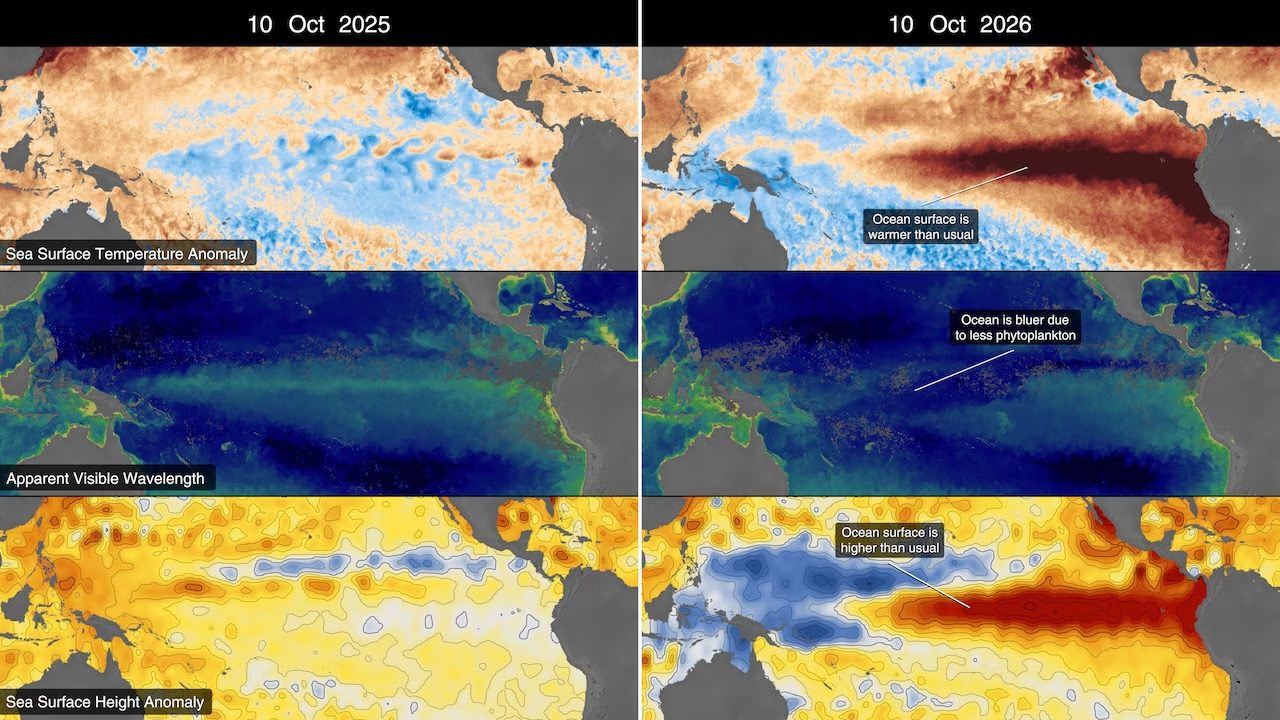
NASA images show a much bluer ocean than in 2025: this happens because the weakening of the trade winds reduces upwelling and deprives the phytoplankton of the necessary nutrients, causing the typical green shades to fade. Meanwhile, NOAA estimates at 83% the probability that the current El Niño will be the strongest since 1950.
It seems incredible and yet the impact of El Niño is so intense that it even changes the hue of the ocean. Images from NASA’s PACE satellite show a Pacific markedly bluer than in 2025which under normal conditions would appear from the space crossed by a green-turquoise band along the Equatorial Pacificmore intense in the areas of upwelling coastal off South America and in the central and western Pacific. NASA is closely monitoring this climate phenomenon, which some scientists have called “a phenomenon rarer than a solar eclipse and more powerful than any single storm system”.
El Niño is a natural climate pattern that recurs every two to seven years and has as its distinctive feature a anomalous warming of surface waters in some areas of the equatorial Pacific. Behind this definition there is a chain of consequences, namely that the trade winds weakenheat accumulated in the ocean is redistributed, rainfall shifts, and the sea surface rises in different areas of the Pacific.
Among the most obvious indicators of El Niño is the warming of the waters and in fact, according to NASA numbers, in the eastern Pacific the temperature of sea surface it’s already about 1.7°C higher to the long-term average, and according to Josh Willis, project scientist of the NASA mission’s Jet Propulsion Laboratory, could rise another fraction of a degree in the coming months.
From green to blue, the causes of the change in color of the Pacific Ocean
As we were saying, among the effects of this phenomenon and the increase in temperatures there is a change in the color of the ocean, a fact observed by the NASA satellite which managed to track this change in hue. This range of color is due partly to microscopic organisms called phytoplanktonwhich form the basis of the marine food web. There are thousands of different species that are green-blue color, brown or green; this year, precisely in those areas, these shades are fading due to the reduced availability of nutrients in surface waters.
In fact, experts have explained that these microscopic plants generally thrive in cold, nutrient-rich waters, conditions that are compromised during El Niño, considering that this phenomenon causes the weakening or a real one inversion of the trade windsi winds which normally blow from east to west pushing warm surface waters towards the western Pacific. Therefore, this weakening reduces the upwelling process, i.e. the rise of nutrient-rich deep water towards the ocean surface. Consequently, with limited food availability, the abundance of phytoplankton decreases.
The effects of El Ñino according to NASA: what is changing in the Pacific
Meanwhile, scientists continue to monitor the effects of El Niño on the global climate, while satellites have identified another phenomenon, a Kelvin wavethat is, ahuge mass of water identified in the western Pacificoff the coast of Micronesia. These are very slow and very long pulses, which cross the ocean from west to east carrying heat. As stated in the NASA statement, they are like underwater highways transferring heat across the Pacificwith the warm water heating the air directly above it, causing it to rise: “the change in atmospheric pressures weakens or even reverses the trade winds, which typically blow in the opposite direction, from the Americas towards Asia, further raising sea levels in the eastern Pacific and warming the waters even further.” Willis compares Kelvin waves to the heartbeat of the phenomenon and satellites, he explains, allow you to look into the ocean and follow its every pulse.
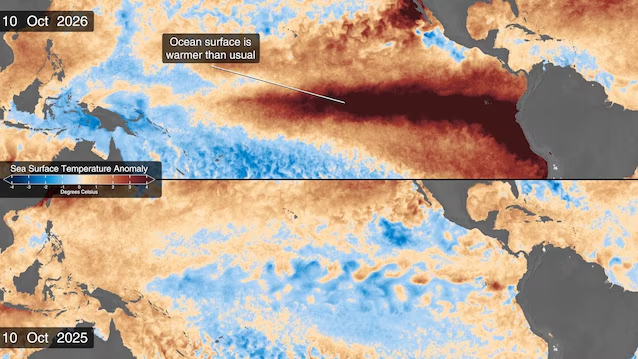
The most relevant data comes from NOAA, the United States scientific agency that deals with oceans and the atmosphere, which in October estimated at83% probability that the current one will be the strongest El Niño since 1950. In fact, in the bulletin he explains that the phenomenon is strengthening exceptionally and that forecasts say that it will continue to intensify until the end of the year, remaining at high levels at least until the January-March 2027 quarter.
