It was August 2020 when one devastating explosion broke out in the port of Beirutthe capital of Lebanon: more than 200 people died, and the whole area around the large port suffered great damage. Among these, there was also the famous SURRSOCK Palacevilla of the Lebanese family notes for having given its name to the largest art museum of the city: in addition to the mortal injury of Yvonne SurSock Cochrane, the works of the private family collection were seriously damaged, including Two very particular paintings attributed to the great seventeenth -century painter Artemisia Gentileschione of the few artists of history to obtain the right recognition for their work (and further re -evaluated in recent years). The two canvases, whose almost nothing was known, are a dedicated to Hercules and Onfale and one to the Maddalena.
The first, Hercules and Onfale It is the most particular and appreciated work: two and a half meters large for two, depicts the famous hero of the seven labors submissive to the queen of Lidia (of which he was a lover). According to the myth, Hercules had been forced to become his slave for having committed a murder, which is why we see him while the wool row, a task usually muliebre, while the onfale brings the heroic lion leather on him. The canvas reported large damage, for which a laborious restoration was necessary.
Despite his attribution In Gentileschi he dated back to 1996, at the suggestion of the Lebanese art historian Gregory Buchakjian, the discovery remained substantially unpublished until the explosion five years ago. After the disaster, the same scholar had reiterated his thesis, also presenting a series of tests in favor, which was supported by the art historian and expert of Gentileschi, Sheila Barker, and by Davide Gasparotto, curator of the Californian J. Paul Getty Museum, who believes this work was coeval with the Maddalena and had been bought a hundred years ago by a merchant of art of Neapolitan art. (without ever being exposed before).
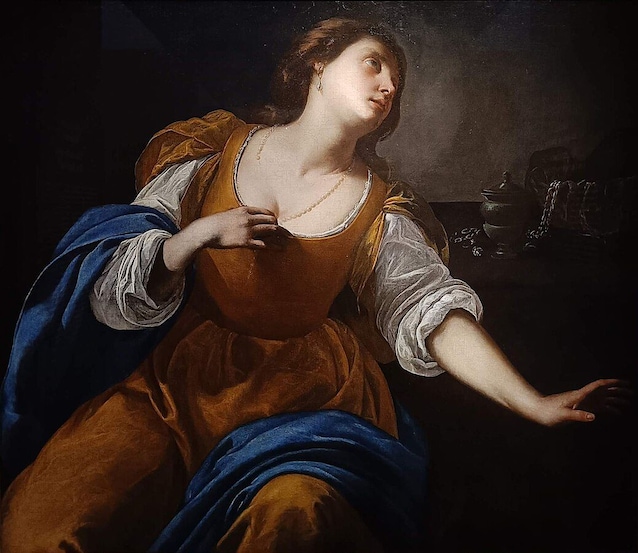
The work that has as its subject the Maria Maddalena, Instead, he sees it at the moment of conversion, while freeing himself from a necklace and looks up. Despite the common theme, for the art historian Costantino D’Orazio it is an important job in Gentileschi’s career, because he was one of the first he made in Naples, in the 1930s of the seventeenth century. The attribution to the artist of Maddalena “SurSck” was also confirmed by the art historian and expert Riccardo Lattuada, who reconstructed his passage over the centuries from one private collection to the other until he was acquired at the end of the nineteenth century by the Lebanese family.
Subjected to years of reconstruction and restoration (also with a view to recovering the original colors) both works have now returned to life: From 10 June Ercole and Onfale is exposed to the public, For the first time after at least a century, upon reopened J. Paul Getty Museum, To then be placed at the Columbus art museum, in Ohio, while the Maddalena was exhibited first in Milan, and in these days in Monumental complex of Santa Chiara in Naples.
