
You’re on the couch, with the credits of the latest TV series you were watching. The drama begins slowly, with an innocent question: “what could I watch now?”. We know what happens next: hours and hours of endlessly scrolling through a streaming catalog. Science defines it as “paradox of choice“: intuitively we think that having many alternatives makes us happier, gives us more possibilities, and yet, we often feel like this paralyzed. The paradox of choice explains to us how a excess of options sends the mind into a tailspin, leading us todissatisfaction rather than well-being. According to Miller’s theory, we can evaluate al maximum seven proposals at the same timeand too much choice, in addition to overloading the brain, generates too much in us expectation and the risk of getting caught by the “perhaps it was better to choose the other option“.
The illusion of abundance and decision block
According to the economic theory classic, offering lots of choice is a advantagesince everyone can find the perfect item for their needs if there are many options. However, psychology has demonstrated that beyond a certain thresholdcognitive costs end up delete these benefits. In an experiment conducted inside a supermarket, researchers set up two tasting stands: one with 24 flavors of jam and one with only 6. The stand with 24 flavors attracted 60% of passers-by, but only 3% actually purchased the product; on the contrary, at the 6-flavor counter, well 30% of people decided to buy.
The scientific explanation for this block lies in the limits of rationality human. According to Miller’s theory, our working memory is able to only manage about seven items at the same time. Faced with dozens of options or attributes to evaluate (such as price, design and features), the complexity of the decision task quickly saturates our mental resources. To avoid this strong fatigue, the brain prefers postpone the choice or not choose at all.
The weight of sacrifices and disappointed expectations
What happens, however, when we finally manage to decide? Too much choice often continues to torment us too After have completed the purchasedrastically lowering our satisfaction. First of all, comes the strong psychological weight of what is called “opportunity cost“. By choosing a specific alternative, we are implicitly giving up the benefits of all the other available options. When there are dozens of alternatives, the list of renunciations grows immeasurably longer, generating in us a profound sense of dissatisfactionand that worm in my head that sounds like: “but maybe it would have been better if I had taken the other choice?”.
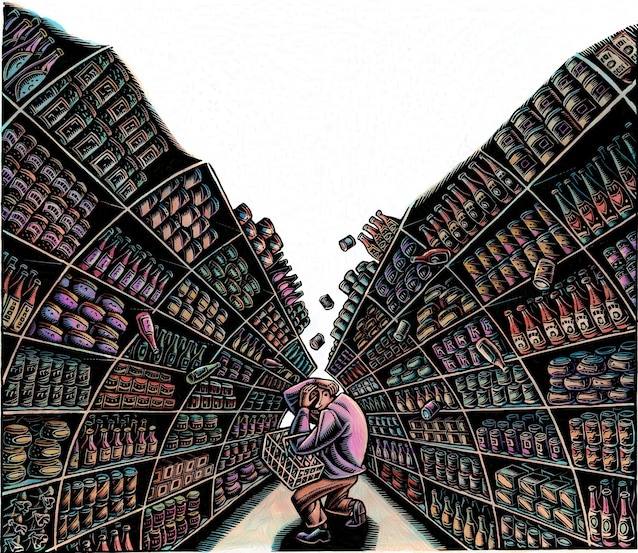
Furthermore, a large assortment tends to unrealistically raise ours expectations. Faced with a hundred options, we convince ourselves that it must necessarily exist the perfect oneour ideal product. When the purchased item turns out to be simply “good”, we suffer a disappointment immediate compared to the enormous expectations we had developed. If the products have unique characteristics that are not easily comparable to each other, the effort to rationally justify our decision becomes exhausting, fueling theanxiety and the chronic doubtor that you have made a mistake.
The “maximizers” versus the “satisficers”
In fact, scientists distinguish consumers into two profiles very distinct: the “maximizers“hey”satisfiers“. Maximizers constantly seek thebest option ever. To find it, they methodically examine all the alternatives, and very often sacrifice precious time and energy. A study published in Personality and Individual Differences has shown, for example, that these individuals are willing to drive a long time to reach an ice cream shop with 200 flavours, completely ignoring the local one which offers only 20. This behavior triggers the so-called “maximization paradox“: while making enormous efforts to ensure the widest choice, the maximizers they end up being unhappierstressed and regretful compared to others. THE satisfierson the contrary, have a profoundly different objective: they seek an option that is simply “pretty good“. They set an initial acceptability threshold and they stop as soon as they find a product able to satisfy it, living the decision-making experience with much less anxiety.
The importance of individual differences
It must certainly be said that the impact of this phenomenon is not universal, but varies based on the personality of the individual: those who by nature love to process in-depth information and are used to complex tasks will experience more positive emotions when faced with abundance, compared to those who immediately feel fatigued by mental effort. Or again, the level of familiarity with the object of choice radically changes the impact: i inexperienced consumerswho do not really know how to evaluate the pros and cons, tend to get stuck and postpone the purchase when they are faced with too many options, while those who already have prior knowledge of options can filter information more quickly and reduce the complexity of the decision by quickly limiting the options.
Sources
Misuraca et al., 2024, On the advantages and disadvantages of choice: future research directions in choice overload and its moderators Fernandez, 2017, The Paradox of Choice: Why More Is Less Dar-Nimrod et al., 2009, The Maximization Paradox: The costs of seeking alternatives Tang et al., 2017, Purchase decision: does too much choice leave us unhappy? Chevner et al., 2014, Choice overload: A conceptual review and meta-analysis Yiengare and Lepper, 2000, When choice is demotivating: Can one desire too much of a good thing? Miller (1956) The magical number seven, plus or minus two: Some limits on our capacity for processing information.
