
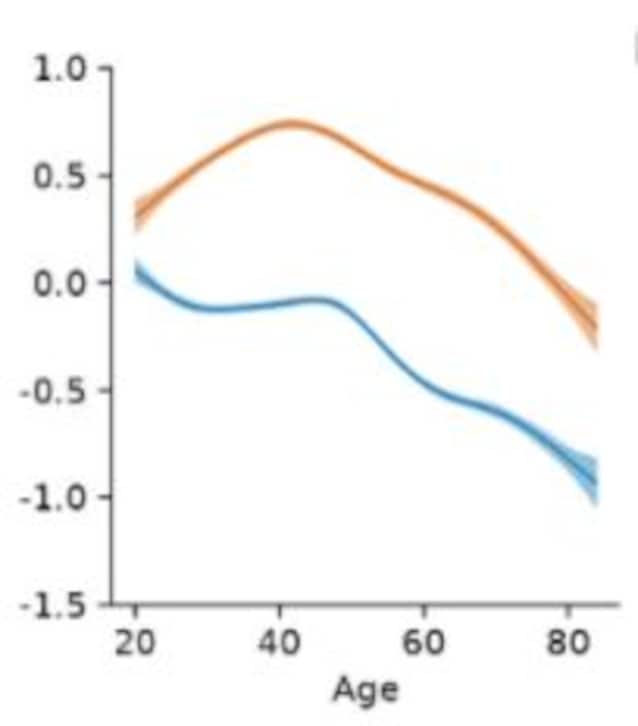
The sexual drive in men would reach its peak on average around 40 years old (the so-called mid-life peak), although testosterone levels in males begin to decline after age 30. This is the result of a massive study conducted on over 67,000 adults from the Estonian Biobank. To explain what seems like a “biological paradox,” researchers have proposed some mechanisms to compensate for the decrease in the main driver of male sexual desire. In particular, live together permanently and being fathers appears to play a role in increasing sexual desire in men.
Peak male sexual desire and the “40-year paradox”
Analyzing a sample of 67,334 adults (about 7% of the Estonian adult population) taken from the Estonian Biobank, researchers have identified what we might call a “middle-age paradox”: male desire not only does not decline with the first signs of hormonal decline, but reaches its statistical peak around 40 years.
The methodology: how they measured desire
To obtain statistically robust data, the study was not based on generic sensations, but on a two-dimensional measure of sexual desire, evaluating the pulse frequency (“urgency”) and the frequency of thoughts of a sexual nature. This approach allowed us to isolate the desire as a psychophysical constructseparating it from the simple sexual activity practiced.
The statistical models used identified gender and age as the strongest influential components, but at the same time saw the emergence of decisive relational and social variables.
The mid-life peak: beyond testosterone
The most striking data is the so-called male mid-life peak. If in women the desire curve shows a more linear and early decline, in men the peak at 40 suggests the existence of psychosocial compensatory mechanisms. As the biochemical “fuel” (testosterone) declines, the stability of adult life appears to act as a catalyst.
In fact, the study highlights that cohabiting men report significantly higher levels of desire. The stability and availability of the partner seem to support the libido more than novelty. Furthermore, unlike women, in men a greater number of children is associated with a higher desire, probably for a reinforcement of identity and social role.
Associations of Sexual Desire with Demographic and Relationship Variables
