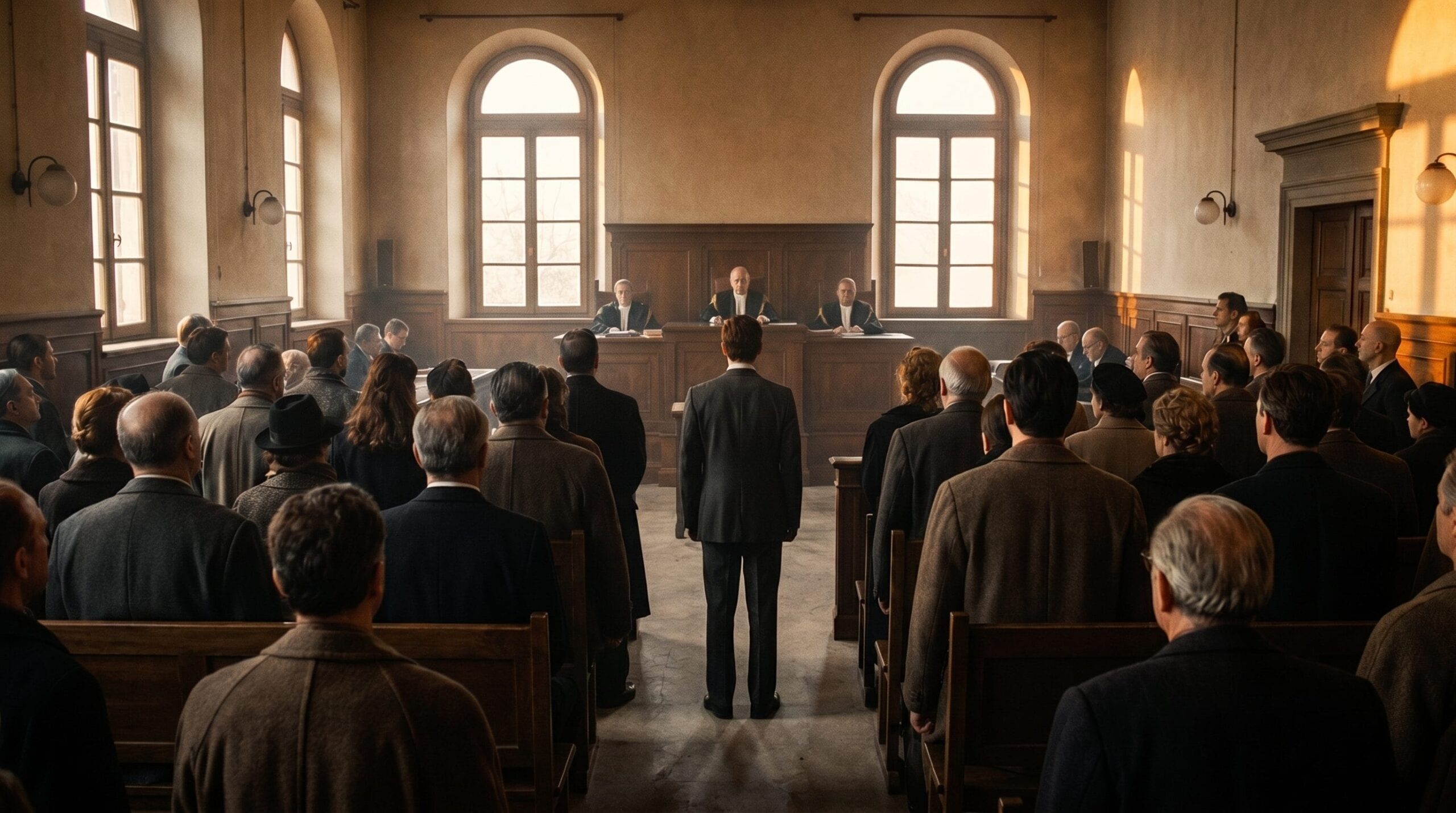
To date we don’t know what the epilogue will be case of the Garlasco crimewhich saw the murder of in 2007 Chiara Poggi (for which the ex-boyfriend was definitively convicted Alberto Stasi) and returned to the headlines due to the appearance of new material relating to Andrea Sempio (associated with the famous footprint 33). In light of the latest developments, it is worth asking ourselves about a phenomenon that is more widespread than we imagine, that of possibles judicial errors (wrongful conviction), which may depend on causes including confirmation bias and media pressure.
When a news story it is violent and emotionally charged, amplified by the media, it becomes urgent for our minds to find an explanation. Identify a culprit it does not only mean giving an investigative answer, but it also acts as a psychological relief: we can tell ourselves that “justice has been done”, that we are safe, that evil has a face and that institutions are always able to protect us. The problem, however, is that the human mind tends to prefer a coherent explanation to a correct one. And it is precisely from this need to create order, from this need to “close the circle” at all costs, that problems can arise. judicial errors.
According to a report from theUnion of Italian Criminal Chambersfrom 2018 to today 4,920 people they ended up in prison unjustly. Only in 2024 have they been 552 compensation orders for unjust detention. In the United States, where the phenomenon of wrongful conviction is studied systematically, the National Registry of Exoneration has recorded approx 3,800 cases of innocent people exonerated from 1989 to 2025, for a total of 35,000 years passed by innocent people, and this can have very serious psychological effects.
Attention: This article does not intend to take or suggest a position on the merits of the Garlasco case, but only to delve into an issue that has emerged following the latest developments. We reiterate that ascertaining the truth is and will be the task of the judiciary.
The “tunnel vision”: the confirmation bias of investigations
Confirmation bias it was first studied in the 1960s by psychologist PC Wason and is the tendency to seek, interpret and remember information in a way that is compatible and coherent with an already formed hypothesis. In the investigative field, once a person enters the suspect’s perimeter, every new element risks being read through that lens. Thus, an ambiguous detail can suddenly seem significant, a neutral behavior can turn into doubt, a minor inconsistency can take on disproportionate weight. At the same time, the elements that contradict the initial thesis tend to be devalued, or simply not explored in depth.
That is, once an explanation has been constructed, the brain naturally wants to protect it because modifying it would require a very high effort and emotional cost. As confirmation bias becomes entrenched, it can evolve into what is called investigative tunnel vision: a progressive narrowing of the field of attention around a single track (interpretative closure), weakening the alternatives and considering marginal the elements that do not match, sometimes “forcing” the narrative. At that point, the implicit objective of the investigation risks changing: we are no longer just trying to understand what happened, but to confirm what we already think we know.
Recognizing the error would not only mean correcting a theory but also admitting that the facts may have been misinterpreted. And this, for an institution, is psychologically and symbolically costly (the so-called lost cost fallacy).
The false myth of infallible memory: false memories and unreliable testimonies
One of the most counterintuitive things to emerge from memory research is that memories do not function as archived copies of the past. Memory is reconstructive: every time we remember something, we do not “reproduce” it faithfully, but we recreate it by integrating and contaminating it with emotions, expectations, fears, subsequent information and external influences. This means that a memory can be authentic in subjective experience and, at the same time, inaccurate in detail, generating what is called false memory.
Numerous field studies have shown with great clarity how much this is easy to influence memory of a person through suggestive questions, external pressure or post-event information. In court cases, eyewitness testimony can have enormous weight in building the prosecution case. False memories, however, demonstrate that you can be sincerely convinced that you have seen something that does not exactly reflect reality.
That of false confessions it is perhaps one of the most difficult aspects to understand; innocent people can indeed confess to crimes that they did not commit: lengthy interrogations, extreme stress, isolation, sleep deprivation and fear can lead a suspect to simply take responsibility for an event to interrupt one condition perceived as unsustainable. Furthermore, a sort of thing can happen internalization of the accusationthat is, starting to doubt one’s memories or even convincing oneself that one is really involved.
Media pressure and public trial
In cases of strong public importance, the judicial process is accompanied by a second process, parallel and informal: that ofpublic opinion. Newspapers, television and social networks contribute to the construction of a collective narrative in which the suspect gradually stops being a person under scrutiny and becomes an already defined character.
The moment a person is publicly exposed as “the suspect”every gesture, expression or detail of his private life is analyzed and reinterpreted. If it appears cold, it is suspicious. If he cries too much, he’s faking it. If he speaks little he is hiding something. This is the so-called “halo effect”, a cognitive bias that leads to generalization and which can also influence a jury or public opinion. In addition, the institutions are expected to resolve the case as soon as possible, and this media pressuretogether with the urgency of finding a culprit, can become stronger than the prudence necessary to seek the truth.
The conviction of guilt it does not remain confined to investigative classrooms. It spreads and becomes collectiveinvolving the mass media and public opinion. But why does this happen?
- Social proof or social proof: it is the tendency to consider a behavior correct or true simply because shared by a majority of people. The concept had already been scientifically demonstrated in the 1950s with Solomon E. Asch’s experiment and more recently the psychologist R. Cialdini formalized the name (“social proof”). In conditions of uncertainty, human beings tend to use collective consensus as shortcut cognitive (heuristic). If newspapers, television, commentators and experts and public opinion converge on the same interpretation, that version of events unconsciously acquires greater credibility: “if they think so, then it’s true”.
- Authority Bias: it is the tendency to attribute greater credibility to statements coming from figures perceived as authoritative. Magistrates, investigators, forensic experts, television journalists or institutional representatives inevitably practice a strong impact on public perception of reality. The brain tends to consider their version more reliable and less questionable.
- Familiarity and reiteration effect: the perception of truth is also influenced by simple repeated exposure to information. In psychology this phenomenon is known as illusory truth effect: People tend to judge the statements they encounter more frequently as more credible, even when they do not have sufficient evidence to verify them.
The psychological effects of wrongful convictions
In wrongful conviction prison is not only experienced as a deprivation of freedom, but one must also deal with a reality perceived as profoundly unjust, even when freedom is obtained through acquittal or having served one’s sentence:
- Post-traumatic stress disorder: many innocent ex-prisoners report typical symptoms of complex trauma (recurrent nightmares, hyper vigilance, chronic anxiety, sleep difficulties, panic attacks and pervasive flashbacks related to the prison experience). Sudden noises, closed environments, authority figures can reactivate the same alarm response developed during detention.
- Loss of identity: in some cases, the trauma does not coincide only with prison itself, but with the constant feeling of having been erased as an individual and of having been redesigned as someone you are not. Time spent in detention produces a deep biographical fracture. Relationships, work, projects, habits and the idea of one’s future are suddenly suspended or destroyed. In narrative psychology we often talk about continuity of the self: the idea that our identity depends on the possibility of perceiving life as a coherent story over time, which leads us to realize our being. Unjust detention abruptly interrupts this continuity.
- Institutionalization: Prison doesn’t just deprive you of physical freedom. Over time it changes the way the brain gets used to functioning. Rigid routines, constant monitoring, and dependence on the rules of the institution can produce what many scholars call institutionalization process. After years spent in a totally regulated environment, some people develop difficulties with even the simplest decisions of everyday life. Freedom can paradoxically become destabilizing, fueling a strong difficulties in social adaptation.
- Emotional dissociation: during detention some people progressively learn to “turn off” emotions, desires and vulnerabilities to psychologically survive the prison environment. Even once released, however, many ex-prisoners report difficulty experiencing joy, building intimate relationships, or feeling present in their lives.
- Social stigma: Even when a person is acquitted, public suspicion often survives the sentence and takes root in the collective imagination. Thus, the ex-convict struggles with reintegration into work, personal relationships and his reputation.
- Secondary trauma: miscarriages of justice never involve just one person. Family members, children and partners can develop forms of secondary trauma (general concept attributed to CR Figley) due to prolonged exposure to stress and experienced helplessness. Anxiety, depression, isolation and a sense of shame can create strong family imbalances.
