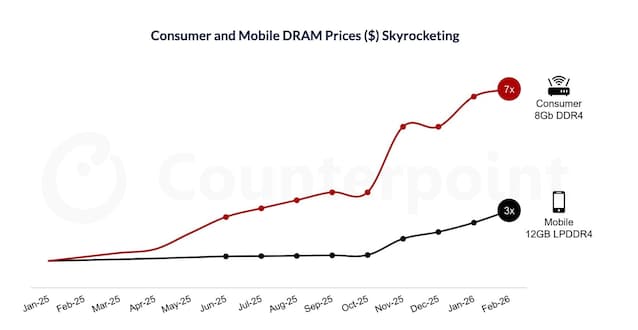
Artificial intelligence’s uncontainable hunger for resources is triggering a crisis in RAM memories, drying up global supplies and generating a domino effect which, ultimately, will increasingly impact the pockets of us end users. According to some market analyzes carried out by researchers at CounterpointResearch (a company specializing in market research in the tech world) so far we have witnessed a vertical increase that has brought the RAM and NAND memories to mark a +600% in the last year for consumer applications.
The oligopoly of three companies (Samsung Electronics, SK Hynix and Micron Technology) which holds the 95% of global production is physiologically diverting the offer towards the technological giants, who purchase immense volumes of memories to power their calculation models. As a result, network equipment manufacturers, having lower volumes and little bargaining power, cannot find the components or pay exorbitant prices to get them. This is why the production costs of a medium-low range router have skyrocketed: if previously the memory affected the 3% out of the total, today it weighs for 20%over a fifth of the value! And this is not a temporary price fluctuation; we find ourselves faced with a structural crisis which, according to some projections, could extend its effects until mid-2026with direct and heavy repercussions on our wallets every time we have to update a network device or activate an Internet line, simultaneously slowing down the infrastructural development of the telephone companies themselves.
The RAM Crisis: The Impact of AI on Modem and Router Manufacturing
So far we have associated the “RAM crisis” especially to notebooks, smartphones or consoles, but the numbers show that network devices are today among the most penalized DRAM (Dynamic Random Access Memory) is the volatile memory that allows a device to process data in real time; without it, routers and gateways couldn’t handle complex traffic flows or simultaneous connections. There NAND flashon the other hand, is a non-volatile memory used to store firmware and configurations. The price increase affects both, because large manufacturers are allocating production capacity towards the data center and server sector which is the basis for the functioning of AI, where every single order is worth much more than in the consumer market.
According to the analyzes of CounterpointResearchin the last nine months smartphone memory prices have “only” tripledwhile those of the memories used in broadband products have grown almost sevenfold. The difference can be explained by volumes: smartphones are produced and shipped in vastly higher quantities, which guarantees more stable supply contracts. Routers, on the other hand, especially those intended for smaller operators or the consumer market, suffer due to a more fragile supply chain and therefore higher prices.
This scenario also has direct implications for telecommunications companies who were aiming for major expansionist plans in the diffusion of optical fiber or FWA technology by 2026. If memory continues to represent such a significant share of the cost, the combined effect of price increases and supply difficulties may slow down expansion plans or make them more expensive. Added to this is the idea, much promoted so far, of integrating artificial intelligence functions directly into routers, further increasing the memory requirement and therefore the exposure to these increases.
Predictions on price increases: the consequences for the future
The economic projections for the future confirm that the upward trajectory will continue inexorably until June 2026. Even once peak prices have been reached «supply problems will continue to persist», to quote the researchers of CounterpointResearch. The expansion of production capacity requires a very long time and the opening of new factories will cost tens of billions, probably becoming fully operational only in 2028. This strong shock wave will change the commercial strategies of telecommunications suppliers, as already mentioned before, and the devices provided on loan for use by operators will probably have higher costs right from the source. Even laptops, game consoles and tablets will suffer evident and probable repercussions delays in the release of next-generation hardware and the concrete prospect of seeing it on the market devices with less pre-installed memoryforcing us end users to absorb the financial and technical burden of the entire situation.
According to the authoritative information site Tom’s Guidea point of reference for enthusiasts of the hardware world, market dynamics indicate that a rebalancing of prices and inventories will probably only occur through two scenarios: a massive expansion of production infrastructures globala complex engineering process that will physiologically require several years, or a decline in demand for memories, if the current drive towards artificial intelligence were to suddenly stop or reduce due to the bursting of the AI bubble.
