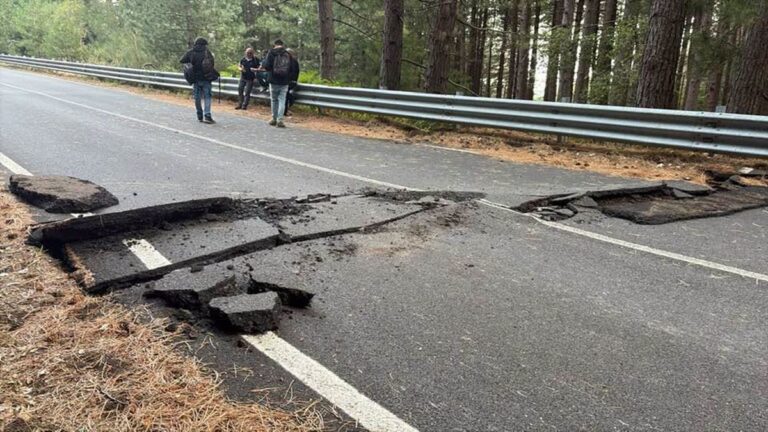
The eastern flank Etna continues to tremble, with the reactivation of the Pernicana Fault. Six new shockswith maximum magnitude of 3.1, were recorded yesterday morning, August 20, 2026from the seismic monitoring network of the National Institute of Geophysics and Volcanology, with its epicenter mainly in the municipality of Linguaglossa and hypocenter at depths no greater than 2km. These new tremors are in addition to the five that affected the same area close to Mid-Augustincluding the earthquake of magnitude 3.9 which it caused damage and fractures along the access roads to Piano Provenzana. The cause of the earthquakes could be attributed to the reactivation of the Pernicana Fault, whose activity has already been associated, on other occasions, with Etna volcanism and with the processes of inflation And deflation of the magmatic system.
Characteristics of the Pernicana Fault: what it is and where it is located
There Pernicana fault cuts the slope north-east of Etnadeveloping from Provenzana planat approximately 2,000 meters above sea level, up to the sea at Fondachelloin the municipality of Mascali, extending for a total length of approximately 20 km and a west-east orientation. In its western portion, the fault bifurcates into two branches: one merges towards Provenzana planwhile the other connects with the Northeast Riftan area of the volcano characterized by deep fractures in the crust which represent a preferential route for the rise of magma. Towards the east, towards the sea, the fault connects with the Fiumefreddo fault.
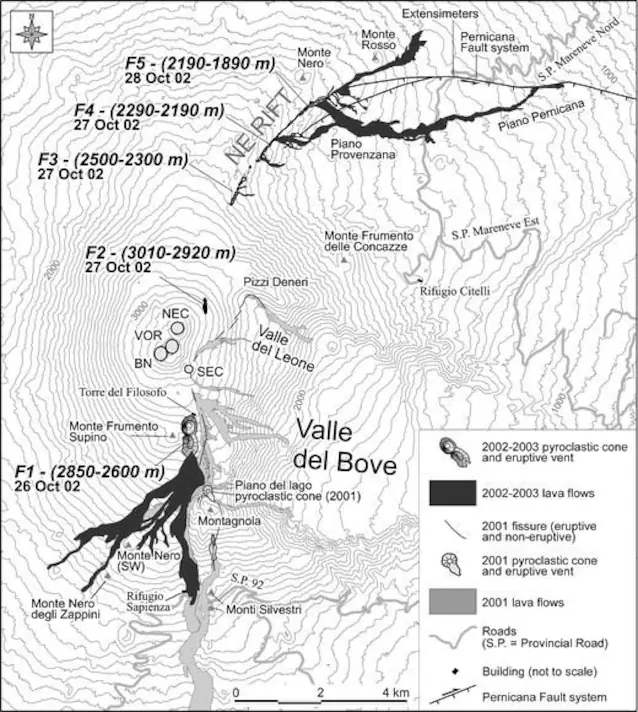
It is probably one of the most important tectonic structures of Etna, both in terms of seismicity and for the control over the surface morphology and for the relationships with the dynamics of the volcano. It was active during several eruptive and paroxysmal phases, including the eruption between 2002-2003during which it gave rise to an earthquake of magnitude 4.4 on the Richter scale, with an epicenter between the municipalities of Milo And Zafferana Etnea and hypocenter at 9 km depth.
The reactivation of the Pernicana Fault in the month of August 2026in conjunction with a new eruptive phase of the volcano, produced thirteen low magnitude earthquakes (less than 3 degrees), recorded by the INGV monitoring stations and with an epicenter in the municipality of Linguaglossa. Two major events, of magnitude 3.9 and 3.1were recorded on August 15th and 20th respectively. The first one produced widespread damage and fractures along the roads connecting to Provenzana plan. From the point of view of kinematics, the Pernicana Fault presents a type of movement sinister transversal. To understand better, if we imagine we are on one of the two blocks separated by the fault and observe the block located on the opposite side, we would see the latter move horizontally to the left. The fault also has a normal movement component. This means that the two blocks of crust also move vertically along an inclined fault plane, with the upper block, called roofwhich is lower than the lower block, said Bed.
The seismicity of the fault and the earthquakes on Etna
The seismic activity of the Pernicana Fault has been recorded instrumentally since late 80s. In most cases, these are shallow earthquakes, with depths generally no greater than 4 km and very low magnitudes, less than 2 degrees on the Richter scale. However, the fault does not exhibit the same behavior in all its portions. A study on the distribution of historical earthquakes has highlighted how, generally, the western portion of the fault, close to Piano Provenzana and the North-East Rift, and the central one are seismogenicand therefore capable of producing earthquakes.
Furthermore, in the western portion, the fault tends to become larger segmented and branched underground. In these areas it is possible to observe fault scarps, i.e. morphological differences in height produced by the relative movement of the two blocks along the fault, with heights varying from a few meters to over 20 metres.
In contrast, the eastern portion, located at lower altitudes, deforms through a process known as creep. This is one slow scrollingcontinuous and aseismic between the two blocks along the fault plane. Since the movement does not occur through a sudden rupture, not enough energy is released to generate an earthquake. Furthermore, due to the slow and continuous nature of the movement, in this portion the surface morphological expression of the fault is less evident.
The study, published in the journal Nature Communications Earth & Environment and led by researchers from the University of Catania and INGV, also shows how, on a time scale, the earthquakes produced by the Pernicana Fault do not occur at regular intervalsbut rather seem to arise from episodic sources of stress. According to the authors, this trend could be directly associated with Etna’s volcanic activity and to magma intrusions, and therefore to pressurization and depressurization cycles of the volcanic system. In particular, the intrusion and rise of magma would cause an increase in pressure in the volcano’s supply system, with a consequent push on the eastern flank which could favor the activation of the fault. Similarly, variations in the pressure distribution in the crust during the relaxation phase following Etna’s paroxysms could favor its reactivation. These same phenomena could also be at the basis of the tremors that occurred close to the 15th of August 2026. However, the movements of the fault could also be associated with tectonic stresses induced by sliding of the eastern flank of Etna.
Raffaele Azzaroresearch manager and seismologist at the INGV-Etneo Observatory, declared in an interview published by the newspaper La Sicilia:
In reality we don’t know if they are tectonic stress adjustments due to what happened on the volcano or if it is instead the large-scale phenomenon of sliding of the eastern slope.
The sliding of the eastern side of the volcano
The eastern flank of Etna is continually deforming. Several studies have confirmed the presence of a slow sliding movement towards the coast. Among the most recent and important, also due to the media outcry it aroused, there is a study published in the scientific journal Science Advances in 2018. The research highlighted a movement with an east-southeast direction, at an average speed of approximately 2-3 cm per year.
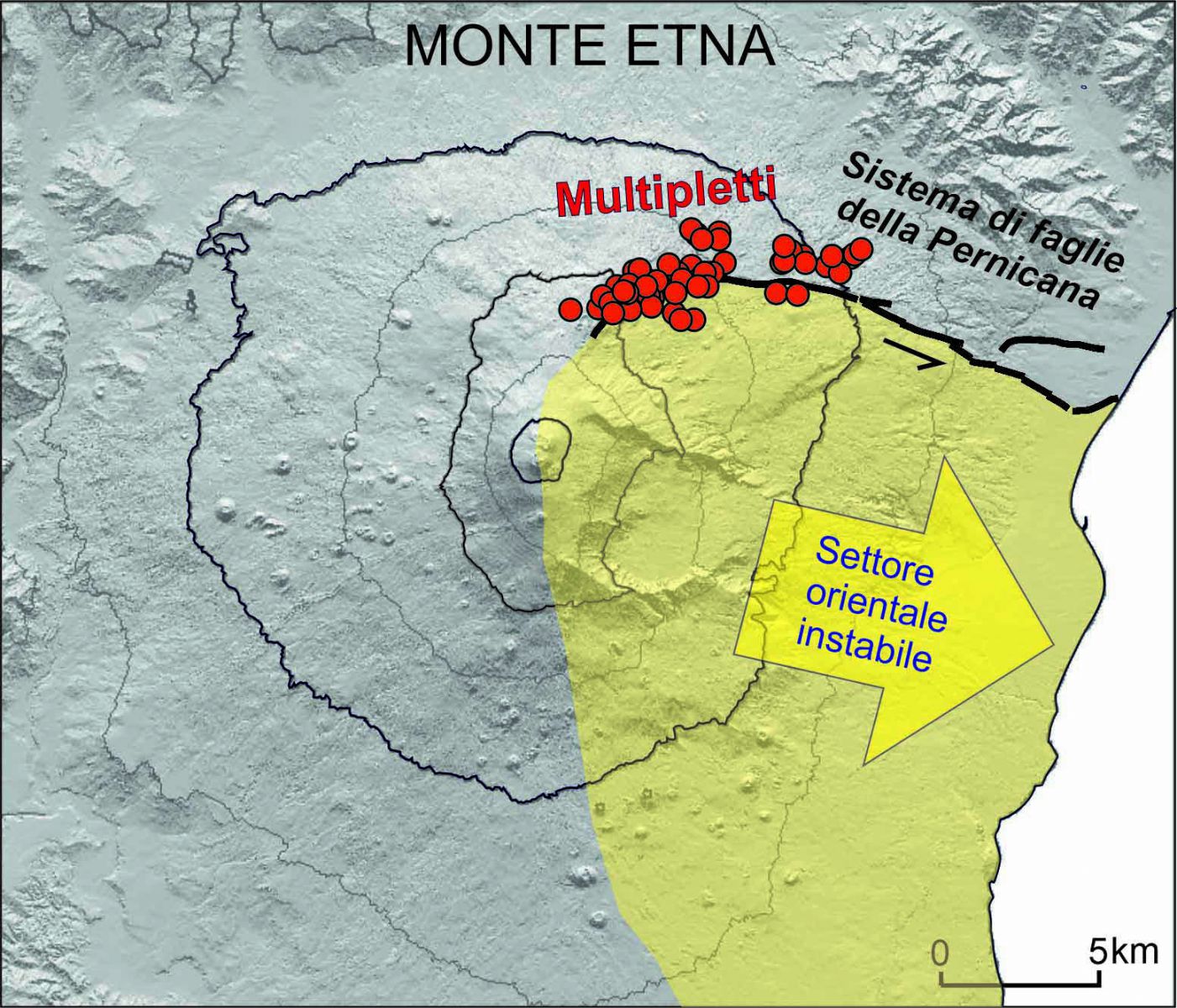
The Pernicana Fault plays a fundamental role in this process. On the one hand, in fact, it clearly separates the portion unstable of the eastern flank from the more stable portion to the north-east; on the other hand, it represents one of the main structures along which the sliding of the flank is accommodated. To the south, the deformation is instead delimited by a complex system of faults, including the Timpe system and the Fiandaca Fault.
Alessandro BonforteINGV researcher, during the interview reported by the newspaper La Sicilia declared:
The Pernicana Fault is constantly moving 2.5-3 centimeters per year; it is a movement linked to the seaward sliding of the eastern flank of the volcano. It acts as a track that releases and makes the “mobile” part slide with respect to the stationary part.
Scientific publications
Cannata, A., Iozzia, A., Alparone, S., Bonforte, A., Cannavò, F., Cesca, S., Gresta, S., Rivalta, E. and Ursino, A., 2021. Repeating earthquakes and ground deformation reveal the structure and triggering mechanisms of the Pernicana fault, Mt. Etna. Communications Earth & Environment, 2(1), p.116. Urlaub, M., Petersen, F., Gross, F., Bonforte, A., Puglisi, G., Guglielmino, F., Krastel, S., Lange, D. and Kopp, H., 2018. Gravitational collapse of Mount Etna’s southeastern flank. Science Advances, 4(10), p.eaat9700. Pischiutta, M., Rovelli, A., Salvini, F., Di Giulio, G. and Ben-Zion, Y., 2013. Directional resonance variations across the Pernicana Fault, Mt Etna, in relation to brittle deformation fields. Geophysical Journal International, 193(2), pp.986-996. Obrizzo, F., Pingue, F., Troise, C. and De Natale, G., 2001. Coseismic displacements and creeping along the Pernicana fault (Etna, Italy) in the last 17 years: a detailed study of a tectonic structure on a volcano. Journal of Volcanology and Geothermal Research, 109(1-3), pp.109-131. Neri, M., Acocella, V. and Behncke, B., 2004. The role of the Pernicana Fault System in the spreading of Mt. Etna (Italy) during the 2002–2003 eruption. Bulletin of Volcanology, 66(5), pp.417-430. THE PERNICANA FAULT (NE SIDE OF ETNA VOLCANO): EXAMPLE OF A SITE OF GEOLOGICAL INTEREST Barreca, G., Bonforte, A. and Neri, M., 2013. A pilot GIS database of active faults of Mt. Etna (Sicily): A tool for integrated hazard evaluation. Journal of volcanology and geothermal research, 251, pp.170-186.
