
The real big joke on the bills of the Meloni/Schlein decree
Thus, after months of gestation, the government managed to launch the “bill decree”, i.e. the long-awaited provision to respond to the cry of alarm from citizens and businesses on the cost of energy, which in Italy is much more expensive than in the rest of Europe, an element which significantly penalizes our businesses and their competitiveness with foreign competitors.
The measure was welcomed by Confindustria and other production sectors (such as Confcommercio), while it was criticized (as well as by the opposition, but this is not too newsworthy) both by the world of multi-utilities and by consumer associations who judged it only as a “palliative” that does not address the issue of “excessive taxation which weighs on 30 percent of Italians’ energy expenditure”.
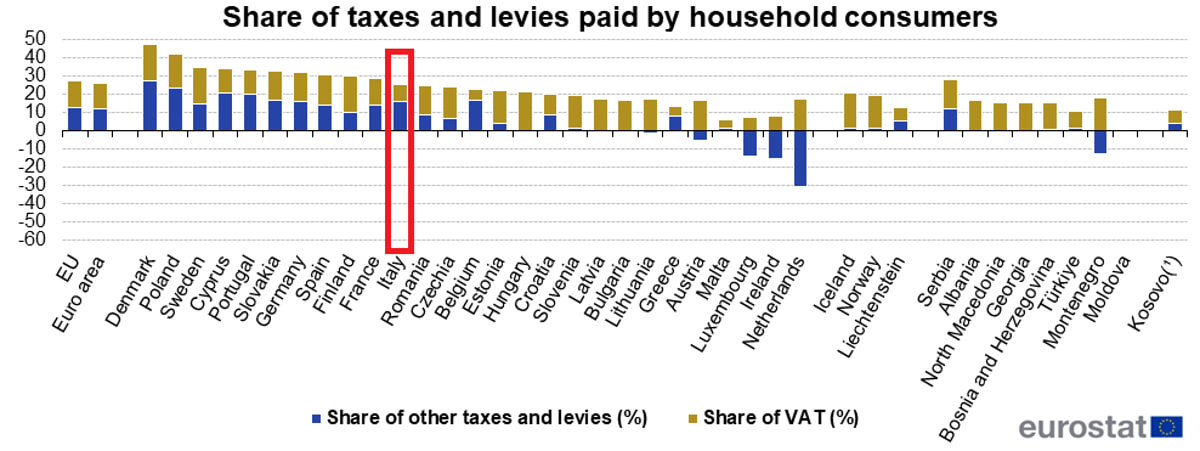
The Prime Minister herself seemed aware of this situation, so much so that instead of presenting the measure with a press conference that would have exposed her to questions from journalists, she limited herself to making it known with a video on social media in which she obviously exaggerated its contents, explaining that it involved aid “for five billion”, even amplifying the calculation that the competent minister, Gilberto Pichetto Fratin, had made, who had spoken of “over three billion”. That’s how it is if you like.
We pay to give others a discount
We also specify that it is a decree, therefore subject to changes by parliament during conversion, which may correct some distortions or risks. One of the most obvious is that since the markets are now integrated, the countries “connected” to the Italian grid (France, Austria, Switzerland and other “neighbors”) will be able to purchase the energy produced in our country which will cost less thanks (also) to the higher taxes imposed on Italian producers to cope with the reduction in the price of electricity itself (the IRAP rises by 2 percent, we’ll talk about it below). If the decree is not corrected, the higher taxes paid by Italian entrepreneurs will finance foreign competition.
The joke explained well
To mitigate the risk of leakage (i.e. the “leak” abroad of energy at controlled prices to the benefit of nearby interconnected markets), the Regulatory Authority for Energy, Networks and the Environment (Arera) is called by the decree-law to act on various levels of control and technical calibration. As has already been seen with the Spanish “tope al precio”, if the State subsidizes the spot price but the producer has already sold at a high fixed price, the subsidy turns into an extra profit for the producer, while consumers with fixed price contracts could find themselves paying the new tax (or system charges) without seeing any benefits on their bills. The Italian decree – which also contains a strong push for the national production of natural gas and biomethane – focuses heavily on the creation of a public platform to allow even small businesses to contract long-term energy directly from producers (PPA) to decouple the final price from the volatility of the spot market (where ETS reimbursements operate), trying to avoid the distortions typical of interventions purely focused on the day-ahead market. The effectiveness of the decree will depend on Arera’s ability to calibrate reimbursements and the real ability of the new PPA platform to stabilize prices in the long term, protecting the national market from cross-border dynamics
But let’s take a step back. The bill decree is essentially divided into two parts, which can in turn be separated. The first clear separation is that between one-off interventions and structural ones. As for the former, the part dedicated to families is not of little importance. Without going into detail, however, it should be noted that we are always in the logic of almsgiving. It is true that they are concrete aid and that they are convenient for 2.7 million vulnerable families (Isee up to 9,796 euros, or 20 thousand but with four children) but in the end a lot of money is allocated without departing from the logic of the bonus, the one that Giorgia Meloni herself has repeatedly reproached for the 5 stars and their citizenship income, or years ago for Renzi’s famous 80 euros. As we approach the final part of the legislature and the long electoral campaign that will keep us company in a year’s time (with a rich appetizer for the referendum on March 22nd), some afterthoughts cannot fail to arise.
Discounts, bonuses, cuts and drills – by Alberto Berlini
The part dedicated to businesses is more multifaceted. We can see that there has been an attempt by the government to create structural measures to reduce the cost of energy and this is certainly appreciable, but wanting to do something is one thing and being able to do it is another.
So Meloni copies Schlein’s mistake
A typical example is the idea of reducing the wholesale cost of electricity by reimbursing thermoelectric producers (in addition to a part of the system charges) also for the cost of certificates for CO2 emissions, the famous (or phantom Ets, around 25 euros per Megawatt hour) by bringing them downstream, in the bills of users (who would still have an advantage, given the reduction in the price of the raw material), mimicking Elly Schlein’s program on the decoupling between energy and gas prices. The weak point of the reasoning, however, is that the entire mechanism, quite complex, is subject to the approval of the European Union which should accept a reasoning that has always been rejected until now, namely that the cost of pollution is “socialised”, i.e. paid by everyone and not just by those who produce it.
Brussels’ approval is therefore far from a given, so much so that European Commissioner Raffaele Fitto, when asked on the subject in recent days, limited himself to a cryptic “no comment, I’ll deal with something else”. Even in this case, one might suspect that the government has launched its package with an eye to the electoral campaign (of the series “we tried but then it was the bad guys in Brussels who cut our legs off”). In this regard, another problematic aspect is that with this mechanism those who produce renewable energy are penalized, whether we are talking about solar, wind or hydroelectric, which would see the generous margin at which they can now sell the electricity generated be reduced. For example, the strongest criticisms came from Edison, and it is no coincidence that the voice was raised by a company that has a foreign majority (since 2012 the main shareholder is the French Edf) and therefore fewer hesitations in institutional communication and in relations with politics. Edison explained that in this way “our investment projects would be put at risk”, pointing to the Meloni government’s decision as a sort of U-turn on the energy transition.
Who pays the hyper tax
Another aspect worth mentioning is that to finance the decree, an IRAP increase of 2 percent is foreseen for companies that produce energy. The increase will last two years and will increase the ordinary rate from 3.9 to 5.9 percent. It is the part of the provision that has obviously attracted criticism from companies in the sector, and which reproduced the mechanism adopted last summer to the detriment of banks and which has a distant precedent in the Berlusconi government’s “Robin Hood tax”, launched in 2008 and judged unconstitutional in 2015. Now, beyond the “rightness” or otherwise of the measure, as in the case of banks there is the risk that not all companies decide to absorb the loss entirely, but find the way to pass on lost profits to consumers. It’s more of an insult than damage.
