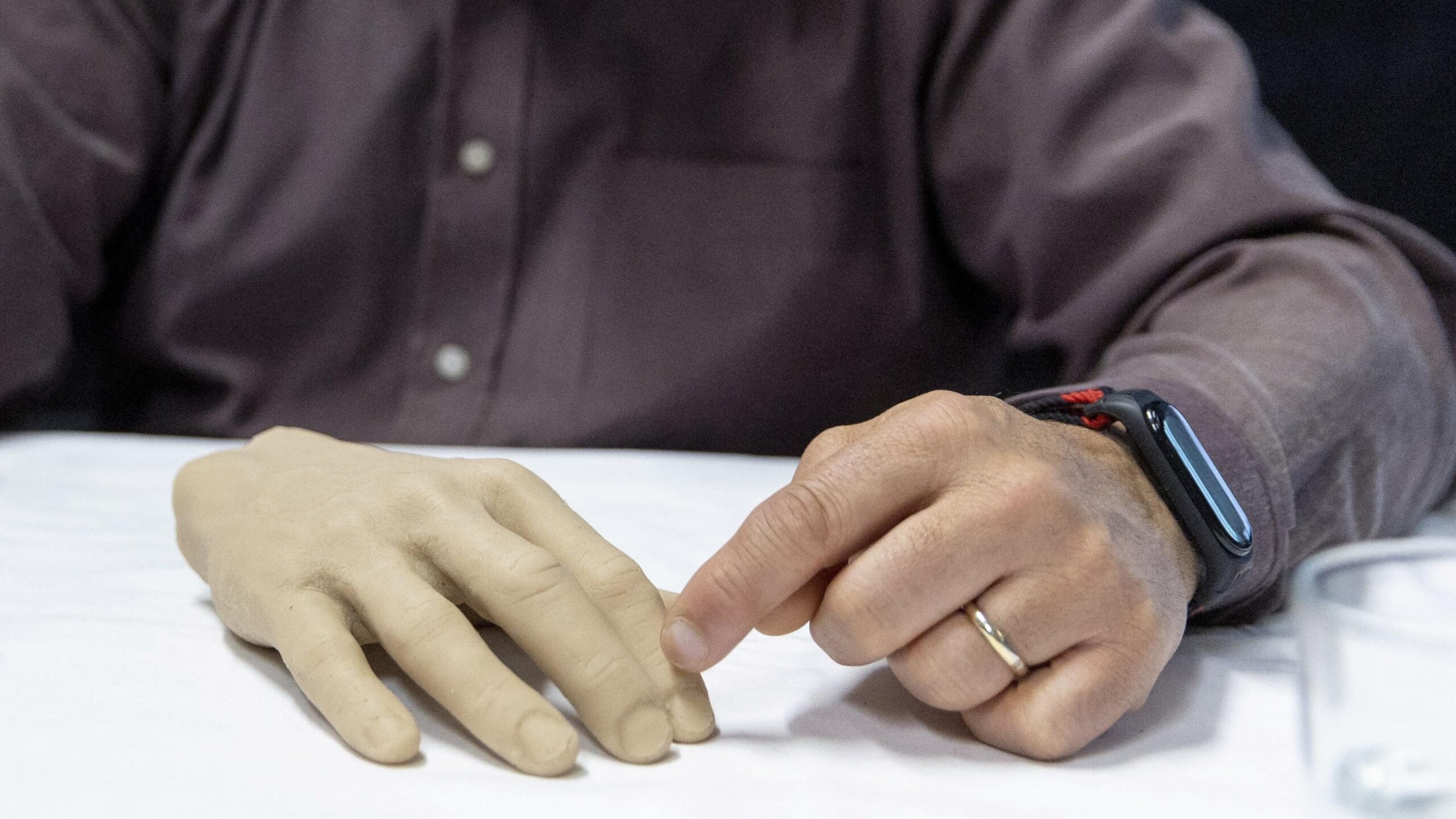
It may seem absurd, but a few seconds are enough to convince you that a rubber hand… is really part of your body. The experiment is based on a perceptual illusion and reveals how our brain can “rewrite” the perception of the body in real time. What we feel as “ours” is the result of a continuous work of integration between the senses.
The rubber hand illusion (in English rubber hand illusion) is a neuropsychological phenomenon that was first described in 1998 by researchers Matthew Botvinick and Jonathan Cohen. Their study has become one of the most famous in the world of cognitive neuroscience, because it demonstrated in a simple but very powerful way that the sense of possession of the body (body ownership) can be manipulated experimentally. Since then, the experiment has been replicated hundreds of times and is now a fundamental model for studying how the brain constructs the perception of the bodily self.
How the fake hand experiment works
The procedure it’s surprisingly simple:
- The participant places one hand on a table
- The real hand and arm are hidden from view
- A fake hand is placed in front of him
- A researcher touches simultaneously the real hand (hidden) and the rubber hand (visible)
After a few seconds (more or less 9.7 seconds) something surprising happens: the brain starts to attribute the fake hand to your body. After about ten minutes, this sensation becomes so strong and consolidated that it is enough to threaten the rubber hand with a pin, a knife or even a hammer, to evoke an automatic defensive response: the participant tenses, grimaces or instinctively withdraws his hand, as if it were really his own.
In recent years, numerous studies have tried to clarify what the necessary conditions for the onset of this illusion, while proposing different interpretations of the phenomenon. It has been observed that the illusion can emerge even in the absence of perfectly simultaneous stimulation between the real hand and the artificial one; however, it tends to weaken or disappear when they are stimulated asynchronously. A commonly accepted explanation is based on the idea that the brain tends to attribute a common cause to multisensory events occurring at the same time (principle of unity), while it considers those that occur at different times as separate. Consequently, if a touch on the real hand and one on the fake hand occur simultaneously, they come integrated as belonging to a single origin; on the contrary, if they are temporally misaligned, they are perceived as distinct.
A further relevant element concerns the role of visual information. The position of the artificial hand, clearly visible, is more precise and reliable than that of the hidden real hand, which is only accessible through less accurate proprioceptive signals. For this reason, the brain tends to attribute the tactile experience to the visually available location, favoring sight compared to the other senses (“I trust what I see more”).
It should be underlined, however, that if the illusion could be explained exclusively through the temporal correspondence between visual and tactile stimuli, it could be hypothesized that any object, if stimulated synchronously, is perceived as part of the body. However, this does not happen. Although the illusion can be induced with objects that vaguely resemble a hand, it fades when some are violated fundamental conditions: when the artificial hand comes oriented in an inconsistent way relative to the body (rotated by 90°); when the dimensions are unrealistic; when it is replaced with one opposite hand compared to the hidden one or, again, when a hand is used instead of the hand object without bodily featureslike a block of wood.
These results clearly indicate that the illusion does not only depend on immediate sensory integration, but is also constrained by bodily representations already present in the brain. In other words, the perceptual system does not indiscriminately accept any stimulus as part of the body, but evaluates it in light of internal models which define what is plausible as a “body”.
What happens in our brain according to neuroscience
At the basis of the illusion there is a very specific mechanism, multifactorial integration; the brain continually builds a representation of the body by combining visual information, tactile signals and proprioception (position of the limbs in space). When these signals are synchronized and coherent, the brain automatically integrates them. Furthermore, the perceptual filling-in (literally “perceptual completion”): Because the actual arm is hidden from view, the brain has no visual information about the connection between the body and the hand; to maintain a coherent perception – seeing a hand being touched and feeling the touch at the same time – tends to “fill” this lack constructing the most plausible solution, that is, that the visible hand is one’s own.
You see the fake hand being touched→ Listen your touch on the real hand → The times coincide perfectly → The brain resolves the conflict in the most “economical” way: he attributes the visible (fake) hand to his own body. It’s as if he thought “if I feel my real hand being touched, then the one I’m seeing in front of me must necessarily be mine!”.
Much simplifying neuroscientific processseveral studies have identified three areas involved in particular:
- Premotor cortex: integrates sight and touch;
- Parietal cortex (intraparietal): builds the map of the body;
- Island: contributes to internal perception and sense of self.
When this illusion works, these areas activate as if the fake hand were the real one. In practice the brain is deceived, which updates your body model in real time.
The rubber hand illusion is not just “a game”
Conducting this experiment and seeing how it works may actually seem like a lot of fun (and it actually is: it really works!); but it also has huge applications:
- Prosthetics: one of the most promising uses concerns advanced prosthetics. Many people with an artificial limb struggle to perceive it as part of their body. Studies based on rubber hand illusion I show that by synchronizing visual and tactile stimuli, it is possible to increase the sense of control, improve the precision of movements and bring out a true feeling of belonging. That is, it helps to make a prosthesis “feel” like part of your body.
- Virtual reality: the same principle is the basis of immersive virtual reality. In VR headsets, when the movements of the real body and those of the avatar are perfectly synchronized, the brain begins to perceive the virtual body as its own. This may have applications not only for the world of gamingbut also in motor rehabilitation and psychological therapies (e.g. specific phobias).
- Neurology: helps to better understand disorders such as phantom limb syndrome, depersonalization and somatoparaphrenia (patients who no longer recognize parts of their own body).
