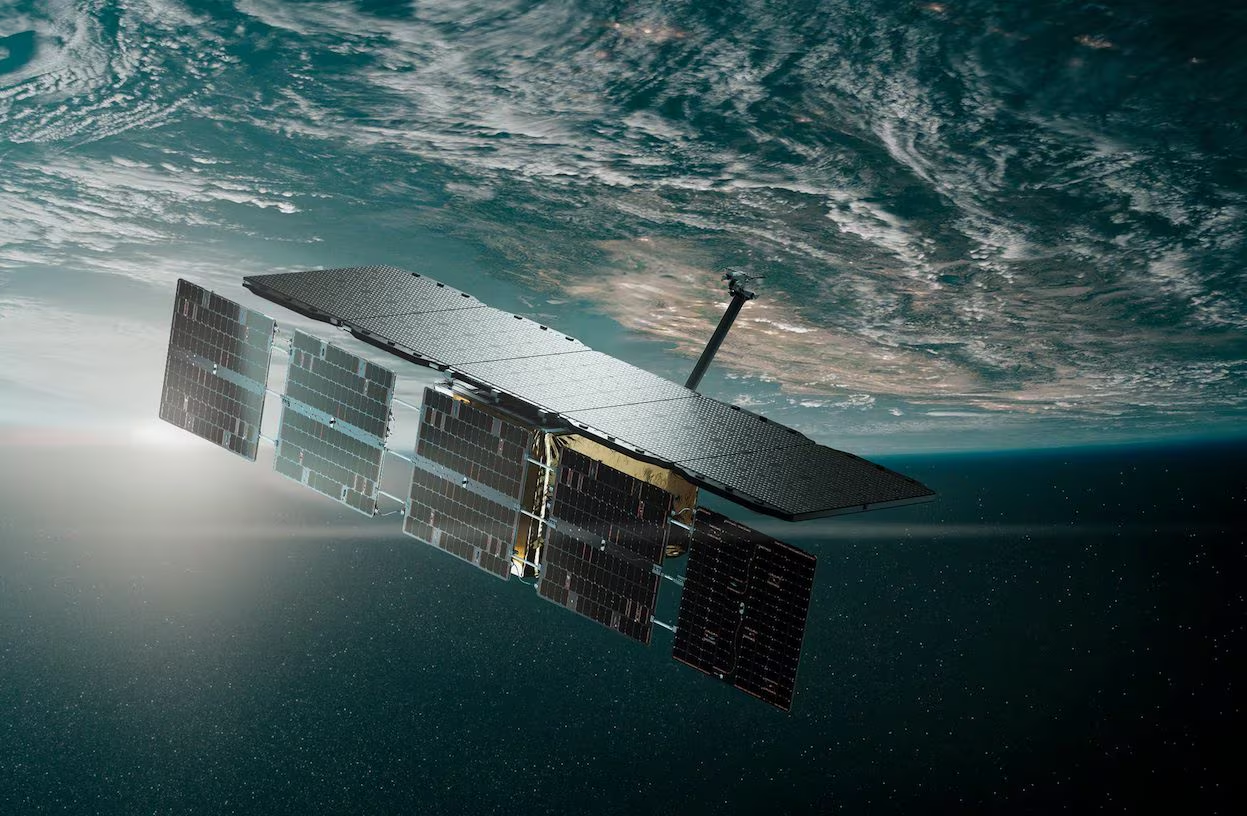
The Russian military satellite Kosmos 2612 intentionally approached the commercial satellite ICEYE-X36, registered in the US and used for radar images provided to Ukraine. The objective may have been to disturb the American satellite, forcing it to readjust its orbits and therefore consuming more fuel.
A Russian military satelliteThe Kosmos 2612performed a series of maneuvers to intentionally approach a satellite commercial registered in the United States, the ICEYE-X36operated by the Finnish company ICEYE and used to supply radar images high resolution to the Ukrainian army.
The two objects, which orbit the Earth at around 540 km altitude (and therefore in low Earth orbit), found themselves at an estimated distance of a few hundred meters (perhaps even less than 30 meters according to some sources).
According to experts, it would be the first case known of rendezvous (simplifying, the approach maneuver between two objects flying in space) between two active satellites in low orbit without the consent of either operator. The objective of this maneuver would have been to disturb the American satellite, forcing it to readjust its orbits, consuming Therefore more fuel and reducing its operational life.
The episode could therefore mark the beginning of a new phase in spatial confrontation between great powersjust weeks after the United States announced it would own weapons in orbit around the Earth to control space.
The approach maneuvers of the Russian satellites began months ago
To better understand what happened, we must first understand what the so-called are rendezvous and orbital proximity operations. In space, to approach another satellite, a vehicle must first move to the same orbital plane of its target and then adjust their speed to match it, so as not to overtake each other. These are extremely complex maneuvers and above all require great skill fuel consumptiona resource that is non-renewable for a satellite. Precisely for this reason, these operations are performed only in cases of extreme necessity.
As for the Russian satellite Kosmos 2612his launch it happened ad April 2026 along with 5 other military satellites, designated Kosmos 2609 to 2614.
Already in May this year, four of these satellites changed their orbits to align with that of the ICEYE-X36as confirmed by a report from the British defense research center, the Royal United Services Institute (RUSI). The US Space Force reported at the time that Kosmos 2610, 2611, 2612 and 2613 had get close to a spacecraft westernwithout however specifying what it was.
On October 15th, then, the distance between Kosmos 2612 And ICEYE-X36 it started to shrink, passing from 350 km to 5 km less than 24 hours. According to LeoLabs, a company specializing in space traffic monitoring, the Russian satellite continued to move around ICEYE-X36, alternating positions front and back the commercial satellite, making small adjustments to maintain proximity without resulting in a direct impact. According to LeoLabs estimates, the two objects would have been within 500 meters of each other, but other orbital tracking sources have indicated that the minimum distance it might have been even lower.
Last Monday, October 19, Kosmos 2612 finally started moving away: moving away from ICEYE-X36among other things, occurred a few days after the US president’s decision to suspend some economic sanctions against Russia.
Why is the episode of the approach into space so important
At the moment, the motivations behind this rapprochement they are not clear: the type of instrumentation aboard Kosmos 2612 it was not revealed and, consequently, it is difficult to know with certainty the operations carried out by the satellite before moving away.
In general, during an orbital proximity operation an aggressor satellite can photograph the target, jam its communications, jam its sensors, or even physically push it out of its orbit.
Also according to LeoLabs, the capabilities demonstrated by the Kosmos 2612 could include the gathering intelligence informationin-orbit inspection, interference with target satellite systems, or preparation for future anti-satellite operations. In short, it does not seem to be a coincidence that ICEYE-X36 provides the Ukrainian army with high-resolution radar images, which allow it to observe the terrain even at night and through clouds.
THE risksin case of collisionthey are quite tall: in the event of an impact between two or more satellites, i debris products could end up hit other satellitesin turn causing new debris and triggering a uncontrollable chain reactionwith the danger of making space activities inaccessible in the future.
The episode, however, fits into a broader framework of spatial dynamics. As mentioned, a few weeks before the approach, the United States they had admitted publicly for the first time have “space control” weapons already deployed in orbit. In 2024, China conducted coordinated orbital proximity operations between its satellites, while with Kosmos 2612 Russia demonstrated that it has the ability to approach a satellite with extreme precision, especially in a short time.
From the point of view of international lawHowever, there is an important regulatory gap: the 1967 Outer Space Treaty bans weapons of mass destruction in orbit, but does not directly prohibit conventional weapons, nor maneuvers like the one carried out by Russia.
