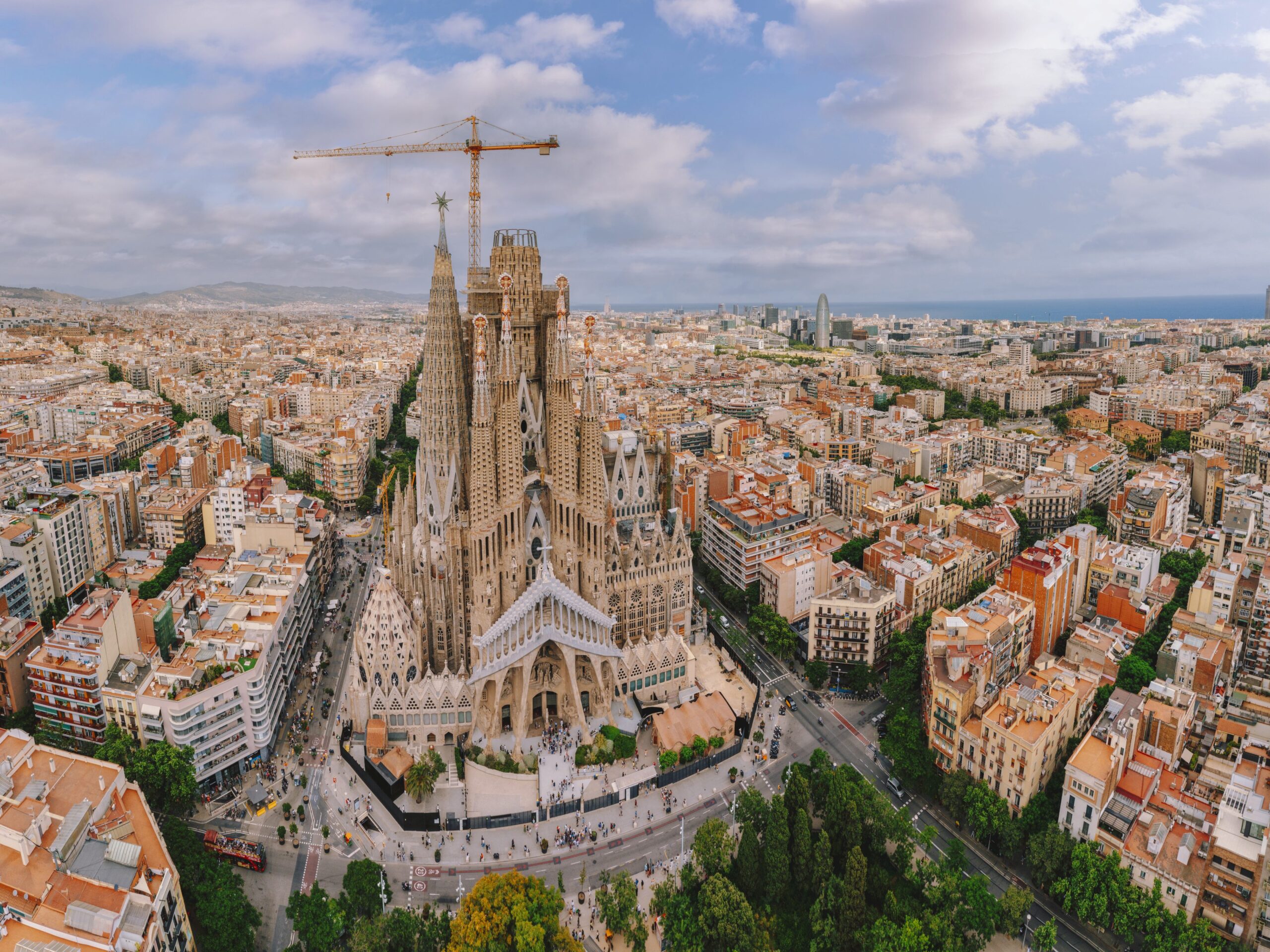
La Sagrada Familia has officially reached its mark definitive maximum heightequal to 172.5 meterswith the installation of the monumental cross that crowns the highest of its towers. An epochal achievement that consecrates the unfinished work of the Catalan architect Antoni Gaudí as the tallest church in the worldin conjunction with the centenary of his death. Precisely on the occasion of this anniversary, which falls on 10 June 2026, the central tower (dedicated to Jesus Christ) will be officially inaugurated. In the meantime, work will continue to close the construction site, with the completion of the basilica expected no earlier than 2035.
History and architecture of the Sagrada Familia
The original project, entrusted to the architect in 1882 Francisco de Paula del Villarconceived the neo-Gothic church as a traditional work. Antoni Gaudí took over shortly thereafter and, at the age of 31, he radically transformed the approach, dedicating 43 years old of his life on the project. When he died in 1926, only part of the work had been completed. During the Spanish Civil Wararson attacks destroyed models, plaster casts and key project documents, an event that slowed down the work and required an enormous reconstruction effort on the part of the architect’s collaborators.
There Sagrada Familia marks, from an engineering point of view, an epochal turning point: it demonstrated in fact that it was possible to build a masonry building of great height without massive lateral buttressesand instead resorting to static solutions of greater complexity and innovation, such as the use of arches and the equally famous catenary curves. Also noteworthy are the internal columns whose articulated natural inspired geometry it is the result of a synthesis between artistic research and structural logic. Made according to a helical configuration, with transition from the polygonal to the circular section, these yes they branch at the top transforming the space into a “stone forest”, capable of supporting the structure of the basilica with extraordinary static efficiency.
The restoration interventions
Today the Sagrada Familia is also a place of coexistence between what was built from scratch and what concerns the conservative restoration of the older partsexposed to the elements for over a century. Precisely for this reason, and in the face of such extended construction times, the supply of materials – in particular of original stone coming from the Montjuïc hill in Barcelona – has until now represented a significant challenge, given the growing difficulty of finding this specific type of material locally. To this end, it was necessary to find blocks of stone with physical and chromatic characteristics such as to guarantee the same structural resistance and consistent color rendering with what has already been achieved.
The complex geometry imagined by Gaudí required the adoption of by the works management contemporary technologies with extremely high yield and production levelcertainly including the use of BIM-type modeling criteria, but also the use of aeronautical design software and parametric CAD-CAM systems to translate organic shapes into calculable and realizable modules while minimizing errors: thus making both the design phase (CAD systems) and the production phase (CAM systems) interact simultaneously.
The new height record
The pinnacle of Tower of Jesus Christwith his 172.5 metersofficially marks the fulfillment of Gaudí’s architectural challenge. Curiously, the architect chose to keep the height of the building slightly lower than the 173 meters of Montjuïc hillthe famous hill in Barcelona, as a symbolic gesture of respect towards nature.
The monumental four-armed cross which now crowns the tower is approximately 17 meters high and 13.5 meters wide and was built with an internal structure in stainless steel and precast concretecovered in glass and white glazed ceramic. These materials were not chosen only for their resistance to atmospheric agents at high altitude, but for their ability to reflect sunlight during the day and radiate artificial light at night, transforming the peak into a beacon visible from the whole city. The prefabricated components were lifted and assembled on an intermediate level of the construction site, 54 meters from the ground, to then be assembled at the level of the 160 metersthrough one of the most complex construction site logistics operations ever carried out in a densely populated urban centre.
Now efforts will focus on the last phase, which involves the construction of the majestic Facade of Glory and the completion of large monumental staircase access on Carrer de Mallorca. The conclusion of the works is currently scheduled for 2035a year that will mark the official completion of one of the most extraordinary construction sites in modern history.
