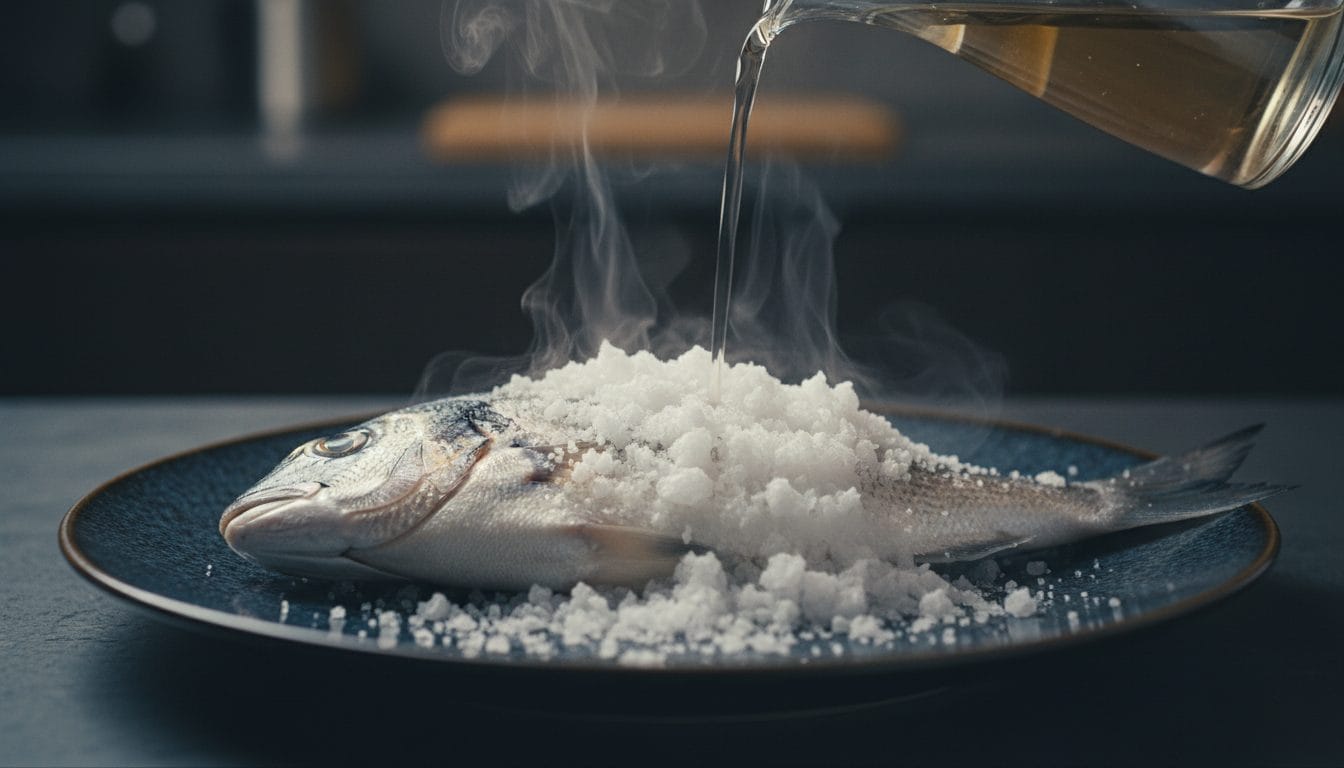
The Salt Aliveor Sal Vivais a technique invented by the Spanish chef Ángel León which consists of using a mixture of water and sodium acetate to cook fish and shellfish without using stoves, ovens or fryers. His method, on stage during the Skill Test in the 20th episode of MasterChef Italia 15, is based on the exothermic reaction ofsodium acetate – a salt obtained from the neutralization of acetic acid from vinegar with a sodium-containing base (such as sodium bicarbonate) – which, in contact with the food, crystallizes, releasing heat and allowing slow cooking a low temperature (approximately 60 °C). This is the same reaction that occurs in hand warmers gel which are activated with a click of the metal plate.
Sodium acetate is widely used in the food industry with code E262i as a preservative, flavor improver and pH regulator. It is considered safe byEFSA – European Food Safety Authority – without a specific maximum daily dose.
In his three Michelin star restaurant Aponient in El Puerto de Santa María (Cadiz), awarded the Michelin Green Star for sustainability, the “Chef of the Sea” revolutionizes cuisine using new marine ingredients. Among these stand out the phytoplanktonthe Zostera marina (an aquatic cereal similar to rice) and the bioluminescenceused to create surprising light effects directly on the plate.
How to cook with Living Salt: crystallization
The process designed by Ángel Leónthe “chef of the sea”, is divided into three moments as shown in the video below:
- Preparation of the solution: bring the water (or a flavored liquid) to the boil and add the “living salt” stirring until it is completely dissolved.
- Cooling phase: the liquid must be poured into a smooth container (glass or steel) and left to cool without moving it or touch it until reaching a temperature below 20°C (ideally 5°C). Any abrupt movement at this stage could trigger the reaction too soon.
- Activation and cooking: pouring the cold liquid on the food, the shock triggers a immediate crystallization. This reaction (called exothermic) releases energy in the form of heatbringing the temperature to 60°C. It is a spectacular method that allows delicate and immediate cooking directly on the plate, but requires the use of eye and hand protection given the risk of hot splashes.
Once crystallized, the fish for example, is covered with a salt “crust”. which, as recommended by the usage protocol, should not be touched for at least 30 minutes after pouring.
The solution for cooking with Living Salt from León can be purchased on special sites and allows you to try this innovative gastronomic technique even at home by providing all the necessary information on the procedure precisely.
How the exothermic reaction of sodium acetate works by chef Ángel León
A starred chef who cooks fish and shellfish with the same principle with which we warm our hands in winter with portable gels.
The solution used to make Salve Vivo is nothing more than water and sodium acetate (a salt that can also be obtained at home by combining vinegar And bicarbonate). The chemical mechanism focuses on the difference of solubility: boiling water (100 °C) can dissolve a lot of sodium acetate, while cold water (from 20 °C and below) much less.
If you melt the salt while hot and let the solution cool without moving it, it remains liquid even at room temperature. It is, in technical terms, one supersaturated solutionan unstable condition in which molecules are ready to crystallize at any moment, but are just waiting for a “spark” to break the equilibrium.
In the case of hand warmers it is the click of the metal foil that allows the transition from liquid to solid, releasing energy in the form of heat. While in chef Leon’s Live Salt technique the spark is given by the mechanical action of the pouring and, above all, by the contact with the surface of the food, which offers thousands of microscopic nucleation centers on which crystals can grow instantly.
If we take as a reference the toxicity data present in scientific literature on mice (4,960 mg/kg), the safety margin on the use of sodium acetate in cooking is very wide. Doing the proportions on an adult man of 70kgthe theoretical dangerous dose would be at well 347 grams of pure sodium acetate. We’re talking about over three ounces of salt to ingest in one go. In the “Living Salt” method, the acetate only acts as an external “thermal shell” and is not ingested, the minimum quantity that could permeate into the fish is negligible compared to the food safety threshold.
