
Raise your hand if you don’t find the noise slightly annoying adhesive tape for parcels when we detach it – precisely – from a package, or from its own roll. It is a familiar noise that, however, for many years, physicists have not been able to explain. Well, a new study just published in the journal Physical Review E seems to have solved the mystery, and the result is rather surprising: the detachment of the tape is so rapid that it generates a large number of tiny supersonic shock waves. In short, the screeching noise of the adhesive tape would in all respects be a sonic boom train conceptually not very different from those produced by aircraft that break the sound barrier!
When we remove the adhesive tape, it does not slip away continuously, but through a series of very close “cracks” very close together in time, in a mechanism called stick-slip: first a microscopic portion of the tape comes off (about 0.2 millimeters), then it slides for about half a millisecond, then the cycle starts again. It is a mechanism that we also find in the propagation of earthquakes along faults, and researchers already knew that it also happens in adhesive tape. What they wanted to find out is the physical mechanism which physically produces the characteristic noise.
So they filmed in great detail the detachment of an adhesive tape from a glass plate, and to do so they used two cameras capable of recording well 2 million frames per second and two high-precision microphones on both sides of the adhesive tape, to understand how the “cracks” propagate in the adhesive tape and how their dynamics are linked to the noise produced. You can see at the top of this article a snippet of the footage produced, in which you can clearly see the stick-slip mechanism in action.
What the researchers discovered is that, during the sliding phase (briefs), the tiny “cracks” in the tape move transversely from one side of the tape to the other, as indicated by the red arrow in the image below.
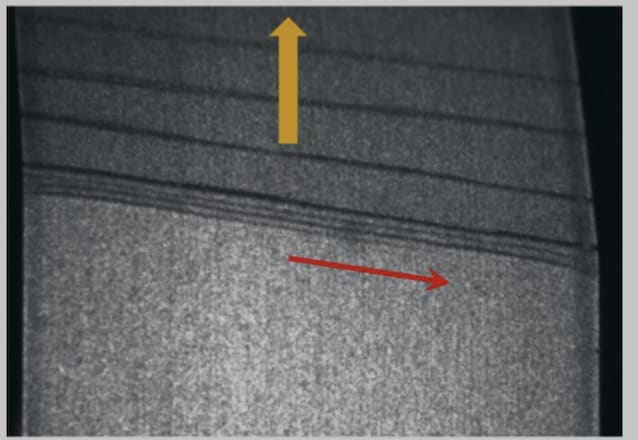
The interesting thing about these cracks is the speed with which they propagate, which can even reach 600 meters per second. This means that when the tape lifts, a very small gap is created empty of air which travels along the crack faster than the surrounding air can fill it. When it reaches the end of the ribbon, the mini-vacuum finally “collapses”, producing very fast shock waves. The researchers measured a speed of well 355 meters per secondi.e. 1278 km/h: it is 4% more than the speed of sound!
In short, when we tear off some duct tape the noise we hear is one very rapid succession of many very short sonic booms produced by the supersonic implosion of tiny air voids. Who would have thought that a simple gesture like tearing off duct tape could produce such extreme conditions?
