
2025 ends with a series of astronomical events not to be missed. It starts on December 5, 2025 with the third of three consecutive “supermoons”, renamed “cold supermoon”. It will be the 7.9% larger and the 15% brighter of a normal Full Moon. We continue with one of the most copious meteor showers of the year, that of Geminidswhich this year will peak on December 13th with more than 120 meteors visible per hour. December 19th is the turn of the much talked about comet 3I/ATLASthe third interstellar visitor observed in the Solar System, which that day will reach its minimum distance from Earth of 269 million km. It closes winter solstice which this year falls on December 21st at 4.04pm.
The celestial appointments of December 2025
The Geminid meteor shower is arriving
December is the month of one of the most abundant meteor showers of the year. We are talking about the meteor shower of Geminids which as the name suggests has the radiant (celestial direction from which the meteors appear to come) in the constellation Gemini. This is a very spectacular meteor shower, not only for the high number of meteors, but also for the multiplicity of colors with which they shine when they disintegrate in the atmosphere, the result of the different chemical composition of space rocks. This year the Geminids will be active from 1st to 21st Decemberreaching the peak on December 13th when it will be possible to sight more than 120 meteors per hour. The best time to place the radiant is around 1 ambut the time slot in which the show will be widely enjoyable goes from 9pm to 5am. Recall that the Geminids are the only major meteor shower that is not generated by a comet, but by the asteroid 3200 Phaethona “rock” 6 km in diameter with an orbit with a short period of 1.4 years.
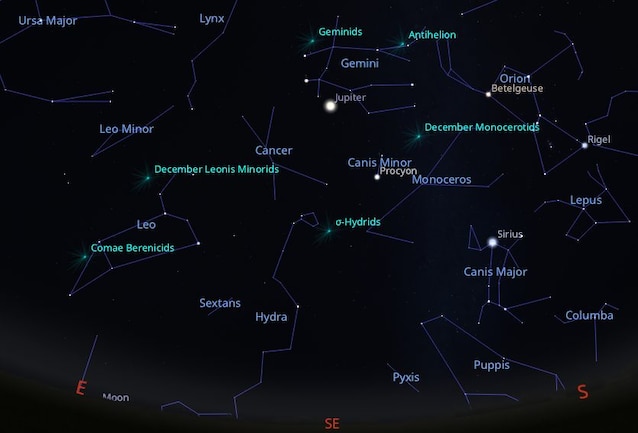
However, the Geminids are not the only swarm of the month. We also have the meteor shower of Ursids having the dial in Ursa Minor. This shower is active from December 17 to 26 with a rate of meteors at the peak on December 22 of about 10 per hour. Then we also have the sigma Hydridsthe Monocerotids and the Coma Berenicidswith radiants in the constellations of the same name, and peaks the 7, 10 and 19 Decemberalbeit with meteor rates below 10 per hour.
The last Supermoon of the year
The December 5th at 0:14 we will have the last of three consecutive “supermoons” in 2025. The “supermoon” of December, renamed “cold supermoon” named after December’s full Moon, it will be only slightly less spectacular than November’s “supermoon,” which was the brightest of the year. In fact, if in November the full moon phase occurred when the Earth-Moon distance was 356,978 km, in December this distance will be 357,218 km, less than 0.1% difference. This will cause the “cold supermoon” to be the 7.9% larger and 15% brighter of a normal Full Moon. At the moment of the fullness phase, 00:14 Italian time, the Moon will be in the constellation of Taurus.
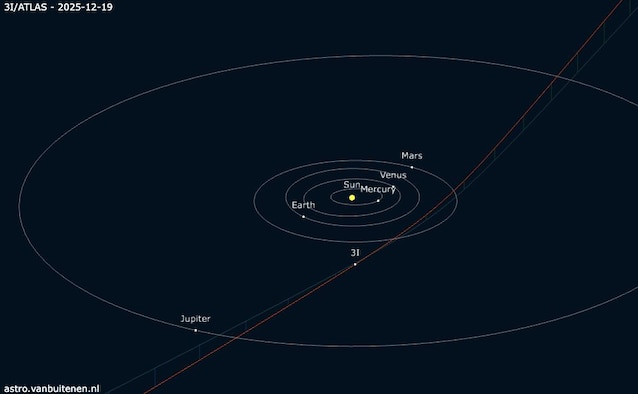
The third interstellar visitor ever discovered by humanity, the comet 3I/ATLASwill reach the minimum distance from our planet on December 19th. On that date, 3I/ATLAS will be at 269 million km from Earth between the orbit of Mars and Jupiter, shining with a magnitude equal to 12.9 which therefore requires the use of telescopes and long exposures to be immortalized. After this encounter, the comet will continue its crazy race in the Solar System towards Jupiter and then definitively exit our star system and get lost in the abyss of interstellar space.
The conjunctions of the month between the moon and the planets
Also this month the Moon will be the protagonist of some “close encounters” with brilliant celestial objects. We leave on December 4th with an almost full Moon that will only be distant 0°48′ at 3:54 from the star cluster of Pleiades. We then continue December 7 when an 89% illuminated Moon comes to be angularly very close to the planet Jupiter which shines at magnitude -2.6. There conjunction between the two objects (minimum distance on the same right ascension) will occur at 4.48pm at an angular distance of 3°42′while the maximum approach you will have at 5.51pm to 3°37′. The December 27th it is the turn of the planet Saturn which will have the maximum approach at 01:42 to 3°34′while the conjunction will occur at 04:24 to 4°00′with a Moon illuminated at only 31%. The last day of the month, the December 31stit is once again the time of the Pleiades to be angularly very close to the Moon, 0°54′ at 2.21pm. Although all of these phenomena are visible to the naked eye, the show is at its best with binoculars or a wide-field telescope.
Winter Solstice 2025, when it falls
We close the roundup of astronomical events of the month with winter solstice 2025 which marks the transition from the autumn to the winter season in the Northern Hemisphere. This year the solstice will fall on December 21st at 4.04pmmarking the day with the longest night of the year.
