
Even October 2025 will offer several astronomical shows to be observed in our skies. Protagonists of the month will be the comets C/2025 A6 (Lemmon) And C/2025 R2 (SWAN)visible throughout October little below the visibility threshold to the naked eye, which will reach the slightest distance from the earth respectively on 21 and 20 October. C/2025 A6 (Lemmon), in particular, has a good chance of becoming visible to the naked eye in the days close to that of the maximum approach. But there will be not only comets in October: in fact we will also have the peak of the meteor swarm of the Orionidswhich will take place in conjunction with the maximum approach of the comets, the first “Superluna” of 2025, renamed “Superluna del Cacciatore”, and a series of spectacular conjunctions between the Moon and the planets of the Solar System.
The celestial nominations of October
Comete c/2025 A6 and C/2025 R2 at the maximum approach
October will definitely be the month of comets with C/2025 A6 (Lemmon) And C/2025 R2 (SWAN) to make it the master. In fact, both will reach the slightest distance from the earth in this month, on 20 October c/2025 R2 (Swan) and on October 21 c/2025 A6 (Lemmon).
The latter is configured to be extremely promising with the latest estimates that speak of a magnitude equal to approximately 3,1 at the most approach of 21 Octobertherefore visible to the naked eye in a fairly dark sky. On the day of the maximum approach, the comet c/2025 A6 (Lemmon) will be visible for about three hours after the sunset of the sun in the west/north-west direction. The comet stands again around 6 in the morning in the north-east direction, about an hour before dawn. Over the month, the comet will be visible both shortly after sunset and before dawn. At the beginning of the month, the visibility after the sunset will be practically nothing, but going to increase up to three hours to the end of the month. The visibility before dawn, on the contrary, will be decreasing over the month. At the beginning of October, in fact, the comet will arise around one in the night, while at the end of the month the rising on the north-east horizon will always be closer to dawn, until 26-27 when the two events will practically coincide.
As for the comet C/2025 R2 (SWAN)Although Perdielio took place on September 12, the comet still seems to increase in brightness with the estimate of magnitude at the time of writing this article equal to 6.6therefore not visible to the naked eye but easily identifiable with binoculars. Despite the growth in brightness of the last few days, estimates do not provide that the swan becomes visible to the naked eye, with a expected magnitude of 7.2 at the time of the maximum approach to the land of 20 October. At the beginning of October, the Swan will be visible in the south-west direction for about an hour and a half after the sunset of the sun. Over the month, this visibility window will increase until it is 5 hours at most approaching October 20, and 7 hours at the end of October. For both comets we recommend that you have a good binocularseven better a small telescopeand to go to adequately dark skies.
The meteoric shamans of the draconid and Orionids are coming
In October there will be two meteoric shamans to illuminate the autumn nights, the Draconid and the Orionids.
Draconids are active in early October, between 6 and 10, with peak scheduled for October 8thwhen up to 5 meteors per hour can be visible. Draconids are generated by the passage of the Earth through the debris left by the periodic comet 21p/Jacobini-Zinner And they owe their name to the radiant from which the meteors that is found in the constellation of the dragon seem to come. The latter, from our latitudes, is a circuit constellation (i.e. that always remains above the horizon), without ever setting. This implies that the meteors can be sighted all night.
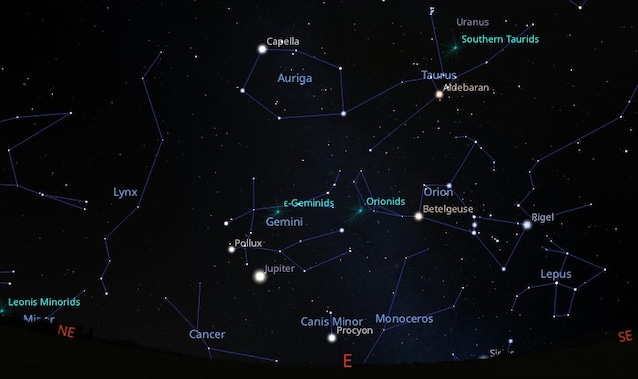
The Orionidson the other hand, they take their name from the radiant in the constellation of Orion. It is an active weather swarm for the whole month of October, which reaches the peak of weather around the 20-23 Octoberin conjunction with the maximum approach to the land of the comets c/2025 A6 and C/2025 R2. The origin of the swarm is the same as that of the Eta Aquarids, or the passage of the earth in the debris left by the wake of Halley’s comet. The number of peak meteors varies from 20 in the boreal hemisphere to 50 in the southern one. In the days of the peak of the meteor sciame, the constellation of Orion will rise around 11 pm, so to fully enjoy the show, you will have to wait at least one in the morning.
The first “superluna” of the year
After the boss of “Superlune” of 2024, this year we had to wait until October to attend a Superluna. It is the so -called “Superluna of the hunter” Of Tuesday 7 October 2025. We remind you that “Superluna” is a journalistic term, non -astronomical, which refers to one Full moon at Perigeothat is, the point of maximum approach to the earth. A “superluna” is therefore a full moon that appears slightly larger and brighter than a typical full moon. This year the full moon phase will take place on October 7 at 05:47 when the moon will be about 362,000 km from the earth.
Conjunctions between moon and planets
Also this month the moon will make the protagonist of a series of spectacular “close encounters” with the planets of the Solar System and beyond. The objects will present themselves angularly very close to each other – we are talking about a handful of degrees – thus allowing to identify the moon and the object in the same view if observed with binoculars or a small telescope.
It starts the 6 October with the conjunction between the moon, almost full, and the planet Saturn. The two celestial bodies will reach the maximum approach at 2:30, when they find themselves at a corner distance of just over 3rd in a south-west direction, about 30 ° on the horizon.
Continue with the conjunction between the moon and the star cluster of the Pleiadi in the constellation of the bull. The maximum approach will take place the October 10th At 5 in the morning, when an 88%illuminated moon, very high on the horizon, will find itself less than half a degree from the Pleiades, again in a south-west direction.
The two subsequent conjunctions will have with the planets Jupiter The October 14th And Venus The October 19th. In the first case, the maximum approach will have at 1: 49 at an angular distance of about 4th (East Directorate), while in the second case the maximum approach is at 20:26 to just over 3rd. On October 19, being the moon in the falling phase, illuminated at 3%, it will set shortly before the sun, so the maximum approach with Venus will not actually be visible.
The 23 October Finally, we will have the conjunction between the moon, growing at 4%, and the planet Mercury. The maximum approach to just over 2nd is scheduled for 5pm. For that hour, however, the sun has not yet set, so you will have to wait for the sunset (shortly after 6 pm) to observe a very thin lunar sickle, very low on the south-west horizon, accompanied by Mercury just above. On 29 October Mercury will also reach the maximum East Elongation, that is, the maximum angular distance from the sun.
