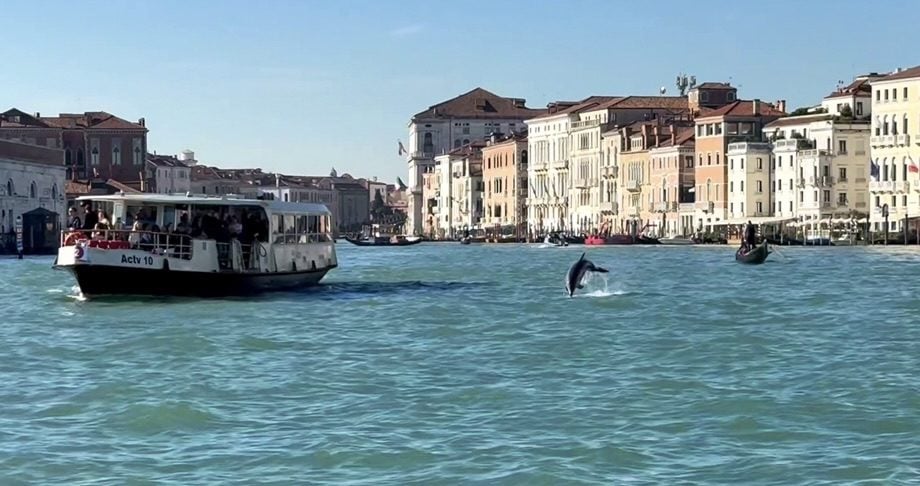
Walking through Piazza San Marco in Venice it is possible to admire the Basilica with its famous Lion, the Doge’s Palace, the Clock Tower and, looking towards the water… the dolphin Mimmo. This is the nickname – along with “Nane” – that was given to a solitary specimen of bottlenose dolphin (Tursiops truncatus) who decided to settle in Venice lagoon starting from June 2025. With his 2 meters longthe young male was spotted for the first time in the waters of Chioggia, and then moved to the northernmost area of the lagoon, driven by the great abundance of food with optimal salinity and temperatures. Since the first report, the cetacean has been carefully monitored to safeguard its health.
As fascinating as the presence of a wild animal in the waters of the San Marco Basin is, this event must not turn into a simple “pastime” for tourists. The risks associated with the squeeze human-dolphin coexistence in fact they are many. For this reason, researchers from the Cetacean Strandings Emergency Response Team (CERT) of the University of Padua and the Natural History Museum of Venice have drawn up a list of fundamental rules and advice to avoid disturbing “the dolphin of Venice”, allowing it to find its ideal habitat in these busy waters. Led by the veterinary pathologist of the University of Padua Guido Pietroluongothe team of scientists also published an article in the scientific journal Frontiers in Ethologyin which the movements, attempts at removal and the concrete dangers that threaten the specimen on a daily basis were analysed.
Because protecting Mimmo is difficult: the attempts to remove him and the human threat
Historically, the northern Adriatic Sea and the Venice lagoon itself hosted abundant populations of two species: the common dolphin (Delphinus delphis) and the bottlenose dolphin (Tursiops truncatus). Unfortunately, due to mass massacres, the Mediterranean populations have been decimated. As a result, the common dolphin almost completely disappeared from the Adriatic between the 1980s and 1990s and has never recovered. Unlike the common dolphin, the bottlenose dolphin has managed to survive in this increasingly degraded environment. It is in fact a species very resilient and opportunisticwhose survival was probably aided by fewer predators (such as sharks) and less competition for food. This species, which usually lives in schools of up to 15 individuals, often inhabits coastal areas and feeds mainly on fish and cephalopods. It is a species present in the Mediterranean that populates the coasts of Sicily with numerous sightings on the Aeolian Islands, Lampedusa and in the Strait of Messina.
To protect Mimmo from the dangers of Venetian traffic, the experts evaluated some intervention options, however reaching the conclusion that the problem to be managed is not so much the dolphin, but the human being and the education of people. The forced removal options they were in fact discarded for very specific reasons: the risks linked to a possible transfer and the ineffectiveness of the methods used.
The idea of capturing Mimmo to physically transport him to the open sea was rejected because it was too dangerous. The psychophysical stress of the capture could have triggered the so-called capture myopathya life-threatening syndrome that causes shock and muscle damage. Even attempts to push him away in a “soft” way using gods acoustic deterrents they failed. The cetacean simply moved away for a short period and then returned to the San Marco Basin.
The CERT video below explains how the animal is monitored.
The dolphin is a precious guest in our lagoon. Observing it is a privilege, protecting it is a duty!
The rules for living respectfully with the bottlenose dolphin in the lagoon
CERT has drawn up a list of fundamental rules to protect this specimen, belonging to a species already rigorously protected by national and international regulations that citizens and authorities are required to respect. Since its presence in the San Marco Basin attracts tourists and mediaunfortunately several violations of the code of conduct have been reported by people trying to attract the dolphin’s attention, for example by organizing guided tours, attempting to touch it or getting too close to take photos.
Here are the rules to follow in case of sighting:
- Keep a safe distance of at least 50 metres.
- Respect speed limits and avoid accelerating, abruptly changing direction or shifting into reverse. Mimmo, unfortunately, already shows lesions on his dorsal fin most likely due to accidental contact with a propeller.
- Do not offer food or throw objects into the sea: feeding a wild animal, be it a pigeon or a cetacean, is prohibited by law.
- Don’t attract the dolphin’s attention shouting, making noises or banging objects against the hull of the boat.
- Don’t come closer and do not attempt any type of physical contact or direct interaction.
All these anthropogenic activities risk altering the natural behavior of the bottlenose dolphin, disturbing its rest and its hunting trips, as well as interfering with its delicate echolocation systems.
