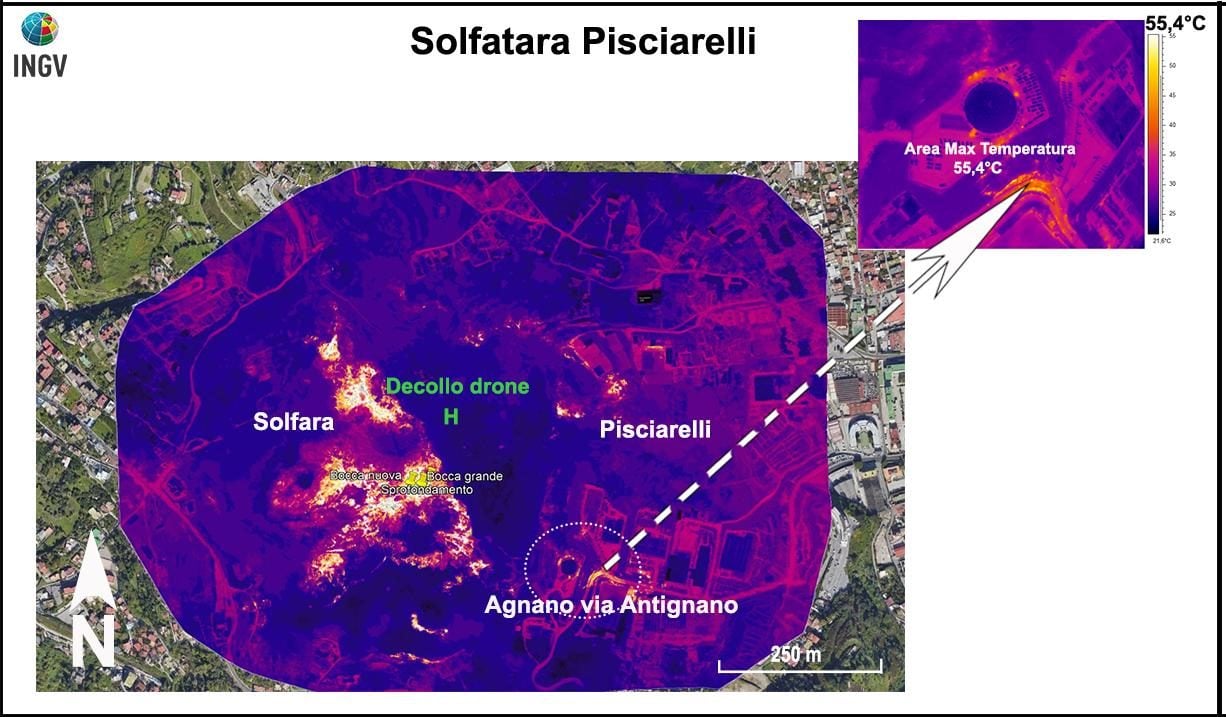
To the Campi Flegreialong the road that runs alongside the Solfatara of Pozzuoli (in via Antiniana), the light -like swellings similar to bubbles were reported: the researchers of the Vesuvian Observatory of the Ingv immediately intervened on the site, which did not highlight “significant temperature increases in the verified area”. We interviewed the doctor Lucia Pappalardodirector ofVesuvian Observatoryto understand the meaning of these results and clarify the dynamics in progress in the Flegrea area.
Dr. Pappalardo, could explain to us what are the results of the analyzes carried out in via Antiniana, in Pozzuoli?
In via Antiniana, near the smoky area, we carried out extraordinary control, as part of periodic monitoring. The thermal reliefs performed do not highlight significant variations in the temperature compared to the usual values of the area. The identification of the causes of the instability of the road surface (for example sagging, laying defects or recent remakes), however, does not fall within our skills: in light of the available data, Fumarolic activity does not appear to be the cause of the swelling of the asphaltor at least not the main cause.
What tools did you use for this monitoring?
As indicated in the information note, the relief was performed with an integrated set of tools: Drones equipped with thermalbenters, mobile cameras And thermometric probes, placed directly in correspondence with the flues. Following the reports received, a dedicated monitoring was carried out within a day, in addition to the periodic checks to which the area is regularly subjected.
Staying on the theme of monitoring, what and how many tools are at your disposal to keep the Flegrei field area under control?
The number and type of tools used depend on the characteristics of the area, the ongoing phenomenon and the extension of the volcano. The Flegrei camps are among the Volcanic areas most monitored in the world: we check several parameters, starting from seismicitythrough an integrated network of terrestrial and marine sensors. They are currently operational 27 fixed stationsto which are added 7 stations of the mobile network, unfolded at different points based on the information needs of the period.

We also have ansubmarine infrastructure consisting of 4 buoysa unique monitoring system of its kind and essential because part of the Caldera Flegrea extends to the bay of Pozzuoli: this allows the continuous control of the marine area. Before this infrastructure, for example, it was not clear if the seabed was also lifting; Today we know that the Caldera moves in unisonin the portion that emerged and in the submerged one.
For the deformation of the soil we use the most advanced techniques, including the satellite observationswith a network of 40 stations distributed on the ground and at sea. These are accompanied by the network of tiltmetersconsisting of 10 stations and dilatometers. In different areas of the caldera we also use drones and thermolets and gravity measures.
Finally, for the Geochimic monitoringwe constantly keep the hydrothermal areas under control, both marine and terrestrial, such as the area Solfatara -Pisciarellione of the most important hydrothermal areas of the Flegrei camps, continuously verifying both the temperatures of the fumaroles and the composition of the gases.
So, based on all data at your disposal, can you exclude risks for the residents of the area?
As for the episode that took place on the Pozzuoli road, at the moment Risk elements do not emerge attributable to variations of the fumarolic field present in that area: the reliefs have not highlighted significant changes.
However, the bradisismic crisis to the Campi Flegrei, with a lifting of the order of ~ 15 mm/month. Our task is to maintain continuous and integrated monitoring to follow the evolution of the phenomenon on the basis of the data gradually acquired. Long -term forecasts are not possible; However, at present, There is no evidence of magmatic movements in depth And there is no eruption in the short-medium period. At the moment, the system has been evolving with characteristics similar to those observed in recent months: deformation of the soil, seismicity and dejection on levels consistent with the implementation phase.
