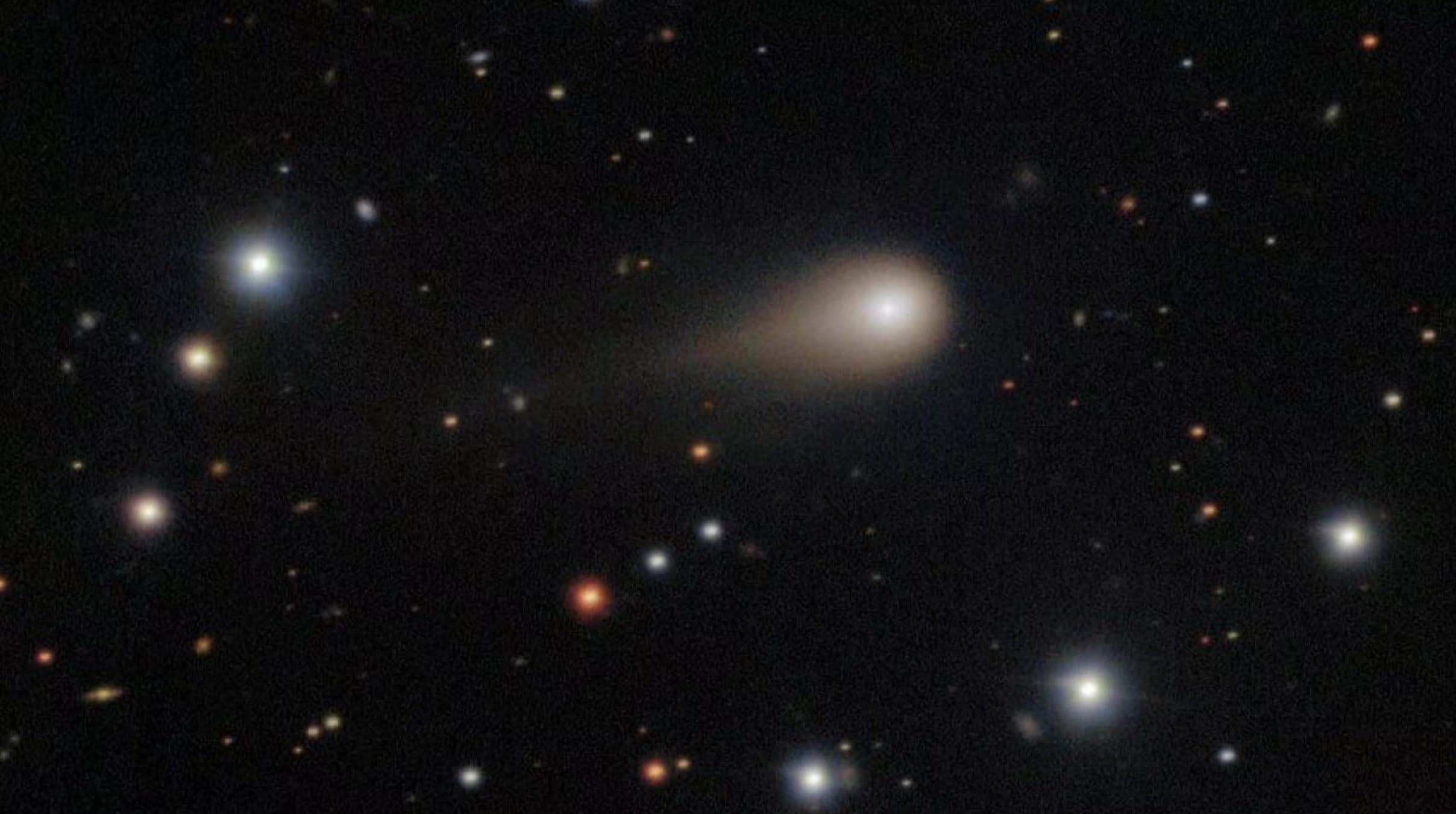
The tone of the debate around the comet 3I/ATLASthe third interstellar object discovered transiting the Solar System. NASA’s November 19 release of images of the comet at a press conference was highly anticipated after all the theories on the possible artificial nature of the comet promoted by the Harvard astrophysicist Avi Loeb. The American space agency, aware of this, addressed the issue directly with an explicit statement from the associate administrator Amit Kshatriya:
This object is a comet. It looks and behaves like a comet, all evidence indicates that it is.
In short, NASA, the world’s highest authority on space, has confirmed without significant margins of uncertainty that 3I/ATLAS is a natural body. So, story closed? In an ideal world, these words should put an “end” to the media debate on this comet (I say “media” because this debate is not happening within the scientific community but only through online content). But it didn’t happen that way, and we didn’t even expect it.
Loeb, in his speech on the platform Mediumfor the first time in this affair he used tones of not too veiled accusation to the American space agency. “NASA has repeated the official mantra that 3I/ATLAS is a natural comet,” Loeb writes. Calling Kshatriya’s statement a “mantra” appears to be a strong one position taken: it is no longer the approach of a curious scientist who explores unlikely and stimulating hypotheses, like the one taken by Loeb so far. Now we are faced with a scientist who in fact is attacking the most prestigious space agency in the world because he does not confirm a hypothesis that he himself considered unlikely, contesting her alleged “refusal” to even take this hypothesis into consideration.
The fact is that NASA is not a priori refusing to consider the alien hypothesis. NASA is proceeding no more and no less than one would expect from a scientific institution: it observes anomalies and collects data to try to explain them; initially it explores the most probable or plausible or compatible hypotheses with the knowledge already established, and if these do not hold up – that is, they do not prove to be compatible with the data collected – then it will move to the most unlikely hypotheses. Here we are in a particular situation because there is limited time to study the comet: it is transiting very rapidly in the inner Solar System and in a few months it will no longer be there. There is no time to evaluate even unlikely optionsand even if there were it still makes sense to proceed with the more realistic ones first.
An example: Loeb, the chemical composition of the cometary emissions of 3I/ATLAS obtained by NASA do not allow us to exclude that under a layer of frozen water, carbon monoxide and carbon dioxide there is an alien spacecraft in place of the cometary nucleus of 3I/ATLAS. But this is a very problematic statement, because in addition to being one “flying teapot” clashes with one of the principles underlying scientific thought, that is, the so-called “Occam’s razor”. In summary, this principle states that to explain a phenomenon, the explanation that makes use of is always preferable as few hypotheses as possible. In this case, to explain the behavior of the comet Loeb would like a very strong hypothesis (that of the extraterrestrial spacecraft) in the absence of elements that indicate a concrete necessity. As said before, there are many anomalies that we still cannot explain, but we will consider the strong hypothesis only when the standard ones prove unsatisfactory.
Loeb quotes Arthur Conan Doyle to show his position regarding the American space agency: «Sherlock Holmes said: “It is a capital mistake to theorize before you have the data. Insensibly you begin to distort the facts to fit the theories, instead of the theories to fit the facts”». Apart from the fact that it is absolutely not clear what facts NASA is distorting, the impression is that it is Loeb – and not NASA – who force a theory which the entire scientific community does not feel the need for before scientists’ work produced reasonable explanations for 3I/ATLAS anomalies.
At the end of his speech, Loeb explicitly accuses NASA: «Unimaginative bureaucrats and scientists want us to believe in what is expected. But the rest of us know that the best is yet to come.” This statement uses a language closer to that of conspiracy theories and pseudosciences than to that of science, and for this reason it almost sounds like a distanced from the scientific community so long as. It’s like a mask has fallen off. And this should make the media think carefully about whether to amplify Loeb’s statements without contextualizing them.
