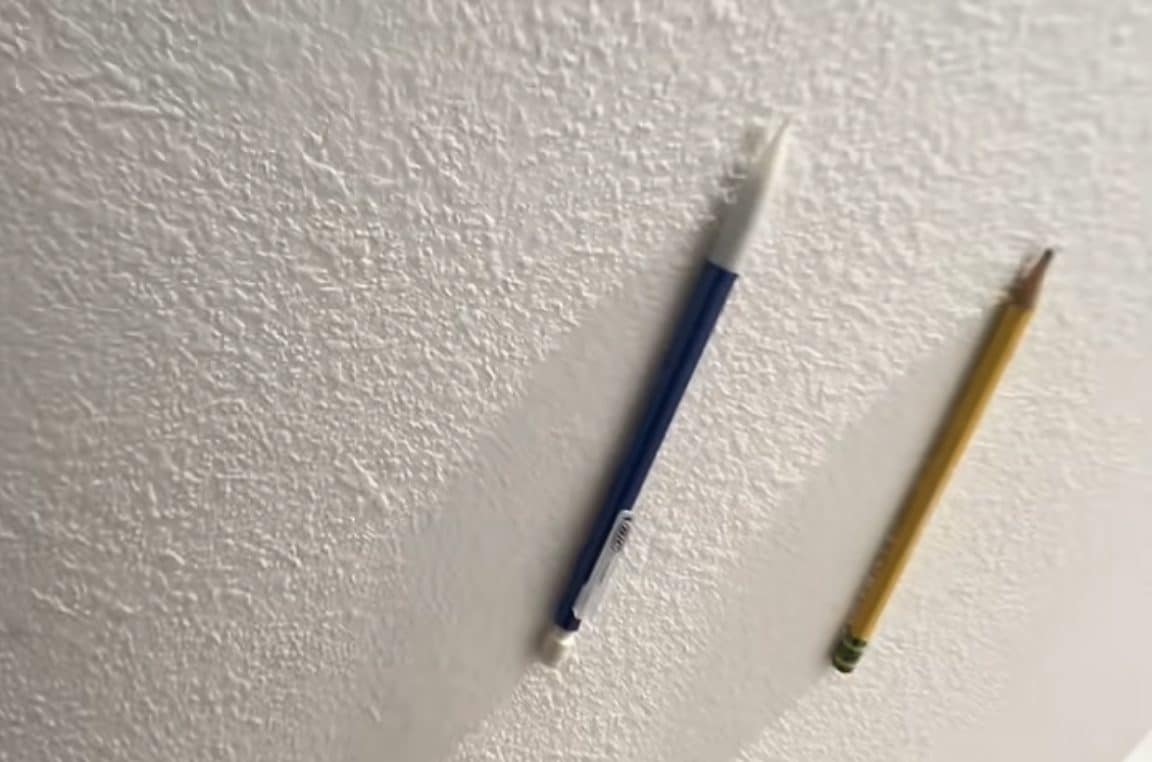
You know those videos that every now and then go viral on social media and show a trick in which someone rubs some objects (pens, remote controls, pencils) with decision and speed and these, in an apparently magical way, they remain attached to the wall overcoming the force of gravity? Well, unlike many things that go around on social media, this trick it can actually work. It rarely works, in particular conditions, and certainly many of the videos that circulate have some trick or deception; but at least some of those videos are real. And the main reason why this trick works lies neither in the wall in the flowing object, but in a place where at first glance you wouldn’t think: theair.
In any case, we recommend Don’t try the makeup at home to avoid dirtying or ruining your home walls!
We often don’t realize how impressive it is atmospheric pressure. The air around us exerts a force equivalent to the weight of an object on every square centimeter 1 kg. It’s not a small thing at all, but in everyday life we don’t notice it because it’s a pressure that always acts, everywhere and in all directions. We feel it when we create some kind of even partially empty: it is the atmospheric pressure, for example, that pushes our drink into the straw with which we drink it, or crushes the packets of rice.
Now, let’s take a wall with a rough and uneven surface, and place an object on it. Between the surface of the object and that of the wall there will be many small gaps filled with air. By rubbing the object on the wall very quickly, we essentially help that air escape, thus leaving the “empty” interspaces. Clearly “empty” is an exaggeration, but after rubbing there will be less air and consequently the pressure of that air is reduced. Here the pressure of the air around the object becomes significantly greater than that of the air between the object and the wall, and this force can be sufficient to keep the object pressed against the wall by overcoming gravity. It’s sort of “suction cup effect” but without a suction cup.
For this to happen you need a sufficiently rough wall, an object that is not too heavy and can offer a sufficient contact surface with the wall, and above all you need sliding done with strength and speed. Satisfying all these requirements at the same time is difficult, but not impossible: we repeat that atmospheric pressure is not at all negligible.
There are two other physical phenomena that can help make the trick work. The first is the surface heating due to strong friction: this can make the paint on the wall temporarily “sticky”. The second is thestatic electricity: intense rubbing can electrify the object (if made of insulating material) and therefore generate an electrostatic attraction between the object and the wall. Generally this force is very weak, but can be sufficient for very light objects, such as balloons.
