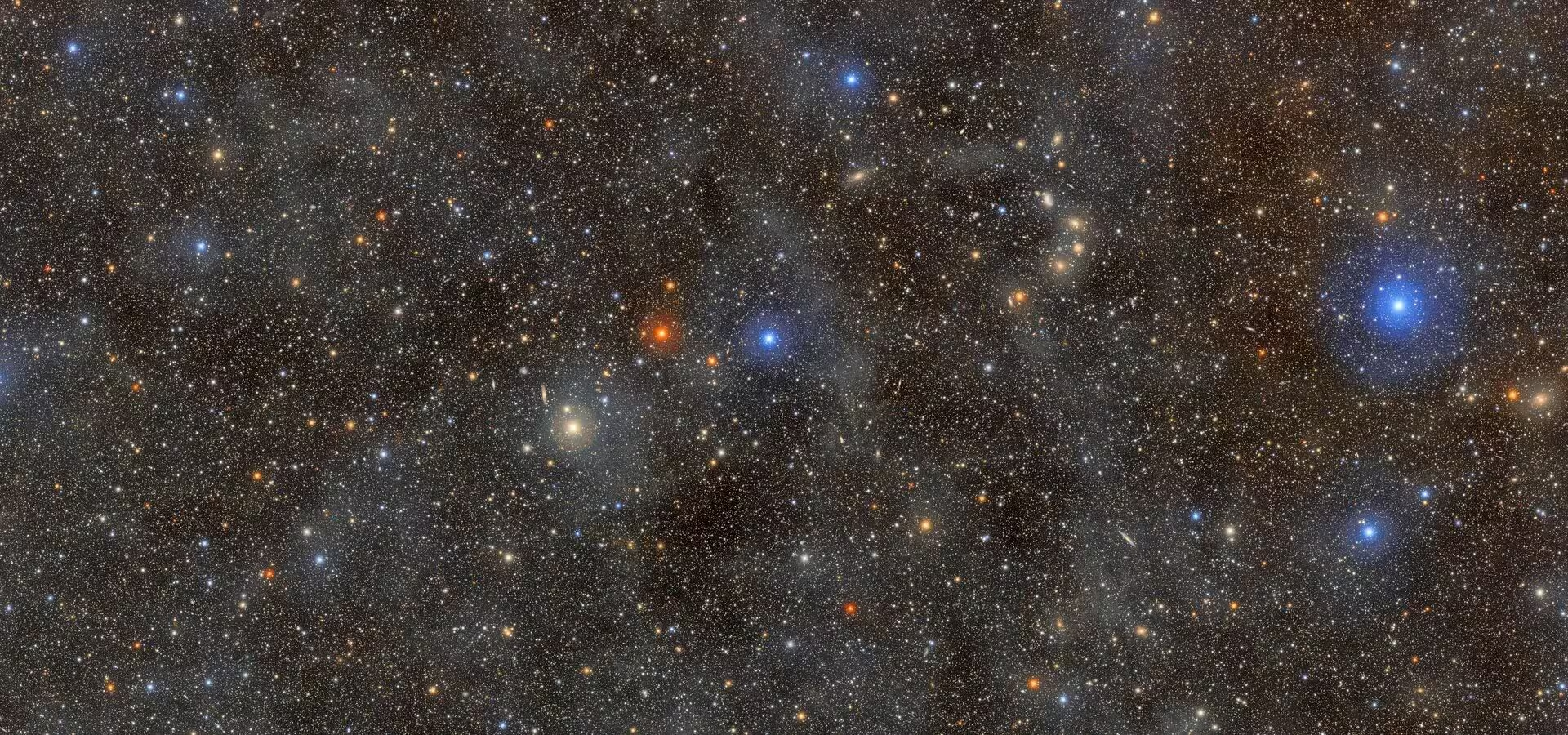
Filming has officially begun on the most greatest film ever produced about the Universe. The Vera Rubin Observatory began its observation campaign that he will capture every day, for 10 yearsimages of the night sky from the Chilean Andes every 40 seconds with your camera 3200 megapixels. Accumulated over a ten-year period, these images will allow astronomers at the Vera Rubin Observatory to create a very long time-lapse of our Universe. It will be like observing the latter come to life before our eyes: we will see stars explode in supernovas, we will discover millions of new asteroids, we will observe cosmic events never seen before and we will put an end to the debate on the existence or otherwise of a ninth planet beyond the orbit of Neptune. Furthermore, at the end of the 10 years of observation, the Vera Rubin Observatory will use all the data collected, billions of stars and galaxiesto revolutionize our knowledge of the Universe, from the closest one, the Milky Way and its satellites, up to the further away in space and timehelping us discover the nature of the mysterious components of our Universe, dark matter and energy.
The first images of the cosmos after a year of testing the telescope
The first highly anticipated images of the Vera Rubin Observatory were released to the public exactly one year ago. The images were part of a process commonly known in astronomical observing campaigns as commissioning and survey verification where they are tested all scientific and technical components of the projectfrom the quality of the images produced by the telescope to the technical characteristics of the digital camera and the “data reduction” process which transforms the “raw data” collected by the telescope into images on which it is possible to carry out scientific investigations.
For the past year, astronomers have been busy testing these components to make sure the images turn out right quality suitable for science that the Observatory must carry out. For example, to discover faint galaxies and almost invisible satellites of the Milky Way requires images collected by the telescope “clean up” by the background noise produced by the detector electronics and by the emission of the Earth’s atmosphere above the Observatory. Important factors that influenced the decision to begin the observing campaign included image quality, the actual speed of image acquisition and telescope movement, system reliability, and calibration accuracy.
After almost a year of careful testingthe Observatory has finally received the green light to begin its ten-year observation campaign. This long-awaited milestone is the culmination of years of effort by thousands of people around the world. THE’Italy has a strong participation in this projectcoordinated by the National Institute of Astrophysics (INAF), through contributions in scientific and technological activities to support the project.
What are the scientific objectives of the Vera Rubin Observatory Universe film
The Vera C. Rubin Observatory, dedicated to the American astronomer Vera Cooper Rubinis located in Chile, precisely on Cerro Pachon, at 2647 meters above sea level. The telescope has a primary mirror with a diameter of 8.4 metersbut the real star of the show is the LSST Camerathe largest digital camera in the world, capable of creating images from 3200 megapixels on onearea of sky equivalent to 45 full moons. The images are acquired every 40 seconds in different photometric bands, from near ultraviolet to near infrared passing through the visible, thus creating a data flow equal to 20 Terabytes per night. The speed of execution of exposures combined with the field of view mean that the Vera Rubin is capable of cover the entire southern sky every 3-4 nights for a total of approximately 800 times during the ten-year survey, thus allowing us to create a real film of the Universe.
Thanks to these technical characteristics, the Vera Rubin Observatory is intended to revolutionize astronomy in the next decade. We will in fact be able to find out millions of new objects in the Solar System (asteroids, comets and interstellar comets), putting an end to the age-old debate on the existence or otherwise of the infamous planet Ninediscover new satellite galaxies of the Milky Way, the galaxy that hosts us, create a complete census of the population of galaxies in the cosmos and use the latter and their distribution in space and time to attempt to discover the nature of more elusive component of our Universe, energy and dark matter.
