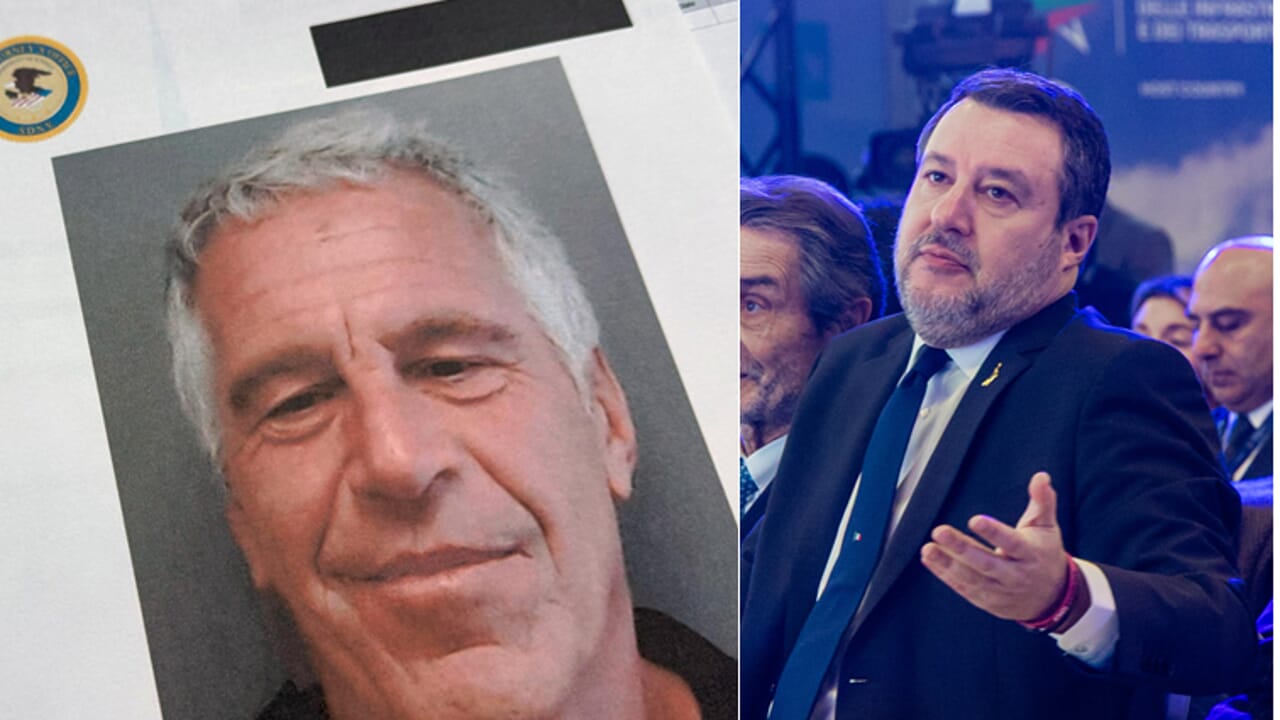
These are the real Epstein X Files, not just pedophilia
The outrage aroused by the content of some files from the FBI investigation into Jeffrey Epstein has focused the public’s attention above all on the most immediately shocking aspect: the moral abyss of his work as the fulcrum of a pedophilia network, the extent of the phenomenon and the culture of elitist impunity that has allowed unsuspecting people to commit extremely serious crimes. An inevitable, human indignation. But also, allow me, misleading. Because that very horror immediately triggered the opposite reflex: denialism. The idea that “it is too much”, that it is “exaggerated”, therefore false. This is where the short circuit occurs: when you deny a part because it is emotionally intolerable, you end up denying the whole picture.
And it is instead on the framework that we should stop, that is, the overall structure, which was first of all financial, political and destabilizing. The operation necessary today is to prevent denialism about the crimes committed on Epstein’s island from serving to deny all the other – political – crimes that emerge from the files: men who deliberately plotted, in conjunction with Moscow, to subvert the European democratic balance.
A chain of shocking events
Current Trumpism, JD Vance’s invectives in Munich, the ostentatious contempt for the liberal world are nothing but the last link in a chain of pushy, media-driven, financed and profoundly artificial events: from Brexit to the yellow vests, to tractor mobilisations, up to our own talk shows. Because in Italy, the work was done transversally, left and right.
This emerges clearly from the communications between Epstein and Steve Bannon. Figures such as Peter Thiel, Bannon and Epstein have had continuous meetings with Moscow, have coordinated and acted by exploiting a real basis of discontent to transform it into systemic destabilization.
But let’s take a step back to understand the mechanisms that led to all this. The trajectory began in the early 1990s, with the death of Robert Maxwell, a central figure of the British establishment, media entrepreneur and man with ambiguous links between the West, Israel and Eastern Europe. His death at sea, never clarified, which occurred at the end of the Cold War, marks a watershed. A few months later, her daughter Ghislaine moves to New York, where she meets Jeffrey Epstein: a financier without aristocratic pedigree, but with an obvious talent for navigating the gray areas of money and power. She brings what he lacks: access, social legitimacy, a map of the right living rooms. He offers resources and protection. It is from this exchange that a partnership destined to grow is born. It is Ghislaine who introduces Prince Andrew to Epstein.
In the following years, Epstein entered a favorable context: the end of the Cold War, political power firmly in the hands of liberal elites, the normalization of excess as a lifestyle. His parties appear no different from many others, and for this reason they go unnoticed. Meanwhile, the arrival of post-Soviet oligarchs in the West introduces already well-established practices: sex as a tool of influence, registrations as a guarantee for the future. Epstein makes a method of it, accumulating information, kompromat and relationships that are worth more than money. It does not pursue an ideological project or a vision of the world: its objective is to remain indispensable. Power, for him, is a currency to be spent to guarantee access, impunity and centrality in any scenario.
Crimes against minors
The crimes against minors in Epstein’s residences took place above all in these years, while a wide circle of powerful people revolved around him. From testimonies and documents it emerges that politicians, entrepreneurs and leading figures from the financial and technological world passed through his homes, including Bill and Hillary Clinton, Donald and Melania Trump, Bill Gates and Attorney General William Barr. Presence in that context does not automatically imply involvement (even if the complaints place these characters in the theater of abuse), but it provides a measure of how integrated and accredited Epstein was at the highest levels.
Epstein also enjoyed surprising social acceptance. Sarah Ferguson, wife of Prince Andrew, maintained cordial relations with him and even asked him for a loan, exchanging affectionate emails; after the 2006 arrest he publicly distanced himself, only to later send him messages of apology. From some communications it even emerges that Mette-Marit, Crown Princess of Norway turned to Epstein for advice on raising her children, in all likelihood unaware of what was happening behind the doors of her homes. It is precisely this normalization of relations, and the trust placed in Epstein, that has contributed to shielding him from suspicion and control for years.
Epstein’s arrest
The parable comes to an abrupt end on July 23, 2006, when Epstein is arrested in Palm Beach after a complaint that brings to light a system of abuse of underage girls recruited under false pretenses. Despite the emergence of a serious and widespread picture, the case was quickly neutralized by a plea agreement in 2008 which drastically reduced the charges, guaranteed immunity to accomplices and resulted in a symbolic punishment. It is the moment in which the impunity of the elite becomes evident: Epstein already has enough compromising material to remain untouchable. After his release, he retreats from the spotlight but does not disappear, simply operating with greater caution.
Starting in 2013, Epstein came into contact with Sergei Belyakov, a former FSB official, and, after the annexation of Crimea in 2014, the relationship intensified: Western sanctions made him a useful resource for Moscow. In exchange for visas and access to high-level officials, he offers advice on how to circumvent sanctions and facilitates contacts with Western finance. In 2015 he asked for Belyakov’s intervention to manage the case of a Russian model involved in blackmail, strengthening a channel of exchange based on capital, relationships and influence. Suspicions are growing about the use of models and escorts as instruments of compromise. Epstein is not a Russian agent: he is a man who offers services to those who pay. He is an opaque facilitator between Russian interests, the Western elite and blackmail mechanisms.
Steve Bannon and a Trump for Europe: inside The Movement
In those years the partnership with Peter Thiel was formed, and marked Epstein’s definitive move towards the republican and sovereignist area. It is the moment in which Thiel promotes Donald Trump to the presidency and pushes Brexit, while the political-technological universe that revolves around him – from Palantir to FaceBook, up to Steve Bannon’s Cambridge Analytica – becomes a central hub of new populist strategies. In this framework, Epstein plays a key role on two levels: as an intermediary towards Russian circles and as a protected figure in the United Kingdom. The Giuffre scandal, involving Prince Andrew, remains deliberately contained, making any investigation into Epstein politically explosive.
Trump and the girl auction, Prince Andrew on all fours: what’s really important in the new Epstein files
According to some of the British press, the very fear of revealing what linked Andrew to Epstein would have contributed to paralyzing any serious investigation into the channels of Russian influence in Brexit. And then, with the interests of Thiel and Bannon in full convergence with those of Russia, the next step was to further fragment the European Union, to the point of destroying it.
The liberal world had to end
Bannon actually moved to Europe to meet the leaders of populist movements and build a large transnational sovereignist front. It was in that period that he attempted to open a far-right Christian school at the Certosa di Trisulti and that he regularly met representatives of the Lega, 5 Stelle, Fratelli d’Italia and Forza Italia, both privately and by participating in party events or conferences. The declassified emails show that in 2018, Epstein and Bannon discussed building a future “sovereignist majority” in the post-Brexit European Parliament, and strengthening figures such as Nigel Farage, Boris Johnson and Jacob Rees-Mogg against Theresa May in the UK. In short, they planned what then happened: to force May to resign so as not to risk a “soft Brexit” that would have kept the United Kingdom in the common market and to bring Johnson to power, with the certainty of a “hard Brexit” that would have represented a clean break. The exchanges go into the merits of financing, logistics and media strategies for the 2019 European elections: Bannon talks about the creation of a dedicated structure.
How does all this relate to pedophilia, the systematic abuse of minors dragged to Jeffrey Epstein’s island? It connects to a human typology and a mechanism of power. To people without moral and ethical restraints, for whom limits do not exist and the other is reduced to an object. In recent decades, these very characteristics have become a competitive advantage in systems of power: vertical structures that select, reward and advance those who are willing to do anything, those who do not feel empathy, those who do not recognize borders – exploiting and destroying people, or even dismembering states and institutions. Everything is valid.
This is what the Epstein files force us to see. Not only the crime, but also the context that made it possible, tolerable, functional. The access of individuals of this type to the control rooms is not an accident: it is the result of a system that has opened the doors to those who see domination, manipulation and violence – physical, psychological, political – as legitimate tools. And it is also from here that we must start to understand the level of destabilization and global chaos we find ourselves in today.
