A study published a few days from in the magazine Nature Human Behaviour It seems to confirm the old adage “whoever resembles himself is pilled”, at least as regards the similarity of the Psychiatric disorders between partners. In fact, it would seem that those who suffer from a certain psychiatric disorder have one greater probability of making a couple with whom is the bearer of the same disturbance, compared to the average. This singular study, published on Natureconcerns psychiatric conditions and disorders from depression atabuse of substancesand involves one scale that it had never been so wide. According to the researchers, the explanation could derive from a mix of factors: It is attracted to those who live and understand the same condition; There may be a tendency to develop behaviors (and disorders) similar to those of the partner; or finally, the isolation created by social stigma Towards those suffering from these disorders can restrict the chances of choosing a partner or life partner.
The choice of the partner is not accidental
This recent study examined nine psychiatric disorders and conditions: depressionbipolar disorder, autistic spectrum disorders, schizophrenia, Substance use disordersanxiety disorders, anorexia nervosa, deficit disorder of attention and hyperactivity (ADHD) and obsessive-compulsive disorder (OCD). Analyzing beyond 14.8 million people from Denmark, Sweden and Taiwan of different generations (from 1930 to 1990): the data shows that the chance that the partners of a couple have the same diagnosis It is greater than you might think.
Let’s try to better understand what it means with an example: let’s imagine that in a certain population 5% of people suffer from depression. This means that, by choosing a random person as a partner, we would have 5% probability of choosing a person with diagnosis of depression. This also applies to those suffering from depression: has a 5% probability of meeting and choosing a partner with the same diagnosis. If the couples were randomly formed, therefore, the probability of choosing a partner who suffers from depression should always be the same.
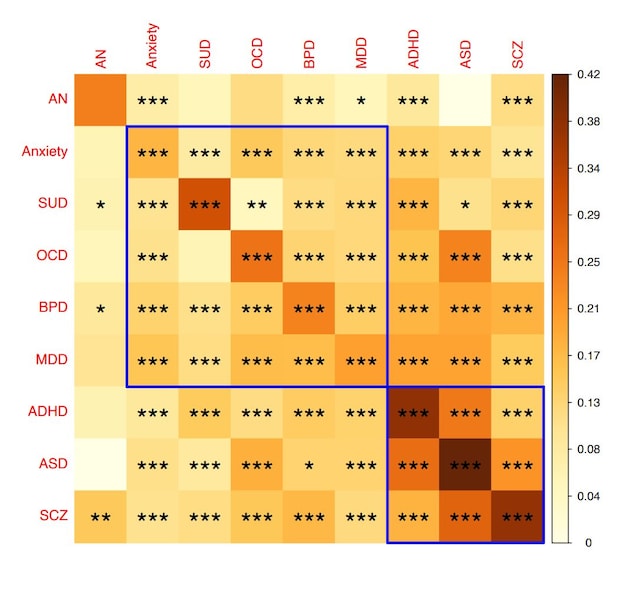
In reality, the study observed major percentages, both for depression (which we used as an example), and for other disorders examined, and in particular for autism, schizophrenia, ADHD and substance use disorder. This means that the couples formed by people with the same diagnosis are more frequent than what would happen if the choice of the partner was completely random. To better view these complex dynamics, below we report one correlation. This statistical tool highlights the strength of the relationship between different variables; In our case, it shows the association among the nine psychiatric disorders examined in the study. It is possible to note that the strongest correlations are observed between partners who share the same disorder.
A trend shared by different generations, countries and cultures
This tendency of couples with the same diagnosis is repeated on average for all the ailments analyzed, even if there are differences. For example, the sharing of diagnosis of depression, anxiety or disorders from the use of substances It was particularly frequent, and slightly increasing with the passing of the decades in the most recent generations. On the contrary, for conditions such as Anorexia nervosa, bipolar disorder and obsessive-compulsive disorderthe data show stronger variations from one country to another: in Taiwan couples with a common diagnosis of obsessive-compulsive disorder were more numerous than in the Nordic countries.
What makes this important is not so much the data itself, already emerged in previous research, but the emergence of the dimension cross-generation and the Cross-cultural diffusion of this singular phenomenon: that is, it occurs in all generations and also in very different countries and cultures.
The study also highlighted that i children of couples who share the same disorder are more at risk of developing it in turn.
Why does it happen? The possible causes of this trend
According to the main researcher of the study in question, Chun chieh fan of Center for Population Neuroscience and Geneticsbehind this phenomenon there may be multiple dynamic both psychological That environmental. A first and simple explanation is that people could be attracted by those who understandliving it firsthand, one’s suffering.
Parallel to this dynamics of attraction, the researcher hypothesizes that sharing an environment for a long time and living with a partner in a narrow way, can lead to a phenomenon known as “convergence“, That is the progressive tendency of partners a become more similar With the passage of time.
Finally, the social pressure that sometimes becomes “stigma“towards certain pathologies or conditions can end up doing isolate who suffers. The patients would thus find themselves having a reduced possibility of choice, which is more easily directed towards those who live the same condition as exclusion.
