
Today in Italy the number of hours of light and darkness are exactly the same, 12 hours each. It is thespring equilightone of the two days of the year – together with the autumn equilight – in which day and night have exactly the same duration. You might be a little confused, having always heard that day and night last exactly 12 hours on days of spring equinox and autumn: after all, “equinox” actually means “night equal (to the day)”. Here, this is it Almost true, but not perfectly True.
If we were to measure the actual length of the day on the day of the spring equinox (which this year falls on March 20) in our latitudes, we would in fact discover that it lasts approximately 10 more minutes than exactly 12 hours. It is today, in Italy, that we have precisely 12 hours of light and 12 hours of darkness. The main reason is the fact that the Sun is not a point in the sky but it’s a pretty big record; then there is the fact that its light is slightly deflected by the Earth’s atmosphere.
The autumn equilight will fall in Italy on September 25tha few days after the autumnal equinox (which will be September 23rd).
Because the equilight does not coincide with the equinox
On equinox days, our journey around the Earth’s axis during the day is actually half lit and half dark. The equinoxes would also be equilight if the Sun appeared to us as a point in the skybut if we take into account its extension things become a little less simple – and more interesting.
For example, how do we define the exact moments when the day begins and ends? We do it in the most intuitive way: the day begins the moment the solar disk (i.e. the highest part of the disk) begins to emerge from the horizon, while it ends as soon as the Sun (also here, the highest part of the disk) goes below the horizon. If you think about it, this definition lengthen the day a littlebecause it also makes him understand the time needed for the solar disk to emerge completely from the horizon at dawn and dive completely below the horizon at sunset. Let’s talk about 9 minutes in all in our latitudes, but enough to understand why the day of the equinox is not also the day of the equilight.
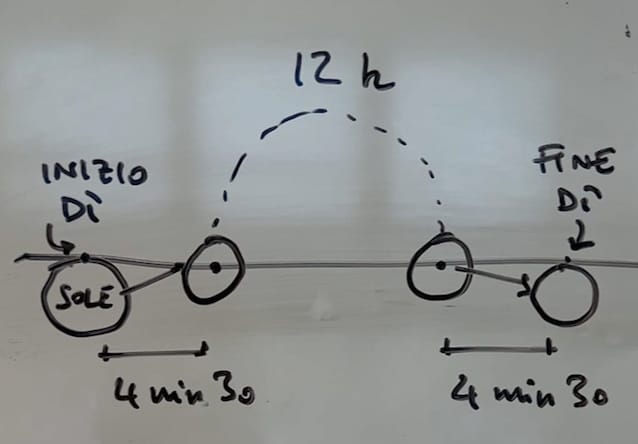
This also explains why the equilight of March comes before the equinox of spring: since at the equinox “there is too much day” and in this period of the year the days are lengtheningwe have to move back a few days to have exactly 12 hours of light and 12 hours of darkness. The same goes for the equilight of autumn: that’s where the days end shorteningso you have to wait a few more days to have the day exactly the same as the night.
Then there is another smaller effect that separates the equilight from the equinox. It’s about the atmospheric refractionthat is, the – slight – deviation of sunlight by the air with which the Earth is surrounded. To be clear, it is the same phenomenon whereby a pen immersed in water appears to be broken in two: the light coming from the immersed part is deflected by the water more than it is by the air, generating the optical illusion. Something similar happens with the air: the sun’s rays are deflected just enough to make the “tip” of the Sun appear above the horizon a little earlier than it would if we had no atmosphere. This effect contributes to approx 1 minute of difference between day and night on the days of the equinox in our latitudes; added to the 9 minutes we were talking about before, this explains the approximately 10 minute difference between hours of light and hours of darkness during the equinoxes.
The equilight does not arrive everywhere on the same day: the dates
Unlike the solstices and equinoxes, which occur at the same time throughout the planet because they depend only on the position of the Earth with respect to the Sun, the days of equilight vary depending on the latitude at which we find ourselves, because – as we have seen – they depend on questions of “perspective” which therefore have a local nature.
At Italian latitudes (40°-45°) thespring equilight falls March 17about 3 days before the spring equinox; the difference between equinox and equilight decreases with latitude, so the further we go towards the equator the earlier the equilight arrives, while the further we go towards the poles the more the equilight is postponed.
Similar discussion for theequilight of autumn: as you go up in latitude it is closer to the autumn equinox, while at low latitudes it moves away from the equinox. In Italy the September 25th in the latitudes of Northern Italy (45°) and the September 26th in the southern latitudes (40°).
Atequator (latitude 0°) there is never equal light; on the other hand, every day of the year there has approximately 12 hours of light and 12 hours of darkness.
Here is a summary table of the dates of the days of equilight innorthern hemisphere:
| Latitude | Equilight of March | Equiluce of September |
|---|---|---|
| 60° N | March 18 | September 25th |
| 55° N | March 17 | September 25th |
| 50° N | March 17 | September 25th |
| 45° N | March 17 | September 25th |
| 40° N | March 17 | September 26th |
| 35° N | March 16 | September 26th |
| 30° N | March 16 | September 27 |
| 25° N | March 15 | September 27 |
| 20° N | March 14 | September 28th |
| 15th N | March 12 | September 30th |
| 10th N | March 8 | October 4 |
| 5th N | February 24 | October 17 |
And here is the similar table forsouthern hemisphere:
| Latitude | Equilight of March | Equiluce of September |
|---|---|---|
| 5th S | April 14 | August 29th |
| 10th S | April 1st | September 10th |
| 15th S | March 28 | September 14th |
| 20th S | March 26 | September 16th |
| 25° S | March 25 | September 17th |
| 30° S | March 24 | September 18th |
| 35° S | March 24 | September 19th |
| 40° S | March 23 | September 19th |
| 45° S | March 23 | September 19th |
| 50° S | March 23 | September 20th |
| 55° S | March 23 | September 20th |
| 60° S | March 22 | September 20th |
