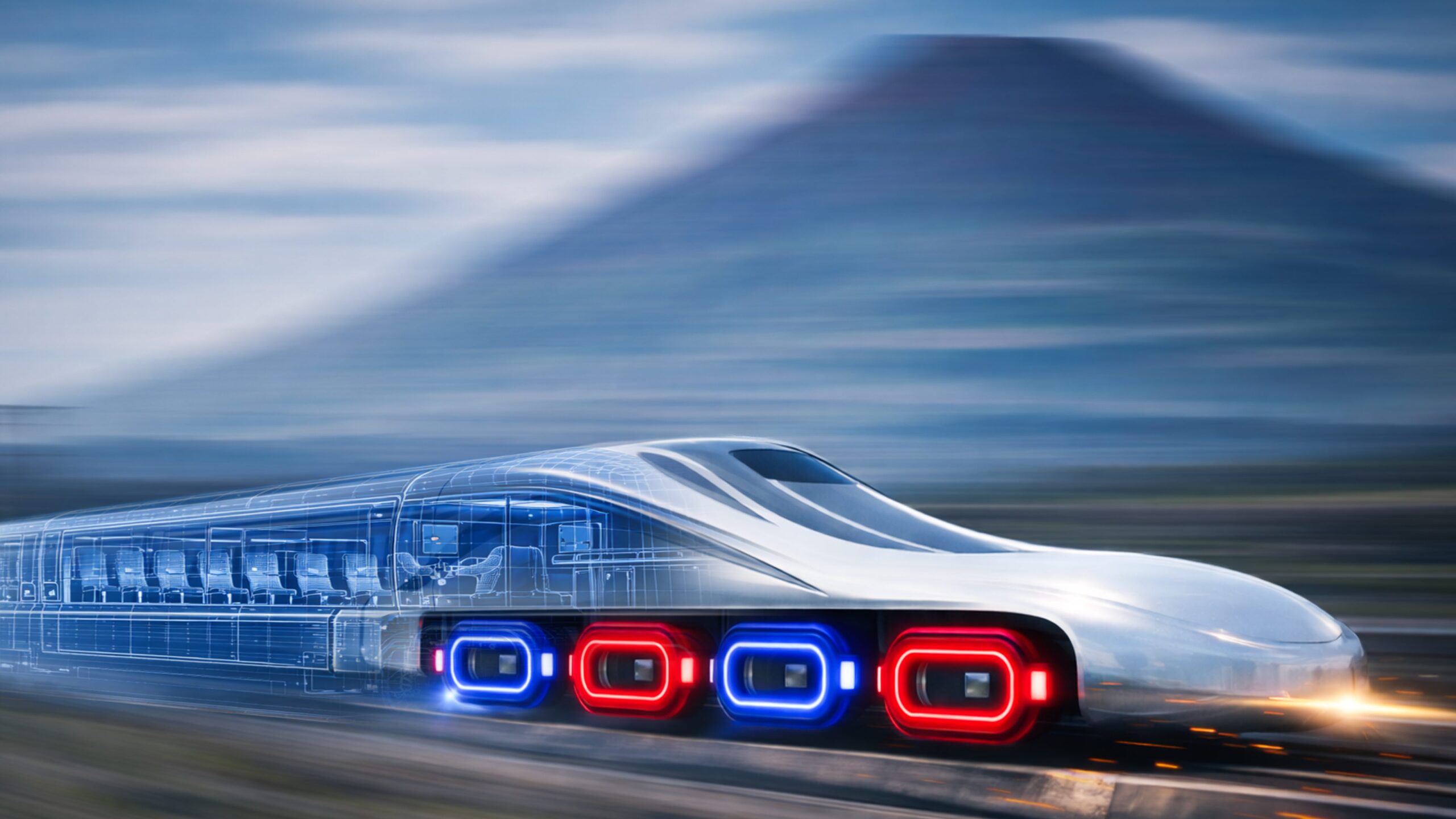
They exist magnetic levitation trains, the Maglev, who travel more than 505 km/h thanks to a technology that levitates them above the tracks, i.e. keeps them suspended 10 cm from the tracks without touching them. In short, they fly! All this thanks to a complex magnetic field system which, by exploiting the magic of physics, allow these trains to reduce the friction component, making them extremely fast and efficient. There are several models and prototypes in Japan, Germany, China and Korea. In this article, we will analyze the operation and features of the Japanese SC Maglev model. We’ll see how it manages to move forward, lift itself up and not skid, that is, not touch the side guides.
Maglev magnetic levitation trains: the basics of operation
The maglev train model we will focus on in this article is theSC Japanese Maglevwhich translated means Superconducting Magnetic Levitation precisely because it uses superconducting magnets to move and fly. The Japanese model is, however, a prototype, because even if Japanese SC Maglevs already exist, they are not yet on the market. The line they are planning in Japan should be ready in 2030/2035 and connect Tokyo to Nagoya in 40 minutes. But how do they work?
Simply put, this technology takes advantage of magnets to create electric currents And magnetic fields between the train and the rails, so as to be able to both push the train forward and lift it. In itself, the underlying concept is also simple: we all know that if we arrange two magnets – two magnets – with opposite poles they attract. But if we arrange them with the same nearby poles they repel. In this way, with one magnet we can push the other forward, or lift it. This is precisely the technology used by magnetic levitation trains to move and “fly”.
Before understanding how the technology works, we must make a fundamental premise. The magnets that we know, magnets, are natural magnets, which, thanks to the material they are made of, generate a magnetic field. Well, these trains don’t use natural magnets, but magnets electromagnets, Meaning what coils of conductive material which, if crossed by an electric current – that is, if they are charged – generate a magnetic field, thus becoming magnets thanks to the electric current. So let’s see how they work.
How they move forward: propulsion
Let’s start with the mechanism that allows these trains to move forward and let’s immediately focus on the “engine” of these cars, that is, the electromagnets ring-shaped positioned on the sides of the train capable of generating a very intense and stable magnetic field. These magnets are placed at groups of four and are traveled by currents that rotate in an alternating direction between one magnet and another, so as to generate four magnetic fields with poles oriented oppositely to each other.
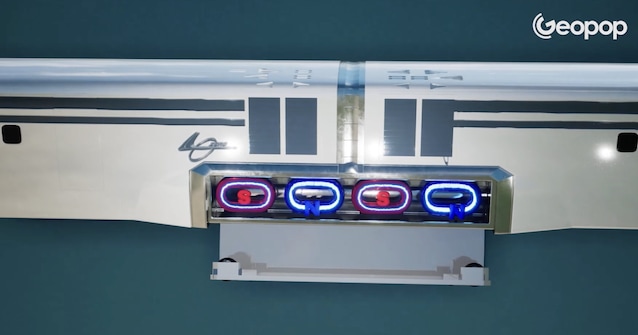
Now, the trains are positioned in a sort of recess and on the sides of this hollow, in the so-called guides, Gods are also arranged there ring-shaped magnets and they too are crossed by currents that flow in the opposite direction, so as to create opposing magnetic fields. And we know that South and North attract each other, while North with North or South with South repel each other. So the magnets on the train attract each other with the opposite pole at the front of the guide and repel each other with the same one at the back. And once aligned, the current of the magnets on the guides is reversed so the magnetic fields and the forces produced are continuously forward attractions.
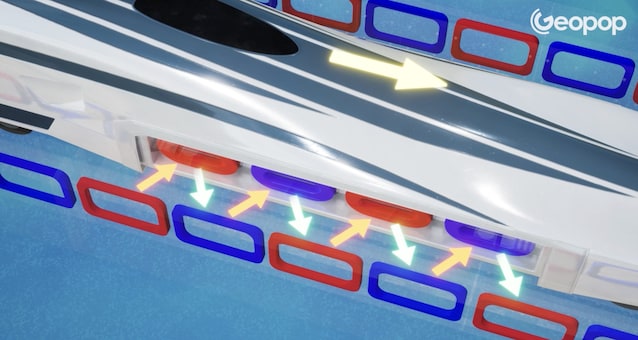
There speed of the train is controlled precisely with the frequency of these switches: the more often the current of the guide electromagnets is reversed, the more the train accelerates. And thanks to this mechanism, it is possible to reach the incredible speed of 505 km/h. It would be about the same as doing Milan Florence in 40 minutes, or – considering a clear route – it would mean Milan Reggio Calabria in two and a half hours. That is, all of Italy in two and a half hours. In practice, this would not be the case because 505 km/h is the speed they reach when fully operational, but when departing or arriving or in specific areas the speed is clearly lower.
These incredible speeds are also achieved thanks to the fact that the train does not touch the ground, i.e reduces friction due to contact with the ground. But how does it “fly”?
The levitation of the train 10 centimeters from the ground
Here too the absolute protagonist is the magnetic field and the 8-shaped coils which are not charged, but simply arranged along the side guides. Here too we must make a premise, namely that just as the electric current induces a magnetic field, the magnetic field variation produces electric current in a closed circuit. And the greater the variation, the more intense the current produced.
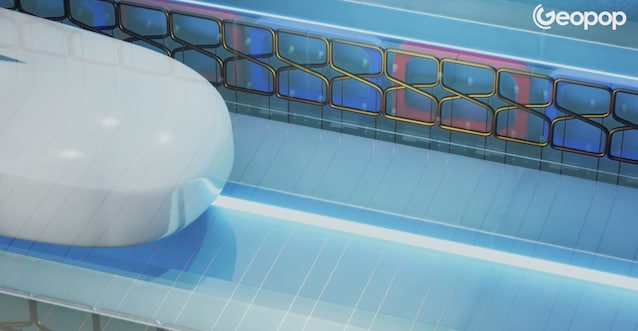
The question is very complicated, but to simplify it as much as possible i magnetic fields generated by the train’s magnets, passing through the figure-eight coils, induce an electric current which circulates in one direction in the lower ring of the 8 and in the opposite direction in the upper one. This in turn generates two clarge magnets oriented in opposite directions in the two rings of the 8precisely due to the fact that the current circulates in opposite directions in the two rings, which are arranged so that the lower pole of the coil is the same as that of the train field, while the upper pole is opposite. In this way, a repulsive force from below and an attractive one from above. And when the union of these two forces overcomes the gravity forcethe train lifts up guys, it starts to fly.
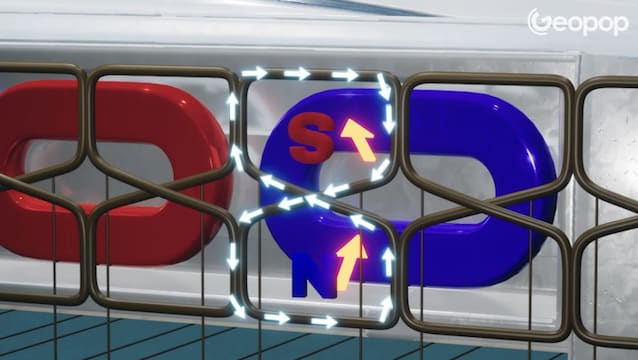
And here a clarification must be made: so that the attractive and repulsive forces are able to fight the force of gravitythe train must have a certain speed, so that the magnetic field variation we need is intense enough. Because of this, the train starts levitating after 150 km/hfirst it actually uses small wheels which then retract, as happens with airplanes.
Now the question of direction remains. How do they not skid?
Maintaining direction
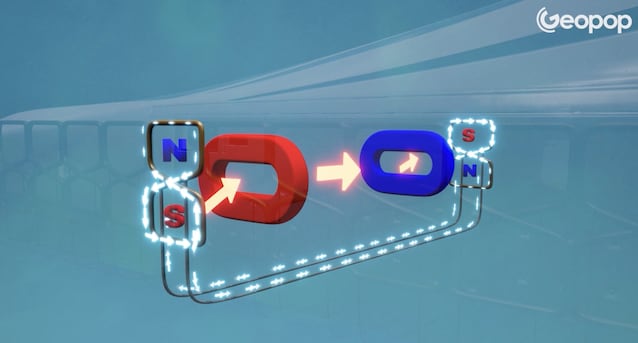
Trying to simplify as much as possible, to ensure that the train never touches the side guides figure-eight coils on both sides of the guide are connected by conductive wires. When the train is centered, the magnetic forces on the right are equal to those on the left, the system is in equilibrium, and all is well. But if it moves slightly towards one of the two sides, for example to its left, the induced currents change in the two “8s”, they increase on one side and decrease on the other.
To rebalance the system theexcess current on one side it passes to the other through the wires that connect the two coils. This current increases the repulsive magnetic force in the left coil and increases the attractive force towards the right coil. The result is that the train is pushed back towards the center. In short, as soon as the train skids a little, the system of cables and coils generates magnetic fields which, playing with each other, keep the train in the right direction.
The train engine: superconducting magnets
To make these trains work it takes a lot of energy to produce very intense magnetic fields. Except that to produce a very intense magnetic field, a very intense electric current must be supplied, and this heats the magnet strongly. To solve this problem, the magnets on board the train are not just any magnets, but superconducting magnets.
And what does it mean? It means I am made of specific materials – in our case a league of niobium And titanium – That below a certain critical temperature they almost completely eliminate their electrical resistance. This means that once electric current circulates inside them, this current does not heat the magnet. And not only that: without electrical resistance, it is as if the current “had no friction”: it can circulate practically without dispersing energy. In this way, the charged superconductor manages to generate a very intense, stable and magnetic field without the need for continuous power supply. However, it must be said that the current that must be supplied initially is very high, but not only that. It also requires power to keep the system at extremely low temperatures. In fact, the price to pay is that superconductors must be kept at a very low temperature, i.e -269°Csimilar to the one we find in space, which is obtained thanks to a liquid helium refrigeration system. So the energy saved by not having to continually charge the magnets is used to keep them at the right temperature.