An M13 virus has been transformed into a drug “postman” capable of crossing the blood-brain barrier by a group of Italian researchers from the Italian Institute of Technology, the University of Bologna and the Pisana Foundation for Science. The objective of the study, published on Advanced Healthcare Materials, is to circumvent one of the most difficult clinical obstacles in medicine: overcome the layer of cells that defends the brain (BEE) to deliver therapies directly to neurons. We are used to considering viruses as enemies to be defeated, but by overturning this perspective, scientists have engineered a bacteriophage (a virus that attacks only bacteria and it is harmless to humans) to make it a precious ally. Possible applications of this innovative technique include the targeted delivery of drugs against tumor cells or the development of new treatments for neurodegenerative diseases.
The pharmacological challenge of the blood brain barrier
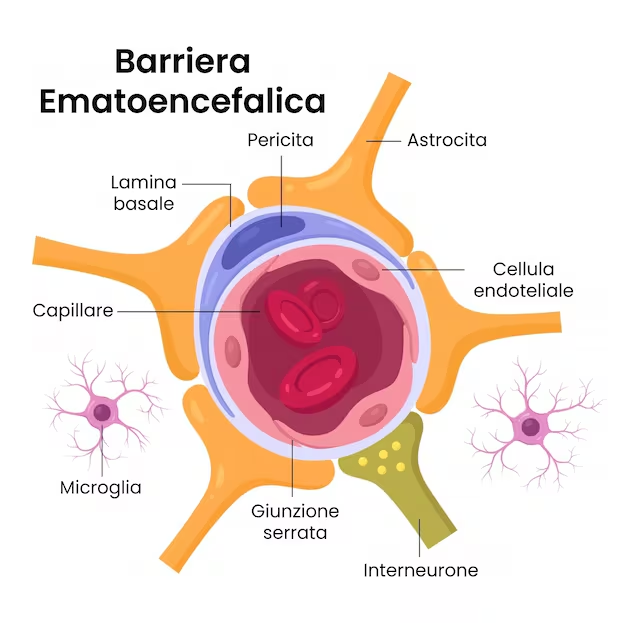
There blood brain barrier (BEE, from English Blood-Brain Barrier) is a layer of endothelial cells which lines the blood vessels of the brain, protecting it from pathogens and toxic substances. This “gate” is made up of cells firmly “sewn” together through tight joints (tight junctions), capable of sealing the intracellular space. This function is fundamental for health, but at the same time represents a pharmacological obstacle: according to the estimates reported in the study, approximately 98% of therapeutic molecules cannot pass through it.
Drugs developed to treat tumors, neurodegenerative diseases or other pathologies of the central nervous system, if injected into the blood, literally remain “out the door”. Among the solutions that have emerged from biomedical research are: synthetic nanoparticlesengineered with antibodies or other proteins, but to date this approach has proven to be poorly effective.
What are M13 bacteriophages and why are they safe
A group of Italian researchers led by Valentina Castagnola of the Pisana Foundation for Science, decided to use the M13 phages to solve the problem. These are viruses that are part of a family capable of infecting exclusively Escherichia Coli. For human cells, however, they are completely harmless: they do not have the tools to “break into” them. For this reason, the M13 was chosen as the ideal candidate to become a drug “postman”. Safe. In addition to this, their abundance in nature and simplicity of cultivation make it an easy and economical vector to produce on a large scale in the laboratory.
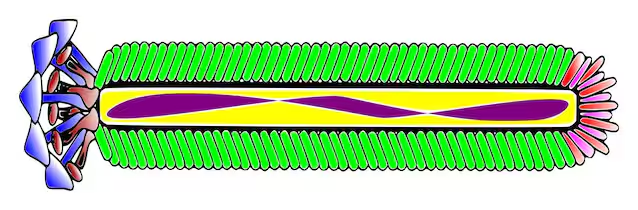
The M13s feature a elongated and filamentous structurenot spherical like the viruses we are used to seeing. In fact, they measure 900 nanometers long and just 6 wide.
Transforming a virus into a “vehicle”, the Italian study
The authors of the study “reprogrammed” these bacteriophages. In summary, they have genetically modified the capsid (the protein envelope that surrounds the DNA of the virus), providing it with a fragment of an antibody capable of recognizing specific proteins of target neurons. The result was a “tailor-made” version of the virus capable of targeting only the desired cells.
Once in contact with the BBB, the phage is actively absorbed by a mechanism (clathrin-mediated endocytosis) in which small vesicles “suck” it into the cell. Once inside they avoid the lysosomes (organelles responsible for degrading foreign molecules) and manage to pass intact to the other side of the barrier to carry out their therapeutic function.
Such a “courier” could pave the way for much more precise therapies for brain diseases, from brain tumors to neurodegenerative diseases, overcoming the obstacle of the blood-brain barrier. By reprogramming the tip of the capsid it is in fact possible to recognize different objectives depending on the pathology. Before reaching the clinical phase, however, confirmations on experimental models and guarantees on the stability of the virus once introduced into the human body are still needed.
