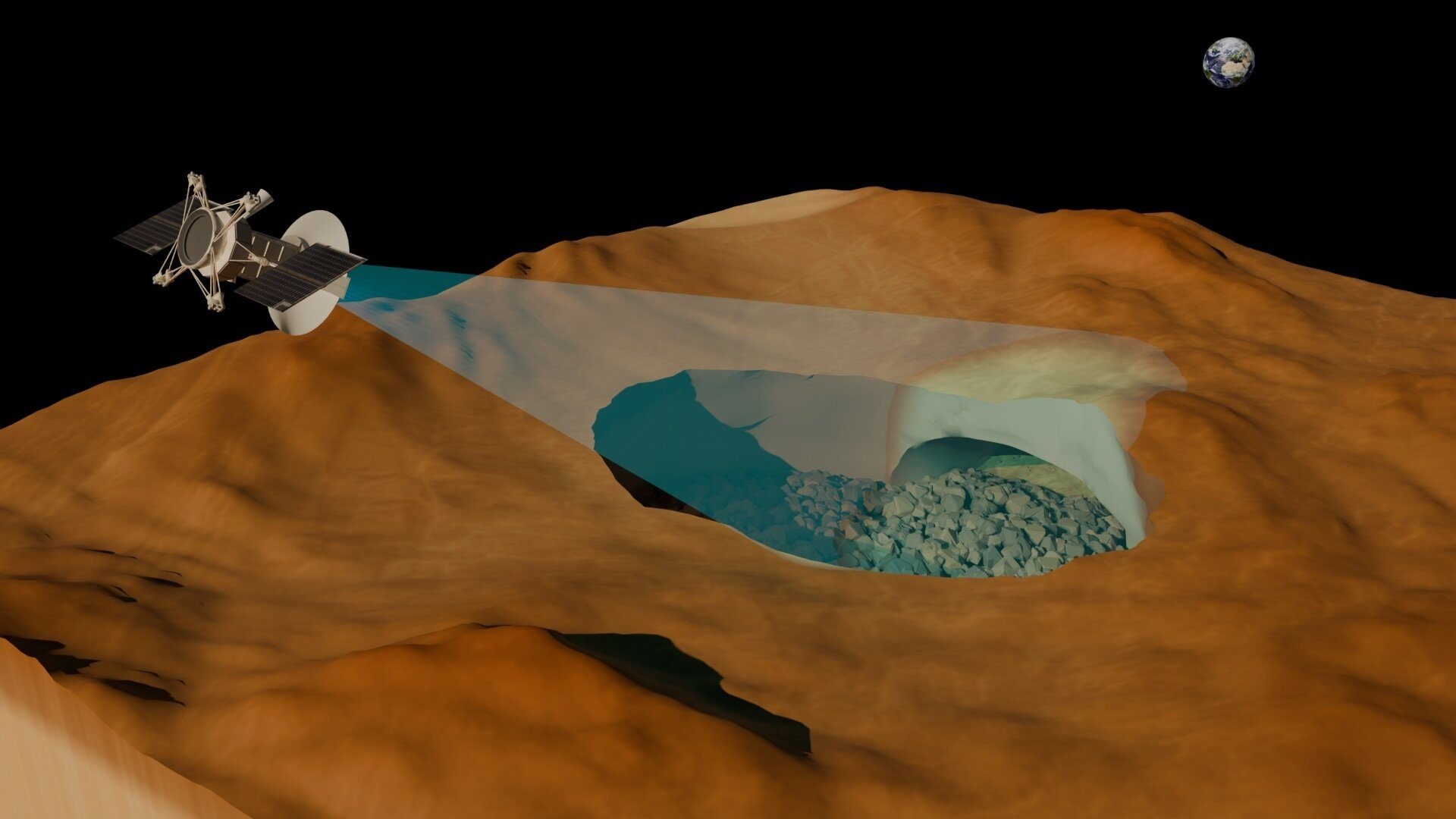
A team of researchers fromUniversity of Trento managed for the first time to directly test theexistence of lava tubes on the surface of the planet Venus. The researchers used modern techniques to analyze old radar data from the 1990s from the Magellan probe of NASA, whose radar in microwave frequencies allowed to probe the surface of the planet beyond its thick blanket of clouds. The data showed the existence of a large underground conduit in the region of Nyx Monswhose ceiling collapsed revealing its underground structure. The lava tube has a diameter of approximately 1 kmone sroof thickness of at least 150 meters and a height of not less than 375 meters. These lava tubes are created when the latter forms a solid surface crust that shields the hot underground flow. The existence of these conduits on Venus has been widely hypothesized, but never confirmed until now. Their existence confirms the theories according to which Venus has previously or still experienced everything intense volcanic activitywhich has modified the surface of the planet over time.
What is a lava tube under a solidified surface
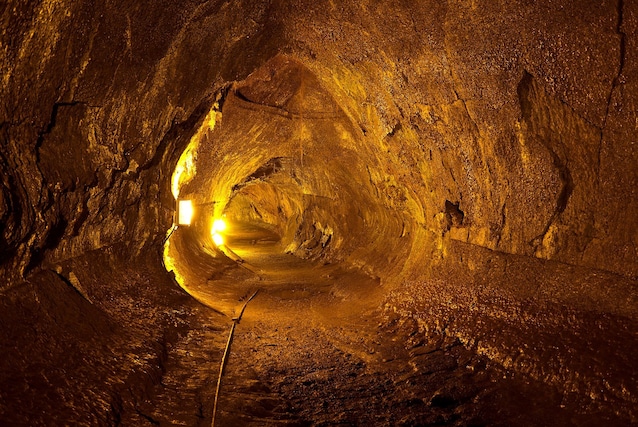
THE lava tunnel they are natural conduits that form when a lava flow continues to flow beneath a now solidified surface. They can be imagined as gods real underground “pipes”. created by the lava itself as it flows. The most common process by which they are formed is called overcrustingthat is, the formation of a solid crust over the still fluid lava. The most common way this happens is when lava flows in a channel: in this case, the edges, also called banks, cool first and the solid surface gradually extends until it completely covers the underlying flow. A second formation mechanism is through a process known as inflation. In this case, an already cooled lava flow on the surface is “inflated” by the arrival of new hot lava which continues to flow beneath it, progressively expanding the internal space.
Once formed, the tunnel does not remain static. The lava that continues to flow within it can erode the walls and bottomshaping it over time both from a thermal (through heat) and mechanical (through friction and movement) point of view. When the eruption ends and the lava supply stops, the conduit can empty partially or completelyleaving behind a underground cavity. Generally the latter has a cylindrical shape where the lower part is called the “floor” and the upper part the “roof” of the tunnel. When you have a localized roof collapse of the tunnel (in jargon skylight), some are created openings that reveal the cylindrical structure underneathjust the way lava tubes were discovered on Venus.
1 km wide and at least 45 km long: the details of the study
Lava tubes have been identified on Earth, Mars and the Moon. Their existence on Venus had remained until now just a hypothesisalthough several studies have found indirect evidence in support of the presence of these structures, based for example on the analysis of the alignments of the pits on the large Venusian volcanoes. Curiously the direct proof of the existence of lava tubes on Venus it didn’t happen through data coming from one new missionbut rather from aanalysis with new techniques of processing 30 year old datathose of the probe Magellan of NASA which between 1990 and 1992 mapped almost the entire surface of Venus using an S-band (2.385 GHz) synthetic aperture radar (SAR) in microwave. The use of these wavelengths is necessary for penetrate the dense atmosphere of carbon dioxide which prevents optical observation of the surface. Microwaves, on the other hand, pass undisturbed through clouds, so measuring the time it takes for the signal to bounce off the surface and return to the probescientists can reconstruct a morphology map surface of the planet.
Despite that, view with Magellan data a lava tube is not directly possible. What can be observed is the localized roof collapsewhich creates a depression called skylight. AND It is through this opening that the radar signal can penetrate the duct And reflect on the internal walls. In the case studied, in the region of Nyx Monsresearchers identified a collapse crater with a radar signature characterized by a sharp shadow and a bright, asymmetric radar return extending beyond the crater rim—exactly the radar signature one would expect from cases where radar “enters” an underground cavity and is reflected from within it.
The authors of the study thus also managed to estimate the size of the lava tube: diameter of approx 1km, thickness of the roof at least 150 meters and one height of the void created by lava at least 375 meters. Considering the presence of a sinuous chain of collapses aligned along the topography, the system could extend for at least 45 kilometers below the surface. The resolution of Magellan images is approx 75 meters per pixel. This means that smaller tunnels may not have been detected. It is therefore possible that many other skylights have escaped analysis.
The importance of the discovery rewrites the geology of Venus
Studying these lava tunnels is very important for planetary geologists: by observing their internal structures, stratifications and minerals present, scientists can reconstruct how lava flowed, how hot it was, and what geological processes shaped a planet’s surface. The lava tubes represent direct evidence that they flowed or still flow on Venus low viscosity basaltic flowssimilar to those on Earth, capable of forming underground conduits through the process of overcrusting. It is hypothesized that Venusian environmental conditions could favor the formation of an insulating surface crust very quickly after the eruption, increasing the probability of the development of lava tubes. In the article, in fact, scientists argue that Venus could host underground networks extended for tens of kilometers.
The study of this tunnel and the possible discovery of new others will be the subject of investigation in the new missions that will leave for Venus, such as EnVision of ESA e TRUTH of NASA. Both will use much more powerful and higher resolution radars than Magellan, potentially capable of detecting other skylights or even directly probing the subsurface. In particular, EnVision will carry a radar capable of investigating up to a few hundred meters below the surface, allowing us to map entire networks of underground tunnels on the second “rock” from the Sun.
