The Nobel Prize for Physics Giorgio Parisi and his colleague Francesco Zamponi they managed to solve a problem remained open for more than 10 years thanks to the support of Claude, the AI developed by Anthropic. The result, published in “Journal of Statistical Mechanics: Theory and Experiment”completes a series of studies published between 2012 and 2014 together with colleagues Patrick Charbonneau, Jorge Kurchan And Pierfrancesco Urbani.
In these studies, the group had worked on a theoretical representation of “jamming”, that is, that physical process by which the viscosity of some materials such as foams, granular materials and glasses increases as the density of particles, to the point of making the system almost “rigid”. To get an intuitive picture, we can think of “jamming” as a “traffic jam” of particles. When traffic increases, cars have less and less space to move until they become completely blocked. Likewise, when particles are compressed beyond a certain limit, they can no longer move freely and the material becomes increasingly rigid.
Explaining how this process works from a theoretical point of view is not at all simple, but in the study published in 2014, the five researchers had given a rather exhaustive explanation and demonstration. However, one point still remained open: two parameters of the model, called a and bthey always had one sum equal to 1. This relationship had been observed through simulations numericbut there was still no theoretical demonstration that would explain why it had to be necessarily true. The problem has remained open for over ten years and now, thanks to the use of Claude, Parisi and Zamponi have finally obtained the theoretical demonstration of this result.
In recent months, cases in which artificial intelligence is being used to tackle high-level mathematical and theoretical problems have been increasing. Beyond the scientific importance of the demonstration, this work represents a concrete and documented example of how an artificial intelligence model can contribute to the resolution of an open problem in theoretical physics.
Precisely for this reason the authors decided to make all the conversations with Claude public, allowing us to reconstruct in detail how the model was used during the work and providing indications on how to use these tools rigorously in scientific research.
How the AI Claude was used by Parisi and Zamponi for the demonstration
To obtain the demonstration, the two physicists asked Claude for support. In particular, from the Sonnet 4.6 and Opus 4.7 models. As stated within the article itself:
The Opus 4.7 model essentially processed the demonstration on its own, with minimal supervision on our part.
This sentence, however, risks being misleading if read without context: in reality, the expert guide of the two researchers was fundamental.
In the first conversation, available in full online, Parisi led Opus for recreate the results of the previous paper, making him analyze the already known equations e generate the code in the C++ programming language to solve them numerically; he then verified that the results coincided with those published.
Only after having correctly reconstructed the entire theoretical framework, Parisi asked him to find an analytical demonstration of the missing relationship.
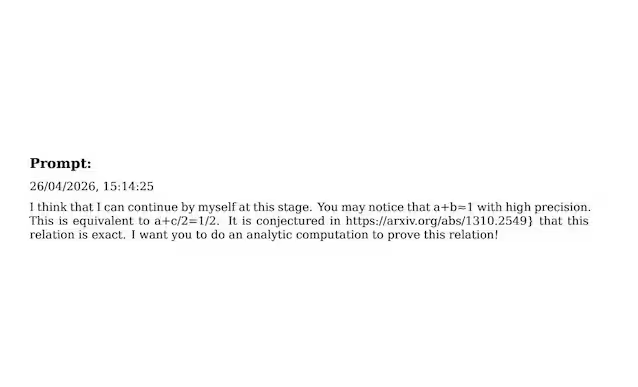
Once they had a first version of the proof, the two researchers had it verified carefully and, in the second conversation, Zamponi reported some to Claude inconsistencies present in the initial version and guided him in correcting them. The Claude Sonnet 4.6 model was then used to further refine some less complex passages.
At every stage of this demonstration, therefore, the researchers checked, revised, modified and refined all of Claude’s answers.
Because the problem was not solved before
In the article the authors ask themselves an interesting question: why had this proof not been found before, despite the problem having been open for over ten years?
Parisi and Zamponi honestly answer that they didn’t have neither tried the approach suggested by Claude, because they were convinced that something deeper was hidden behind the relationship to be demonstrated, a new mathematical structure or a symmetry not yet seen. They were looking for a complex explanation, and this led them to neglect a more conceptual path simplebut extremely laborious due to the amount of calculations required.
This study shows us one of the most interesting aspects of the use of AI in scientific research. The intuition of those who do research remains fundamental for formulating the right questionsevaluate the results and understand which problems deserve to be addressed. AI, however, can become a very effective tool for verifying laborious steps or navigating paths that a human being might discard because they are too long or repetitive.
More than automating search, cases like this show how AI can expand the space ideas that scientists can explore. And, in some cases, help close problems that have remained open for years.
