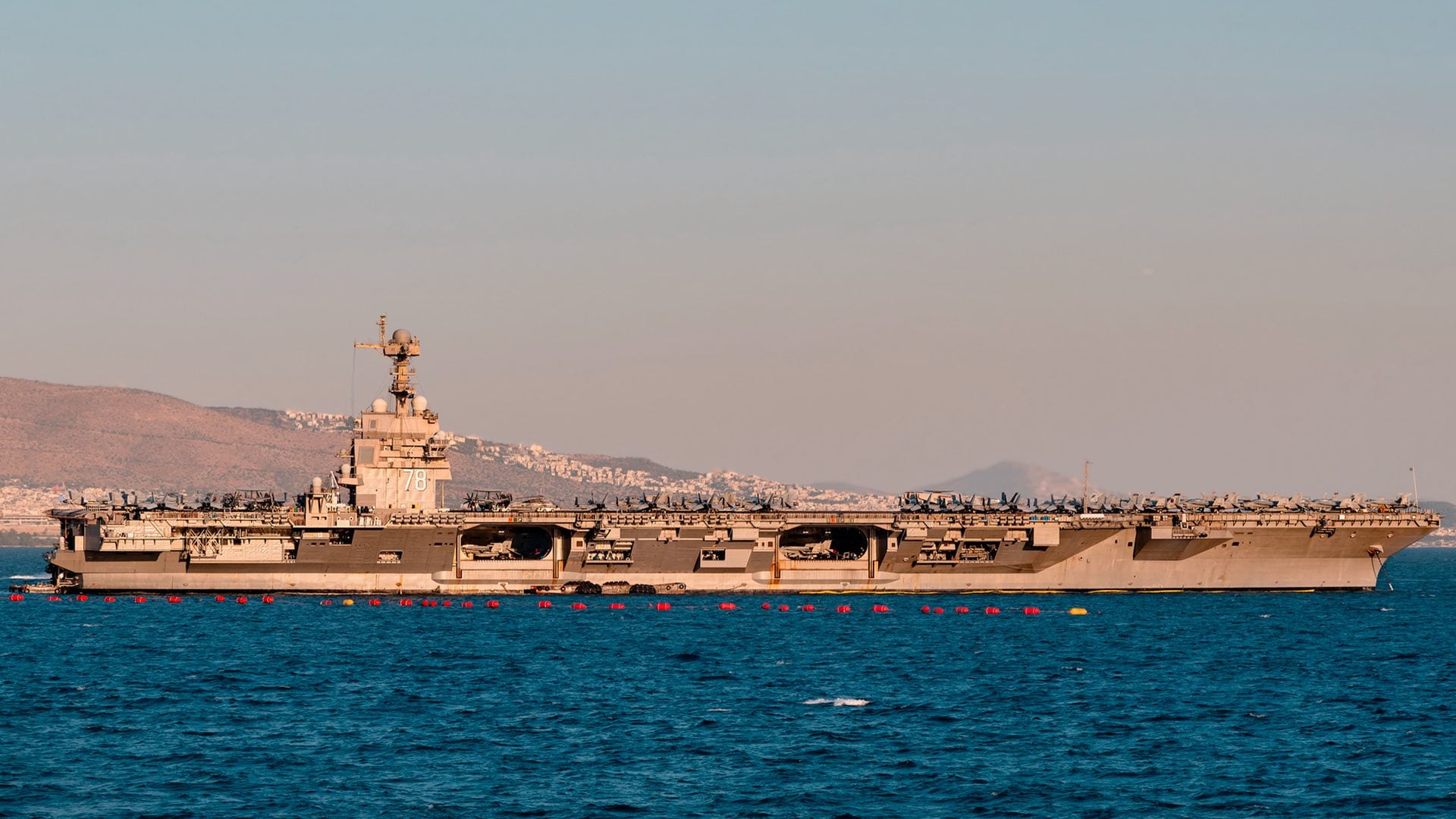
There USS Gerald R. Ford (CVN-78) of the US Navy is the bigger aircraft carrier never built. Entering service in July 2017 and operating at Norfolk Naval Base, the Gerald Ford was now unfolded by Donald Trump towards the Middle Eastafter the crescents tensions geopolitics between the United States and Iran.
From a technical point of view, this engineering record has a length Of 337 meters and a total weight almost 100,000 tons fully loaded, it can travel at over 30 knots, accommodate up to 75 planes And 4539 people. Equipped with cutting-edge technologies, such as EMALS electromagnetic catapults (which replace steam ones), i A1B nuclear reactors (capable of generating triple the energy compared to aircraft carriers of previous generations) and an advanced arresting system, the USS Gerald Ford has unique technical characteristics and operational capabilities, which define a new generational leap standard in the aircraft carrier construction and represents the future of the US Navy.
What the USS Gerald R. Ford aircraft carrier looks like: dimensions and characteristics
The aircraft carrier USS Gerald Ford, code CVN-78, is currently the largest aircraft carrier never built and also the largest ship from war never built. This record is held thanks to one length equal to 337 metersmore than three times a football field, once length Of 41 meters in correspondence with the waterline and atotal height Of 76 metersalmost one and a half times the height of the facade of the Milan Cathedral.
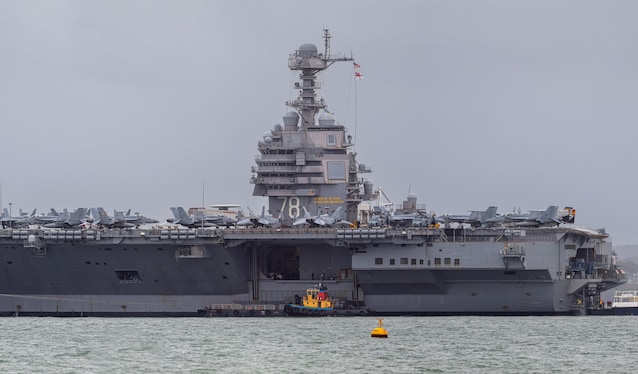
These dimensions bring its total weightwhen fully loaded, almost 100,000 tonsapproximately equal to that of 4,200 trucks also at maximum transport capacity. As the name suggests, an aircraft carrier is used to transport aircraft: the USS Gerald Ford can accommodate up to 75 aircraft and the flight deckor the one from which they leave And they land The planesis as long as the ship and is 78 meters wide. Moreover, inside it can be embark until 4,539 people.
From the point of view of armaments, among other things there are two launchers on board RIM-162 ESSM missiles2 21-cell RIM-116 RAM systems (a short-range point air defense weapon, designed to protect warships from anti-ship missiles) and 4 12.7 mm caliber machine guns.
THE construction works of the USS Gerald Ford began in 2009while the launch it happened in 2013. The work was subsequently carried out setupin which all the equipment such as engines, weapons and all systems to support the personnel on board were mounted, up to the official delivery occurred in 2017. The record for the largest aircraft carrier in the world will be held together with sister ships of his own class: the USS John F. Kennedylaunched in 2019 and currently under constructionthe USS Enterprisewith launch scheduled for November 2025, the USS Doris Millerfor which construction work has yet to begin, as well as a further yet unnamed aircraft carrier.
The engines of the largest aircraft carrier in the world
The USS Gerald Ford can reach the 30 knots Of maximum speedequal to almost 56 km/hthanks to the push of 4 5-bladed propellerseach with a diameter equal to 6.4 meters. Each propeller is moved by an axis, that is, by a long and robust steel “pole”, in turn moved by a steam turbine. The steam in turn is generated by two A1B nuclear reactors designed by Bechtel Corporation. It is estimated that each reactor can generate a quantity of steam capable of producing up to 125 megawatts of electrical powerenough power to power more than 41,000 homes. Such nuclear reactors are type PWR (Pressurised Water Reactor), i.e. pressurized water reactors in which the hazelnutwhere the reaction occurs nuclear fission, water heater which, thanks to the high pressures, never manages to vaporize. This water is then pumped and used to transform other water, coming from a separate circuit, into steam.
The flight deck equipped with 4 launch catapults
Thanks to its dimensions of 337 meters long by 78 meters wide, the flight deck of the USS Gerald Ford was equipped with 4 launch catapults of new generation. These catapults, called ElectroMagnetic Aircraft Launch System (EMALS), i.e. electromagnetic systems for launching aircraft, were designed by General Atomics. These systems work like real ones catapults or slingshotsbecause they generate a very fast push which allows the aircraft to accelerate in relatively short spaces: just think that the runways at Milan Malpensa airport are almost 4 kilometers long.
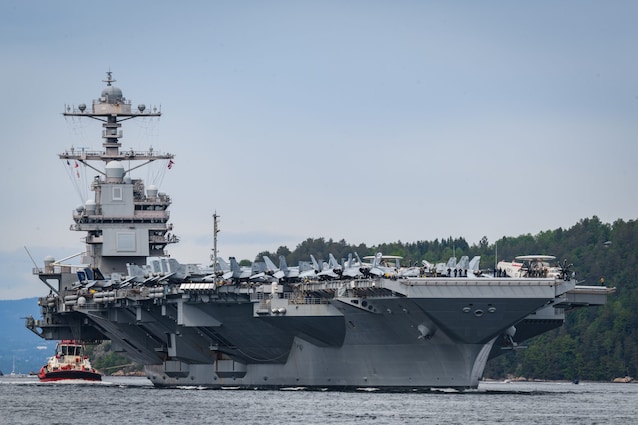
For the landings instead systems have been envisaged Advanced Arresting Gear (AAR), or advanced stopping systems. These are composed of three or four cables extremely resistant and placed perpendicular to the runway at a certain distance from each other. The planes upon landing they are equipped with a detail hook which, once it touches the flight deck, hooks up to one of these cables and help the plane to stop before the end of the runway.
