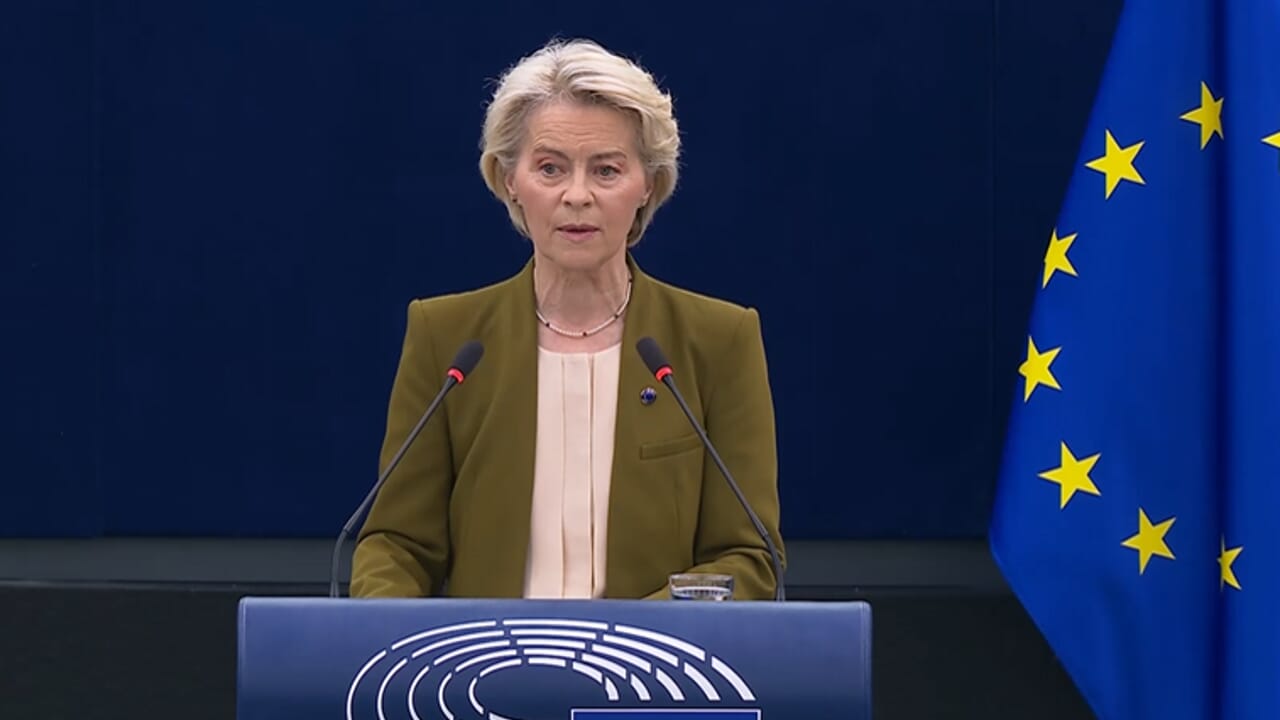
With Russia continuing to test European capabilities by sending drones to fly over and disturb the airspace of member countries, Brussels is looking for effective tools to defend itself against hybrid threats. The project of the so-called “drone wall” was at the center of the speech by the President of the Commission Ursula von der Leyen, today in Strasbourg in the plenary of the European Parliament. The implementation, however, takes a long time and complex methods, also complicated by disagreements between the various European chancelleries.
Develop more cost-effective capabilities to protect European airspace
“The drone wall is our response to the reality of modern warfare,” declared the President of the European Commission, drawing attention to the cost asymmetry that characterizes contemporary conflicts. “Think about what happened in Poland: we had to deploy very expensive systems, latest generation fighter jets, to shoot down relatively cheap, mass-produced weapons. This is not sustainable,” he warned, stressing that the 27 member states cannot rely solely on expensive military capabilities, such as Patriot missiles, to defend the skies from aircraft made for a few thousand euros. The solution indicated by the community executive is clear: the Union will have to respond to drones with drones, developing autonomous and more economical capabilities to protect European airspace.
What is the European Union drone wall and how does it work
The number one of the Commission has identified an example to follow: Ukraine. Since the start of Russia’s large-scale invasion, Kiev has developed a military industry with low-cost drones, capable of hitting even Russian refineries. The Ukrainian government has already started collaborating with some European countries and the Commission is preparing an aid plan to boost the production of drones in Ukraine, with the idea that the European Union will also be able to benefit from it in the future. “Ukraine is ready to support our efforts. The drone wall will also contribute to the surveillance of the eastern flank. This will monitor and protect the skies, seas and soil of our eastern members. But it is not only about our eastern border,” von der Leyen recalled, underlining the need to “get out of the comfort zone to deter those who want to harm us.” A far from implicit reference to Russia and its hybrid war.
Who finances Putin’s war in Ukraine
“The largest increase in defense spending in the history of the Union”
In response to threats from Moscow, Brussels will “soon” present a roadmap to implement the “Readiness 2030” plan, as ReArm Eu, the new European rearmament project, has been renamed. “The Readiness 2030 agenda will mobilize up to 800 billion euros for defense, including through new instruments such as Safe”, which provides 150 billion euros of joint loans already subscribed by 19 countries of the bloc. A figure which is part, as specified by the leader of the Commission, of the “largest increase in defense spending in the history of our Union”. As indicated by Von der Leyen, “we now need a precise pan-European plan, closely coordinated with NATO, on how to proceed”. The president announced that “we will soon present our ‘Preserving Peace Readiness Roadmap 2030’: this will not only define common objectives, but also concrete goals for 2030”.
The technological alliance in the defense sector
Von der Leyen also announced the creation of new “Technology Alliances” to strengthen the European defense sector. The initiative aims to connect start-ups and large companies in the defense sector, accelerating the transition from innovation to the operational field and promoting broader economic impacts. The objective, explained the President of the Commission, is to build a defense industrial base which is both a guarantee of security and an engine of growth for the Union. Even with the help of artificial intelligence. The use of AI also falls within this scope, as envisaged by the launch of the European Union’s “Apply AI” and “AI in Science” strategies.
