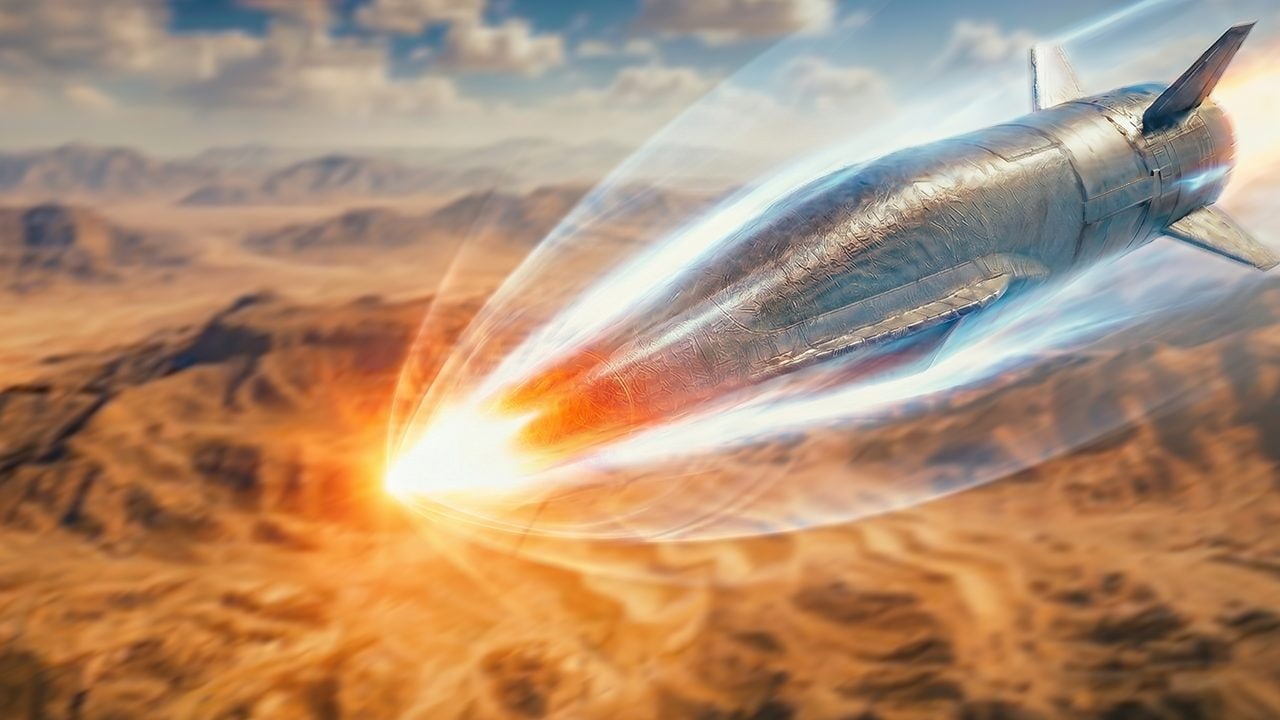
From “low cost” drones Shahed 136 to the sophisticated power of ballistic missiles of the latest generation, the global missile arsenal is rewriting the rules of modern warfare. But which countries have which weapons? In this article we will delve deeper into this aspect, taking as our main reference the states actively involved in a conflict.
The Iranian Shahed
One of the weapons most used in the current conflict in the Middle East, paradoxically, are not missiles. I am referring to theHESA Shahed 136 Iranian: 3.5 meters long, 2.5 wingspantested by 40 kg and a maximum speed of approx 185 km/h. Numbers that, compared to hypersonic missiles, seem ridiculous. Yet it is perhaps the weapon that has most changed the economics of modern warfare.
The reason is the cost. Iranian production is between 20,000 hey 50,000 dollars per unit. What one might say: wow, a lot! But it’s actually nothing compared to the cost of the systems used to shoot them down: an interceptor Patriot PAC-3 for example it costs between 3 and 4 million dollars. If you want to save money, there is the system Coyotewhich costs at least 125 thousand dollars per missile. The logic is clear and simple: it is not necessarily necessary to hit the enemy, it is enough to force him to spend much more to defend himself.
Precisely for this reason, in the first days of the latest conflict in the Middle East, Iran went further 2000 drones towards various countries in the region: the objective was precisely to saturate the defense systems, also reducing their ability to react to every single blow. But the Shahed is only the lowest level of the Iranian arsenal.
Iran’s ballistic arsenal
Among the systems most used in this phase of the conflict by Iran is the Kheibar Shekan: medium-range ballistic missile with range 1,450 kmtested up to 600 kg and powered by solid propellant. The advantage of the solid – and this applies in general to all missiles with this characteristic – is an operational as well as technical advantage: it does not require refueling of liquid fuel before launch, it can remain in the bunker until the last moment and be ready in minutes. The old liquid missiles like ballistic Emad – with greater range, 1,800 km – instead require hours of preparation, during which the pitcher is identifiable and vulnerable to preventive strikes. This is exactly why Iran is gradually abandoning liquid systems in favor of solid ones.
The Fateh-313 represents the other extreme: a tactical a short range of 500 km with a precision of the order of 10-30 metersused against close bases and infrastructure. Clearly these are only some of the many missiles supplied to Iran, just as we will now see only some of the main ones from other countries. By the way, how is the situation on the opposite front?
Israeli arsenal
Israel’s contribution toOperation Epic Fury introduces a weapon that until recently did not exist as an operational offensive system: the Sparrow. Or rather, the family of the Sparrow missiles, which were born as test targets for the Arrow defense system but which, in a short time, became real weapons in all respects. The trajectory is their most relevant characteristic from a tactical point of view: they are launched from a F-15 at high altitudethey get on a quasi-ballistic bow which takes them to the limits of the atmosphere, before returning at very high speed with an almost vertical descent angle. This attack profile drastically compresses the reaction times of defensive systems – designed primarily to intercept horizontally approaching threats – and makes it extremely difficult to calculate interception trajectories.
And within this family we find 5 different types of missiles whose main differences are related to size and range:
- Blue Sparrow;
- Black Sparrow;
- Silver Sparrow;
- ROCKS;
- Golden Horizon.
Alongside the Sparrows, the forensic analysis of the ammunition conducted by ARES also documented the use ofAGM-154 JSOW – a long-range aircraft-launched glide weapon that allows aircraft to release the device out of reach of anti-aircraft defenses – as well as bombs 225, 450 And 2,900 kg precision guided.
The US front
On the US front, however, the Operation Epic Fury attack package is perhaps the most recent and documented example of the combined use of different vectors.
Among the various we find for example the Tomahawkwhich remains the US Navy’s flagship cruise missile: subsonicabout 880-900 km/hrange up to 2,500 kmtested by 450 kg. Launched from destroyers and submarines in the eastern Mediterranean, it was used in the second wave of attacks against stationary targets — such as ministries, Revolutionary Guard bases and missile facilities.
Alongside the Tomahawk, for the first time in an active conflict, the PrSM — Precision Strike Missiles: ballistic missiles a short-medium radius developed by the US Army with range exceeding 500 km and high terminal precision. It is their first documented operational use in a real conflict, against Iranian mobile launchers and underground installations.
Unfortunately, however, as we said at the beginning, the war is not localized in just one place: it is still ongoing in Ukraine. So I think it’s worth spending a few words to also talk about the Ukrainian and Russian missile systems.
Russian missiles
Starting from Russia, they also use the Shahed to saturate Ukrainian air defense, while missiles from cruise And ballistic they are used to hit the most sensitive targets, such as energy infrastructures or military bases. In the field of cruise missiles, one of the most launched is the subsonic Kalibr (3M-14)with at least 177 jobs documented only in 2024. The long-range one Kh-101 instead it is more advanced, with a smaller radar cross-section, and is reserved for attacks on civil infrastructures – such as power plants or water networks. This is usually launched by bombers Tu-95MS which never enter Ukrainian airspace, operating thousands of km away.
Moving on instead to ballistics, theIskander-M it is one of the most used tactical: it is also solid propellant, it can reach Mach 7 in the terminal phase, and has a precision of the order of a few tens of meters. Russia produces them between 60 and 70 per month – as also reported by the Kyiv Independent – and the more recent M version has made the systems less effective Patriot Ukrainians thanks to the possibility of carrying out variable trajectories – therefore effectively becoming similar to a cruise missile – and using decoys in the final phase of the flight.
The Kinzhal However, it deserves a separate discussion. The media in recent years has transformed it somewhat into the ultimate weapon. Although in reality this is not exactly the case: it is an air-launched hypersonic ballistic missile. The weapon can reach Mach 10 and so yes, it is very complex to intercept, but during the conflict a few dozen were launched, and some of these were intercepted by Ukrainian systems anyway.
Finally, to close the picture, let’s also briefly look at the Ukrainian side.
The Ukrainian side
The Ukrainian missile arsenal is divided into three distinct pillars.
The first is made up of Western supply systems: for example tactical missiles ATACMS Americans or cruise missiles Storm Shadow British-French (with a range of up to 560 km and with an armor-piercing warhead for underground bunkers).
The second pillar, and the most relevant from a strategic point of view, is development domestic. First of all, there is the subsonic cruise missile Neptune (R-360), designed in Ukraine on an architecture derived from the Soviet Kh-35, and also has a longer range variant, the Long Neptunewhich can reach 1,000 km of range. Then there is the tactical ballistic missile Sapsan/Hrim-2capable of achieving Mach 5.2 with a range of between 300 and 500 km, which completed its first combat test in 2025.
The third pillar is represented by systems missile-dron hybridsand how the Palianytsiadesigned to penetrate low-altitude radar coverage. The counterintuitive element of this evolution is that domestic systems – unlike ATACMS and Storm Shadow – are not subject to any deployment constraints imposed by third countries, which makes them the most autonomous and long-lasting strategic response to dependence on NATO supplies.
