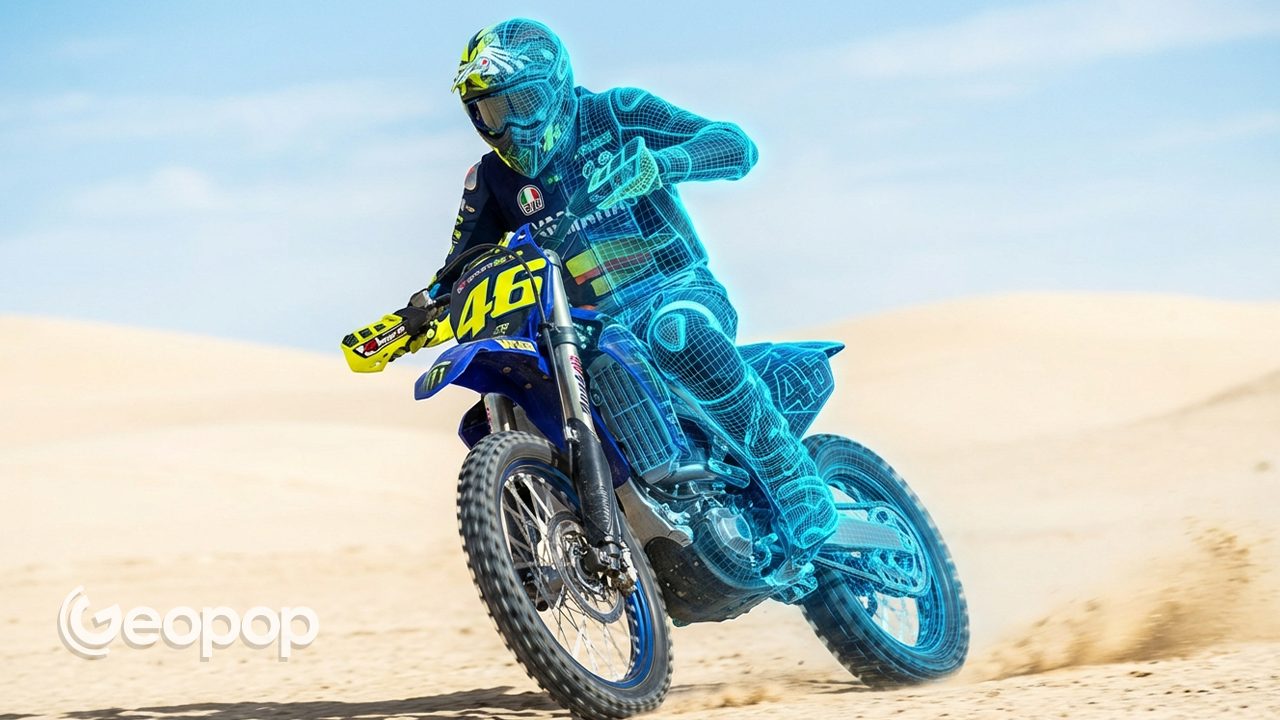
We went to Tavullia, in the Ranch of Valentino Rossi where the 100 km of championsto understand the physics and technique of transverseor powerslidethat is, that technique of drifting when cornering in which the rear wheel of the motorbike loses grip. The race in the Valentino Ranch in fact takes place on an unpaved track, where there is a mix of sands on a concrete surface, so the friction of the wheels is very different from what happens in MotoGP. A terrain that is certainly much more suitable for launching into acrobatic and spectacular drifts. Even the motorbikes are different, since they are from enduro but modified with lower suspension and track-friendly wheels.
But how do you do a traverse? The driver approaches the curve at high speed, closes the throttle and brakes mainly with the front brake. In this way the weight of the motorbike and the rider are projected forward. Technically it is said that there is a load transfer to the front. This load “presses” the front wheel tire onto the road surface, making it so firm that it acts as a “pivot” during cornering.
At this point the pilot performs a countersteeringthat is, it moves the handlebar in the opposite direction to the one in which it should turn. The rear wheel, already less firm on the ground than the front one, becomes free to slide and the motorcycle begins to rotate. It is at this point that the pilot opens the throttle again and that’s it slide the rear wheel outwards. Looking at the geometry of the bike, we have the front wheel pointing towards the curve and the rear one sliding in the opposite direction: here we have done a crosscut!
The bike is optimally positioned to “cut” the curve, but in doing so it is necessary maintain the drift by controlling the slip of the rear wheel with the handlebars but above all with the accelerator. Oh yes, because more gas means more rotation, while less gas means more stability. Even the handlebars, in this phase, are used to maintain the stability of the motorbike and not to steer. Throughout all this, the rider keeps his body forward (to improve front wheel grip) and tilted towards the inside of the corner.
The traverse ends at the exit of the curve: the load on the front is gradually removed (even by moving the body backwards), the bike is straightened and the throttle is opened again.
