
How was it organised? Alcatraz prison, one of the prisons most famous in the worldlocated approximately 2km away from coast of San Francisco, California? It is one of the questions that still today most intrigues those who are passionate about the history of this island prison. Thanks to map general and to the even more detailed one of the cell blocks, we can reconstruct every single space of this prison: from the access pier to the most feared cells of all, nicknamed by the inmates “The Hole“.
This federal prison Of maximum safetyoperational in the USA from 11 August 1934 to 21 March 1963, has become famous for being one of the most impregnable places in the world, hosting approximately 1,576 prisoners: let’s find out in detail how it was made.
How Alcatraz Island was organized: the map
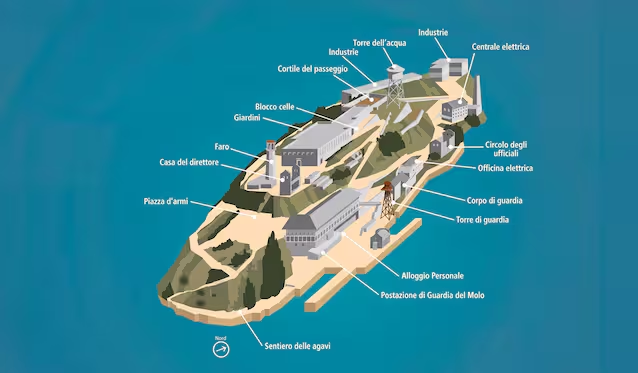
Looking at the map One thing immediately catches the eye: Alcatraz was not just a prison but a real one micro-cities in the middle of San Francisco Bay. And it made sense that it should be so: isolated as it was by strong currents and freezing water, the island must have been almost self-sufficient. The only access to the prison was through the wharfperpetually monitored by guards: everything and everyone passed through there, from prisoners in chains to supplies. Then there was the Piazza d’Armi and, next door, the residential area. Because yes, here on the island there were not only prisoners but also guards And relative families – children included! And that’s why there were also grocery stores, a post office and even a track from bowling. Clearly the director’s house, now in ruins, was the most sumptuous and panoramic, and it was here that he also lived James A. Johnstonthe historic first director of federal prison. And then there was the lighthouse: was built in 1854becoming the first lighthouse on the West Coast of the United States, and then being rebuilt taller in 1909 to stand out above the new cell block.
Speaking instead of prisoners, those who had earned the “privilege” of working spent their days in the buildings dedicated to industries: laundry, carpentry, shoemaking, metalworking. During the Second World War the prisoners even produced cargo nets and uniforms military. Finally we find the courtyard Of recreationsurrounded by very high walls with barbed wire and constantly observed by armed guards on walkways.
But now let’s move to the heart of the island, inside the blocks reserved for prisoners.
The prisoner cells organized in blocks A, B, C and D
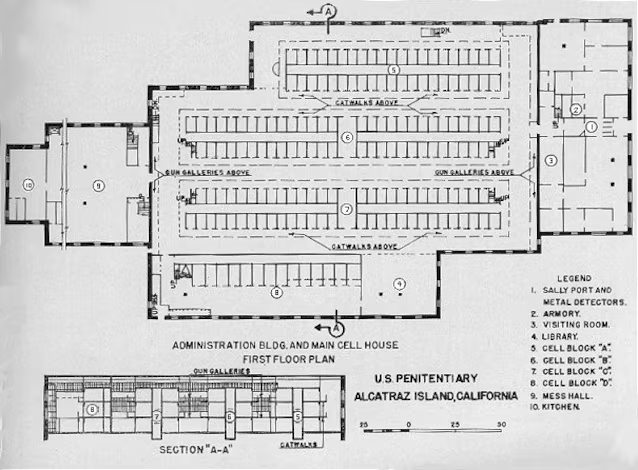
There were four main blocks. The Block TO it was the oldest, the only one with the original 1912 doors and locks, rarely used. THE Blocks B and C instead they housed the general population: tiny cells from 1.5 meters For 2.7with only a cot, a toilet, a cold water sink and a folding table. The inmates, with that hint of irony typical of those who no longer have much to lose, had nicknamed the central corridor “Broadway“.
And then there was the Block Dthe one that scared everyone. It was the block punitive: locked inside 24 hours a day and only going out once a week for the shower. After all, the cells 9 to 14 they were “The Hole” – total isolation and complete darkness once the steel door was closed.
However, within this sector there were not only prisoner cells. There cafeteriafor example, was considered the most dangerous point in the entire prison: hundreds of inmates gathered together, armed with knives and forks. To foil riots, the ceiling hid containers of gas tear gas can be operated remotelywhile the unarmed guards between the tables were covered by armed colleagues behind the grates.
At the ends of the blocks ran the Gun GalleriesMeaning what catwalks multilevel from which the guards kept every movement under control. Then there were a hospital and one library – books were a highly coveted privilege, delivered directly to the cell. Finally, for the time, a not bad innovation: a metal detectorwhich the inmates had to cross when returning from the laboratories, to avoid stolen blades or tools.
In short, Alcatraz was a fortress designed to the millimeter, where every single detail – from geographical isolation to file-proof steel – served to remove any hope of escape. And perhaps that is precisely why, for 29 years, he was the nightmare of America’s worst criminals.
