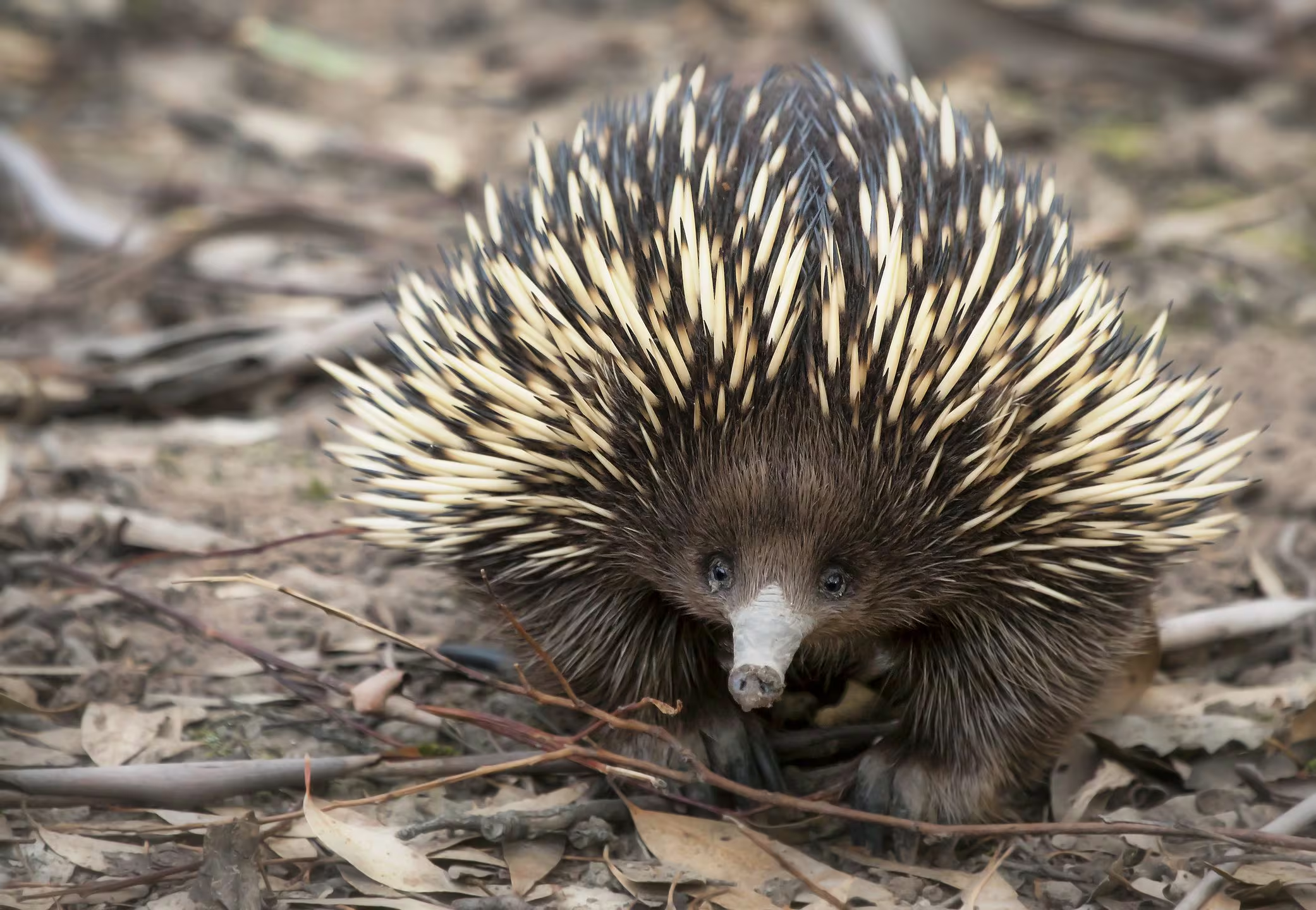
An ancient mammal that lays eggs, has a cloaca and produces milk but does not have nipples for breastfeeding. It has characteristics bordering on mammals and reptiles and is classified as a monotreme (family Tachyglossidae) like the platypus.
THE’echidna (Tachyglossus aculeatus), also known as the spiny anteater, is one of the most paradoxical mammals on the planet. It belongs to the order of monotremes (a very ancient group that separated from mammals about 200 million years ago) together withplatypus and preserves unique anatomical traits reminiscent of reptiles and birds: it has a body temperature of 31-32 °C, has a single opening for excretory and reproductive functions (the cloaca), produces milk but she doesn’t have nipples and lays eggs (oviparous). There are 4 species of echidna that are distributed between Australia and Papa New Guinea. Its back is covered with quillsbut has no relation to hedgehogs and porcupines with which it is often mistaken.
The Tachyglossids: oviparous mammals that hunt via electric fields
The short-beaked echidna (Tachyglossus aculeatus), the most common and studied species, generally measuring between 30 and 45 cm in length for a weight that varies from 2 to 6 kg. The three long-billed species are much more massive (1 m long and up to 15 kg). The body is compact and equipped with powerful legs suitable for digging in the ground.
The echidna does not have teeth but its own tubular snout (7-8 cm) allows him to find ants and termites in the earth and capture them with one long, sticky tongue. For this reason it is also known as the spiny anteater.
The surprising part is how he finds his takes: as reported by a 1989 study published in Journal of Physiologythe snout is equipped with electroreceptors, sensors that perceive the weak electric fields generated by the movements of insects. The number of receptors is much lower than those of the platypus or other animals that have them, such as electric eels and sharks. It is probably theonly terrestrial animal to use this strategy to find nourishment.
Echidna reproduction: eggs, lactation and reproductive organs
The reproductive biology of the echidna challenges normal classifications: how is it possible for a mammal to lay eggs? About three weeks after mating the female lays a single egg directly into a skin pocket which forms on the belly. Just after 10 days the egg hatches, giving birth to a very small puppy (puggle). Similarly to marsupials, the baby remains in the pouch for about three months, then is moved to a den when it begins to develop quills, here the mother breastfeed up to 12 months. Since the echidna does not have nipples, breastfeeding occurs in a very particular way: milk is secreted from specific porous areas of the mother’s skin (milk patches) and the puppy licks it directly from the pores.
Developing outside the womb, the puggle it is extremely vulnerable to disease and infection. Research published in PLOS One in 2013, demonstrated the presence in breast milk of a antibacterial protein very effective (EchAMP), exclusive to monotremes. Researchers hypothesize that this “natural disinfectant” evolved precisely to defend puppies in an ancient era in which mammals did not yet possess nipples, only to be abandoned by subsequent evolutionary lines.
Between June and September (mating period) the males put on the scene “the train of love“, multiple individuals follow a single female in single file for entire weeks. Equally unique is the moment of mating, studied by Jane C. Fenelon and colleagues on Sexual Development: the male has a 4-headed penis but only uses two at a time, alternating them to maximize efficiency.
Habitat and conservation status
The Tachyglossus aculeatus it lives in much of Australia and in some areas of New Guinea, occupying very different habitats: from sea level up to 1600 meters above sea level in humid forests and arid deserts. Due to its large and stable population, the IUCN Red List classifies this species as “Minimal Risk” (LC – Least Concern) despite being subject to local threats such as road investments.
The other broad-billed species (genus Zaglossus) are endemic to the forests of New Guinea and are classified among “Vulnerable” And “Critically endangered” due to habitat degradation and hunting. The most emblematic case is that ofAttenborough’s echidna (Zaglossus attenboroughi): considered completely disappeared since 1961, it was rediscovered and immortalized only in 2023 by an expedition from the University of Oxford to the Cyclops Mountains.
