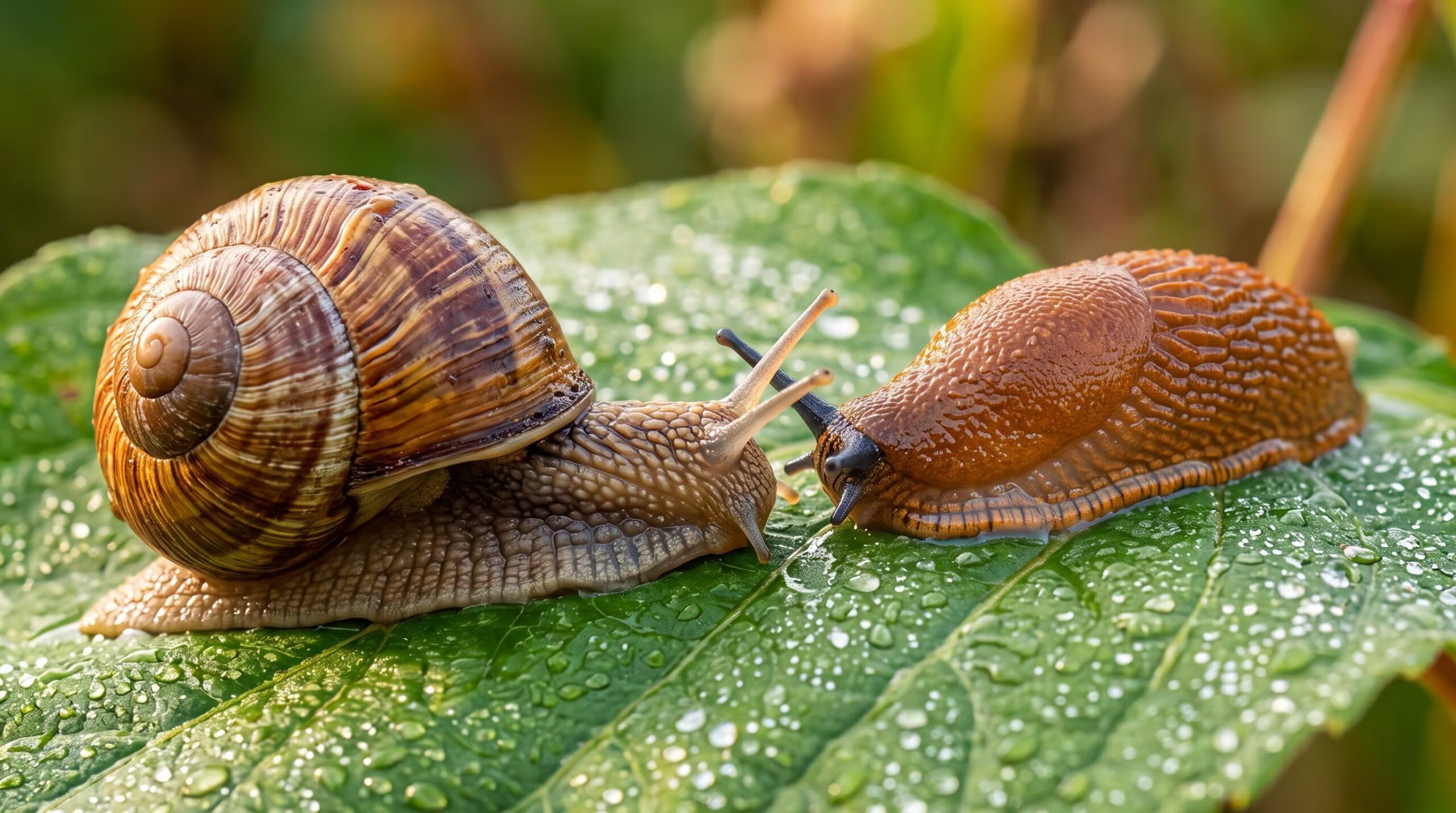
Snails and slugs are pulmonate gastropods of the order Stylommatophora. These are therefore terrestrial molluscs that differ not only in the presence or absence of the shell, but also in their evolutionary adaptations and defense strategies. Both produce mucus essential for movement and protection of the body and adopt specific strategies to deal with heat, drought and cold, reducing activity and seeking adequate shelter. Some slug species also show interesting metabolic adaptations that could help them survive freezing.
In autumn, after the first rains, the humidity of the soil increases and in the morning the meadows are covered with dew, ideal conditions for the activity of snails And slugs. In common parlance everyone defines them without distinction snailsbut it is useful to make the appropriate distinctions. The specimens equipped with shell they are commonly called snails and belong to different orders and families than those without shellsgenerally indicated with the term slugs or, sometimes, snails. The differences between these organisms are not limited to the presence/absence of a shell, but are much more complex in terms of evolutionary history and variety of adaptations to the environment. All are feared by farmers because they are phytophagous and scrape with their mouthparts (radula) the surface of the leaves of vegetables and a large number of ornamental plants by consuming them.
Noticeable differences in appearance
All what we commonly call snails belong to the Class of Gastropodsal Superorder of the Lungworts and to theOrder Stilommatophora (from Greek etomology, bearers of eyes on stalks). These are the terrestrial relatives of aquatic species such as the murex (Murex brandaris), the patella (Patella vulgata) or the sea hare (Aplysia fasciata). They are known throughout the world over 28,000 species of terrestrial gastropods, the only conquerors of the mainland of the entire Mollusc phylum. Some have a shell, others do not have one, still others retain it only in a vestigial form (i.e. much reduced and now devoid of its original function). They have adapted to terrestrial life by evolving a sort of “lung” rudimentary, very vascularized, in communication with the outside through an opening, the pneumostomawhich allows air exchanges and regulates the animal’s hydration rate. In slugs, without a shell, the pneumostome is clearly visible on the right side of the back, in the snail it is partly hidden by the external edge of the shell.
The usefulness of the shell and the slime
Try touching them even with a simple blade of grass and you will notice that they will immediately retract cephalic tentacles (i.e. the sensory organs that look like small mobile antennas to us) and the head, but while the snails will be able to hide completely in their shell, the snails will shorten their body as much as possible until they form a sort of compact ball, still remaining exposed and vulnerable. The most obvious distinctive element is certainly the shell; in the snails it presents a notable variety of shapes, from flat ones to tall tower or rounded ones. Each form represents an alternative solution to optimize the efficiency of this “shelter” that protects the animal’s vital organs. In slugs, however, the loss of the shell is the result of a rather complex evolutionary process that led from mechanical protection to the chemical defense of the body; its absence or drastic reduction has led to advantages in agility and speed of movement. Many slugs, in fact, defend themselves from predators by releasing toxic, disgusting or highly adhesive secretions. The western dark snail (Arion subfuscus), for example, as soon as it is touched, it releases from its back a defensive fluid with a sticky consistency and high adhesive properties, an aqueous gel that covers the entire body, adheres to the contact surface and immediately solidifies into a particularly resistant coating.
Snails and snails produce drool: a slightly sticky mucus that has a lubricating and weakly adhesive function during locomotion. It is a mixture composed of 90-99.7% water and the rest of a large number of organic compounds (glycoproteins, enzymes, hyaluronic acid, antimicrobial peptides, glycolic acid, elastin, collagen and allantoin). The numerous properties of slime have attracted considerable interest and this mucus finds therapeutic applications in wound healing, antimicrobial therapy, inflammation management, cosmetics and even for the production of bio-glues.
Snails and slugs: rather voracious animals
If in the morning in the garden you find the lettuce leaves “nibbled” and partially covered by a silvery and sticky fluid, snails or slugs have certainly passed by to feed. They are rather generalist herbivores (they feed on a large number of plant species) and move mainly during the night or on rainy days, infesting vegetable gardens and gardens. To counteract them in the past, the metaldehydea powerful and highly toxic snail killer. Today, to avoid the use of pesticides, it is possible to adopt biological control methods or natural remedies such as physical barriers (ash, crushed egg shells, coffee grounds) which prevent them from sliding on surfaces. Among the species most feared for its voracity is the invasive Spanish snail ( Arion vulgaris ), a species of slug now widespread throughout the European continent, where it has also entered into competition with many native species of snails and snails. However, according to a popular anecdote, the common Roman snail (Helix pomatia ) appears to compete effectively with the invasive species by controlling the proliferation of its eggs. Some even suggest encouraging the presence of this native snail in vegetable gardens to control it Arion vulgaris .
How they survive extreme heat and cold
Both groups are extremely susceptible to dehydration considering that they lose water through perspiration, through breathing, but also through the production of the trail of mucus they emit while moving. Suffice it to say that an active snail can lose up to 30-40% of its weight in just 2 hours due to water loss. In drought and high heat, snails cope with dehydration by going indoors aestivation (a sort of summer hibernation caused by drought). After climbing on branches and bushes in order to get as far away from the heat of the ground as possible, the snails close in the shell, also sealing the entrance. Slugs instead change their circadian rhythms: they increase their activity at night when it is cooler and more humid and they aggregate together in compact groups when the climate is dry, possibly in shaded ravines or under the foliage.
Even the winter is faced in shelter and in hibernation closed in its own shell or, in the case of snails, in the first layers of the soil under the leaf litter or under pieces of damp wood. It is a combination of factors: seeking shelter, reduced metabolism, control of body water and the ability of the tissues to resist ice. From a metabolic point of view, changes occur in respiration and in the levels of some chemical parameters. A scientific study, “Freezing and anoxia tolerance of slugs: a metabolic perspective” compared the physiological reactions to low winter temperatures of three species of land snails: Deroceras laeveintroduced from North America and Deroceras reticulatum And Arion circumscriptustwo European species. The species Deroceras laeve showed a strong hyperglycemic response to freezing, with a 100-fold increase in glucose levels, suggesting that glucose may have some protective function against tissue freezing in this species.
