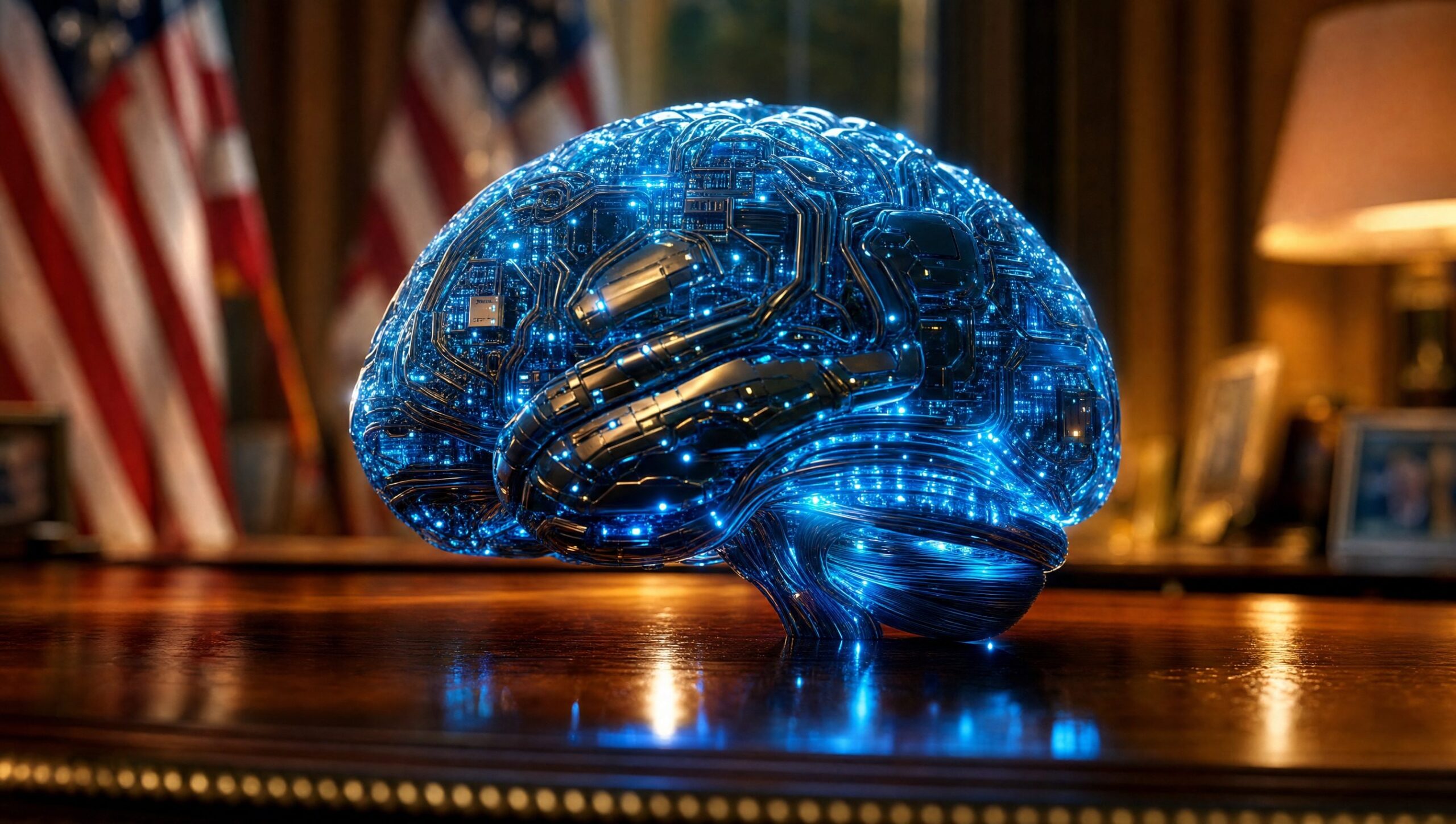
US President Donald Trump has announced that in the USA artificial intelligence will no longer be called that, but “Super Intelligence”, in short “YES”. On September 29, 2026, Trump signed a executive order requiring federal agencies and departments to use this new name in public communications and official documents.
This name change is not tied to any particulars technological improvementbut it reflects the direction the Trump administration wants to give to AI development in the United States, focusing onacceleration of technology and on the self-regulation of companies.
The reasons for the name change: Trump’s statements
During a speech to the United Nations General Assembly, President Trump declared that the term “artificial” makes it look like this “fake” technology” and believes that it should be called “superintelligence”, by virtue of its ability to “achieve what was previously impossible”.
The same concept was also reiterated in official documents in which it stated that:
The capabilities of today’s systems go far beyond imitating or automating individual aspects of human intelligence.
And that the term “Super Intelligence” represents better
the promise, potential and rapidly evolving capabilities of these technologies.
There is, however, a problem: the term “super intelligence” in the world of AI already exists and refers to very technologies more powerful of those that currently exist, is not a synonym for artificial intelligence and should not be used to describe the AI we use today.
What does Artificial “Super Intelligence” mean
When in the world of AI we talk about Artificial “Super Intelligence”. (ASI) means a hypothetical AI with intelligence clearly superior to that of the best human minds. Philosopher Nick Bostrom, a former professor at Oxford University, defines super intelligence as any intellect that far surpasses the cognitive performance of humans in virtually all fields of interest. It is therefore a theoretical concept: we do not have an AI today that can be considered superintelligent.
Figuring out how to uniquely determine whether a system has achieved such a capability is also an issue still debated in the field of AI research. ASI is often described as a possible subsequent development compared to the AGI, i.e. thegeneral artificial intelligence. AGI is a type of artificial intelligence capable of generalizing knowledge, transferring skills between different fields and solving new problems without the need for specific reprogramming for each task. In essence, an AGI is an artificial intelligence with same human capabilities in many different fields, while the ASI is able to significantly surpass human capabilities.
It is important, therefore, not to get confused with the new name chosen by the Trump administration: when the American government talks about “Super Intelligence” he’s not saying that current systems have done a technological leap and achieved super intelligence (ASI) in the technical sense of the term. So, on a practical level, what changes with this new name?
What changes on a practical level for AI
At the level technologicalFor now, it doesn’t change Nothing. Changing the name of a technology does not change its capabilities: ChatGPT does not become super intelligent because a US government document defines it as “Super Intelligence”.
The news mainly concerns the way in which the American government will talk about AI. The executive order in fact requires federal agencies and departments to use the term “Super Intelligence” in public communicationsin the documents and in political directions. At the same time, the administration will have to develop a new definition of “super intelligence” and evaluate whether this should modify or replace that of “artificial intelligence” already present in American laws.
Furthermore, this decision has a political significance. Trump has repeatedly supported the need for accelerate the development of AI and to avoid regulations that his administration believes could slow U.S. technological competition. The new term is therefore part of a strategy that aims to present AI as a technology develop and strengthenrather than to be limited. This executive order comes along with a security agreement signed by Trump and the leaders of some of the major technology companies, including Google, Anthropic, Meta, OpenAI, Nvidia and SpaceXAI.
The deal is voluntary and focus onself-regulation of companies, through four levels of control: internal checks on the models, an internal team responsible for checking that these measures work, evaluations by independent external auditors and oversight by a committee of the board of directors.
This agreement, however, is not a new federal law and does not introduce in itself legal obligations. Trump called it “morally binding” and reiterated that he preferred self-regulation to new government-imposed limits. However, the document leaves open the possibility that these procedures will be transformed into laws or regulations in the future.
