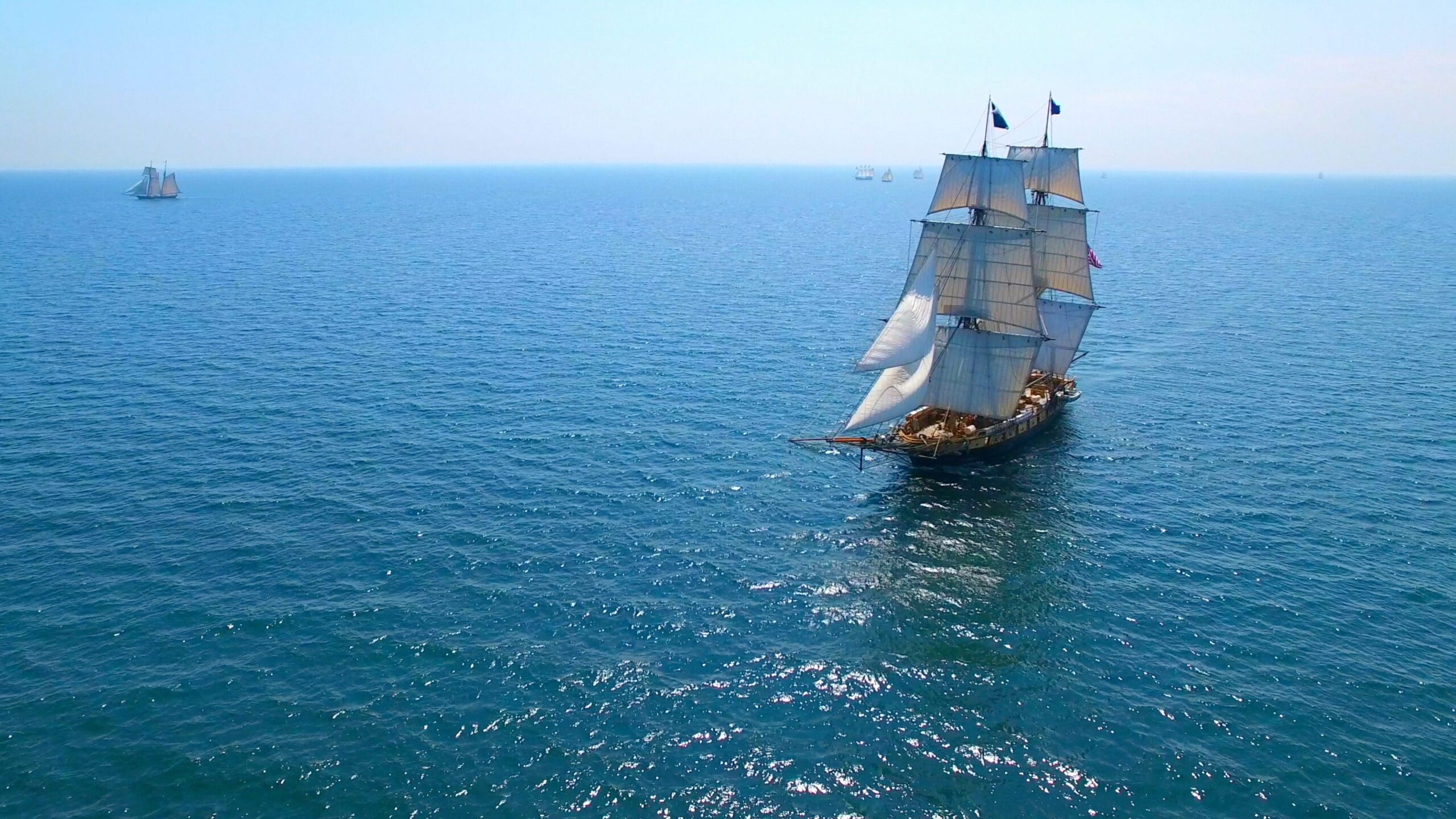
After more than 30 days of navigation to the Gaza Stripthe Global Sumud Flotilla It was affected by the Israeli Navy, who recently confirmed the detention of all the activists involved (including 22 Italians), now on the road to the port of Ashdod and then be expelled from Israel within 48/72 hours. But what does it mean to approach a ship, how was it realized in the past and what establishes international law about it?
From historical abroad to flotilla: what it means and how it happened
By definition, the abroad indicates “the action of approaching the edges of two ships together”: from a military point of view, it means attacking an enemy ship, approaching its edge. In practice, therefore, it means supporting another ship, considered a threat, with the aim of stopping it, blocking the crew and possibly arrested it. Throughout history, bordering was one of the most used combat tactics to take the physical control of an enemy ship: the ancient war galleys, such as those of the Greek and gods Persianthey were armed with heavy rams (a large wooden trail reinforced wood and used to break through doors and walls) to pierce the sides of the opposing boat. THE‘Roman Empireon the other hand, had designed a special ramp, called corvuswith two twin -mounted steel tips mounted at the end: a ship was maneuvered next to the opponent’s and the ramp was dropped on the enemy bridge to allow the crew to cross it.
In the Middle Agesbordering was almost the only way to fight at sea: for this reason, ships began to be built more and more in height, to give the crew the advantage of attacking or shooting from their bridge to the opponent. With the arrival of the cannons aboard the ships, starting from the seventeenth century, the episodes of abroad were gradually reduced, even if they continued to be used above all by piratewhich aimed to capture the naval booty creating the least damage to the ship or to its load.
What does international law on international waters provide for international law
From the point of view of international law, the reference treaty is again Montego Bay convention from 1982 (UN Convention on the Law of the Sea), which in article 110 establishes:
Except for the case in which the acts of interference derive from powers conferred by virtue of treaties, a war ship that crosses a foreign ship in the high seaside not having the right to complete immunity according to the provisions of articles 95 and 96, cannot legitimately approach it, unless there are founded reasons to suspect that:
a) the ship is engaged in piracy acts;
b) the ship is engaged in the slave section;
c) the ship is engaged in illegal transmissions;
d) the ship is without nationality; or
e) while beating a foreign flag or refusing to exhibit his flag, the ship actually has the same nationality as the warship.
Any intervention, among other things, must be previously authorized by the state whose flag beats the boat (if present). However, over time we have tried to simplify this mechanism, both because the failure to respond, within a certain term, could be equated to an authorization for the tanks, and because, in cases of particular urgency, it was necessary to proceed with the fulfillment immediately, without prior authorization. In this way, the respect of two has therefore tried to combine principles of international law: the principle of territoriality, which would prohibit the bordering of ships flying foreign flag without authorization, and the need for safety in high seawhich requires, in serious and exceptional cases, immediate police interventions by maritime police, even foreign.
