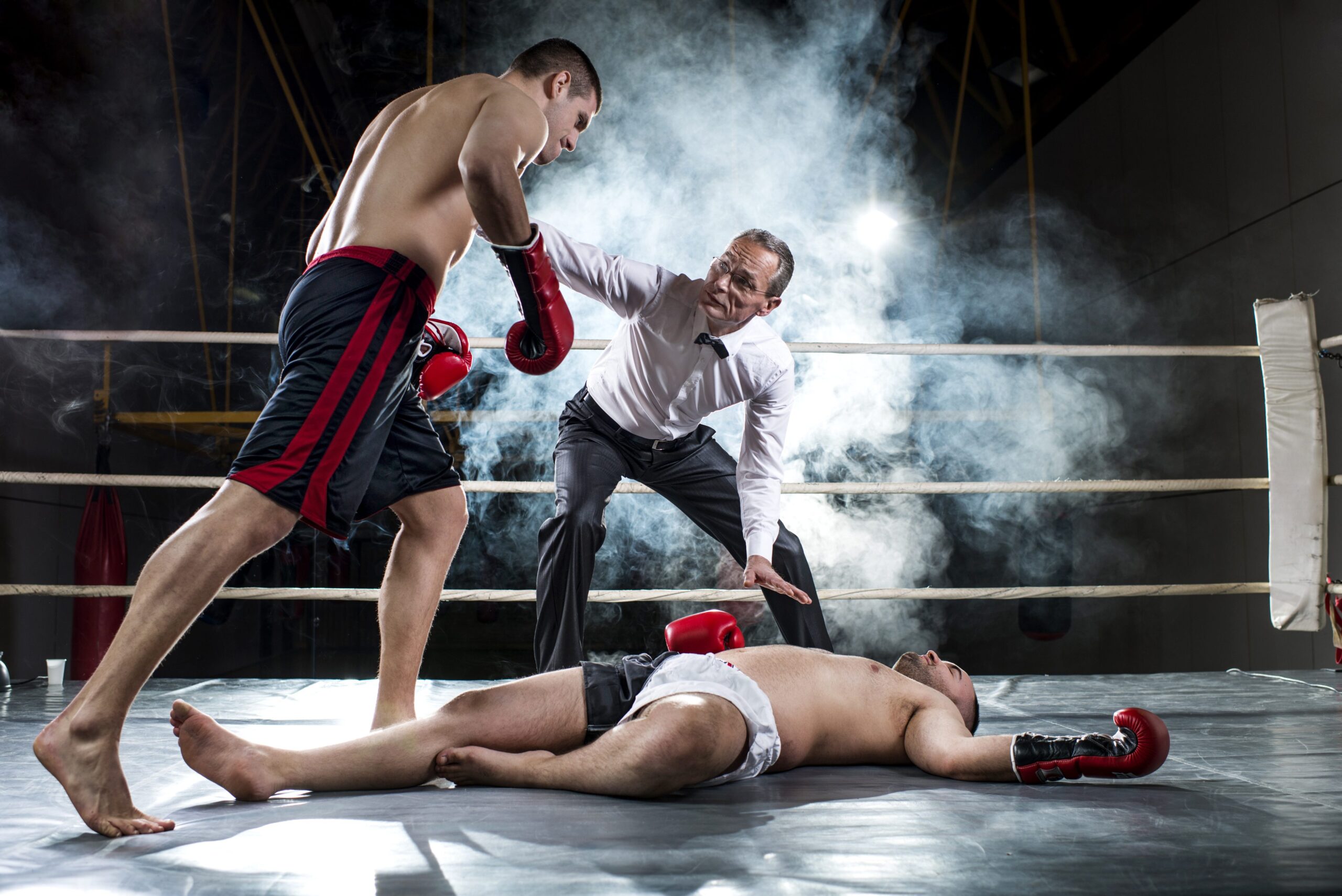
The term “Knockout” or Koindicates, in combat sports, a condition for which the athlete who suffers one or more significant shots becomes physically unable to continue the meeting. It is often accompanied by alterations of the mental state and loss of consciousness. This phenomenon, favored by blows and movements rotationalcan be explained by taking into consideration several theories: the theory reticularthe cortical theorythe vascular theory and the convulsive theory. For their biomechanics, circular shots such as hooks and rotating kicks are the most dangerous for athletes, especially when they impact the jaw or the temporal area.
As a KO happens: the effects on the body
When the head suffers an important trauma like a punch, you can face one traumatic brain lesion (TBI), which can cause brain damage and alterations in its functions. There are different forms of TBI with symptoms that include: amnesia, alterations of the mental state (confusion), neurological deficits e loss of consciousness (Loc). The sudden and temporary loss of consciousness is the most curious symptom of brain emotion and its nature has been the subject of several studies and theories. Many of these are based on the fact that the physiological maintenance of consciousness depends on the interaction between the brain trunk, the thalamus, the hypothalamus and the cortical activity.
According to the reticular theorythe loc occurs when the activity of the reticular formation of the encephalic trunka key area for the adjustment of consciousness, vigil and movement. Otherwise, the cortical theory attributes the loss of consciousness to a Direct damage to the cerebral cortex.
The so -called vascular theoryon the other hand, claims that a trauma can alter the cerebral perfusionthat is, the blood supply of oxygen rich in the brain, causing a temporary hype and, therefore, it fainting. Finally, the convulsive theory suggests that a very strong blow to the head can trigger an activity similar to one epileptic crisis. The anomalous electrical discharges that follow, would hit the brain trunk or the cerebral cortex and, in a not very different way from the first two theories described, stop the normal activity of our brain leading to the loss of consciousness.
Which shots are most responsible for the Knockout and why
TBI are mainly caused by forces of acceleration and deceleration generated during a trauma, responsible for vigorous movements of the head and, therefore, of the brain. Acceleration can be linear or rotational depending on the movement of the head with respect to the body. Although both implicated in an impact, it is therotational acceleration (Ra) The one most involved in cases of TBI. Minimum threshold values have also been identified in the literature in reference to impacts that can cause conclusion. In the specific case of the RA, the value relating to the loss of consciousness can go up to 12,900 Rad/S² (Unit of measurement that indicates what quickly changes the angular speed of an object over time).
The shots most responsible for the boss during combat sports are, for the biomechanics of the technical gesture, i circular shots like the hook in boxing and the rotating football In the taekwondo. As regards, however, the most at risk impact points (which therefore record higher ra), these are the temporal area and the jaw.
Sports at risk and possible precautions
The combat sport that has recorded higher figures of RA is the boxingwith a value of 9306 Rad/S² normally associated with the hook and up to 11,279.5 Rad/S² In the case of Loc after the blows. Also in other disciplines, similar results have been achieved, for example, in taekwondo Rotating calcium generated the highest RAs, with peaks of 10927 Rad/S².
In mixed martial arts (MMA – Mixed Martial Arts) a combat sport that brings together the techniques of the most specialties, the impacts with brain emotion have recorded accelerations until 7.561 Rad/S². The wrestlingon the other hand, has produced lower values, of about 2,434.4 Rad/S²as they are associated with projections on the ground and not at the head.
In precautionary terms, the protective helmet It is certainly the most used tool in the disciplines mentioned, even if there is still uncertainty about its real effectiveness. Although in almost all cases the RA subsequent to the blows with a helmet is reduced, there are situations in which the threshold remains above the limit values and, in some cases isolated, even higher than episodes characterized by the absence of protections. In 2013 theInternational amateur boxing association (AIBA) prohibited the use of the helmet in competitions and justified the decision highlighting a 43% reduction of the arbitration stops related to significant strokes, a reduction in the target surface and an increase in peripheral vision. He also added that wearing a helmet could induce a false sense of safety And more aggressive movements. Even these arguments, however, are the subject of controversy because it does not seem to have been taken into consideration, in the choice, no measuring RA which, however, is a fundamental predictor of TBI. Despite these data, it is good to specify that the combat ones are not the only sports responsible for worrying values of rotational and linear accelerations of the head induced by concluding traumas, also other contact sports such as the American footballThe rugby el ‘ice hockey They present similar risks.
Sources
